

Top 10 Most Dangerous Airports in the World: The Most Extreme Places to Take Off and Land
Table of contents
- 1. Lukla Airport in Nepal: A 527-meter runway between a mountain and a cliff
- 2. Paro Airport in Bhutan: Landing in a Narrow Himalayan Valley
- 3. Altiport Courchevel in France: a runway with a gradient of up to 18.5%
- 4. Madeira Airport, Portugal: strong crosswinds and a runway over the ocean
- 5. Toncontín Airport in Honduras: a challenging approach amid mountains and urban development
- 6. Innsbruck Airport in Austria: Landing in a Narrow Alpine Valley
- 7. Gibraltar Airport: Turbulence Near the Rock and a Runway Between Two Seas
- 8. Eagle County Airport in the U.S.: a high-altitude landing in Colorado
- 9. Princess Juliana Airport, St. Maarten: Airplanes just tens of meters above the beach
- 10. San Diego Airport, USA: a busy runway in the middle of an urban area
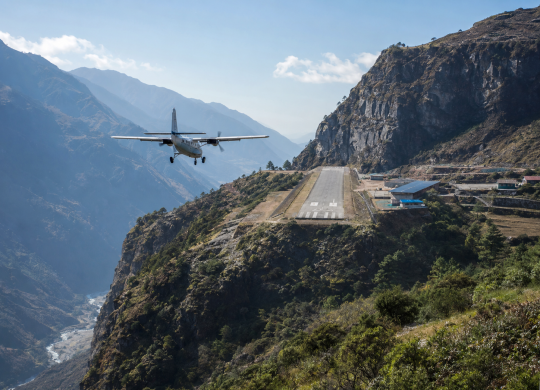
Short runways, high mountains, sudden gusts of wind, and the ocean just a few meters from the plane turn an ordinary flight into a challenging ordeal for the crew. Learn more about the 10 most dangerous airports in the world and the reasons why only specially trained pilots are allowed to land at some of them

Not all airports have long, flat runways, modern instrument landing systems, and enough space for a go-around. Some are located in narrow mountain valleys, on small islands, or near cliffs, where the weather can change in a matter of minutes. Such conditions require pilots to have additional training, perform precise maneuvers, and strictly adhere to restrictions.
At the same time, the concept of the “most dangerous airport” is relative: there is no single official global ranking based on this criterion. This selection features ten active airports known for their challenging terrain, short runways, unpredictable winds, or unusual approach patterns.
In our previous article, we discussed how to choose safe accommodation, avoid mistakes, and book a hotel without unnecessary expenses.
Planning a trip abroad and want to protect yourself from unforeseen situations?
Travel insurance from Visit World will cover medical expenses, flight delays, and lost luggage in any country. Get a policy online in a few minutes and travel with confidence!

1. Lukla Airport in Nepal: A 527-meter runway between a mountain and a cliff
Tenzing and Hillary Airport is located in the Himalayas at an elevation of 2,846 meters and serves as the main air gateway for travelers heading to the Everest region. Its paved runway is only 527 meters long and 20 meters wide.
The runway is situated on a steep slope: on one side it is bordered by a mountainside, and on the other by a steep cliff. Planes typically land in only one direction and take off in the opposite direction, and there is virtually no possibility of making a go-around.
Flights are conducted under visual flight rules, so fog, cloud cover, and strong winds often cause delays or flight cancellations. Due to the altitude, the short runway, and the unpredictable mountain weather, only crews trained to fly to short-runway airports can operate here.
In our previous article, we explained how to find cheap last-minute flights using Skyscanner’s tips.
2. Paro Airport in Bhutan: Landing in a Narrow Himalayan Valley
Bhutan’s only international airport is located at an altitude of about 2,235 meters in a valley surrounded by mountain peaks. Its 2,265-meter-long runway seems long enough, but the main challenge isn’t its size—it’s the terrain: during the approach, the plane must maneuver between the mountains and make several sharp turns before the crew can see the runway.
Due to the proximity of high slopes, flights in the Paro area are permitted only under favorable visibility conditions. Bhutan’s aviation regulations require that, before the first flight, the aircraft commander undergo special instruction, a familiarization flight, training on an approved simulator, or use the services of a pilot-navigator. The challenging route, mountain air currents, and rapid weather changes make Paro one of the most demanding airports for crews.
3. Altiport Courchevel in France: a runway with a gradient of up to 18.5%
The Courchevel mountain airfield is located in the French Alps at an elevation of 2,007 meters. According to the municipality of Courchevel, its single paved runway is only 537 meters long, and the maximum gradient reaches 18.5%. During landing, the aircraft moves uphill along the slope, which helps it slow down, while takeoff is performed downhill.
The mountains surrounding the airfield do not leave enough space for a standard go-around. The situation is further complicated by the altitude, winter snow, and rapid changes in visibility. Courchevel mainly accommodates small aircraft and helicopters, and pilots must have special mountain qualifications and clearance to fly at this airfield.
Learn more about the world’s most beautiful airports in 2026 according to the Prix Versailles ranking by following the link.
4. Madeira Airport, Portugal: strong crosswinds and a runway over the ocean
Cristiano Ronaldo Madeira International Airport is located between mountain slopes and the Atlantic Ocean. Its runway, which was originally only 1,600 meters long, has been extended several times. After a major renovation, it reached 2,781 meters, with part of the runway extending over the coast and supported by 180 concrete piers.
The main challenges are strong and variable winds, turbulence, and wind shear near the mountains. During the approach, the crew must navigate around the terrain and then align the aircraft with the runway only during the final stage. Airlines provide special training for crews flying to Madeira, and exceeding the established wind speed limits leads to delays, go-arounds, or flight diversions.
5. Toncontín Airport in Honduras: a challenging approach amid mountains and urban development
Toncontín is located within Tegucigalpa at an elevation of about 1,000 meters and is surrounded on all sides by mountainous terrain. During the approach, the crew must execute a steep turn, descend rapidly, and precisely align the aircraft with the relatively short runway. The mountains also complicate the go-around procedure if the landing must be aborted.
In May 2008, an Airbus A320 operating TACA Flight 390 veered off the wet runway; five people were killed, including two on the ground. Following the opening of Palmerola Airport in late 2021, regular international passenger flights were transferred from Toncontín to the new terminal.
Today, the old airport continues to serve mainly domestic, private, and charter flights, so passengers traveling internationally to Tegucigalpa typically use Palmerola Airport.
In a previous article, we discussed Europe’s “trap airports”—the destinations where travelers actually end up after purchasing cheap airline tickets.
6. Innsbruck Airport in Austria: Landing in a Narrow Alpine Valley
Innsbruck Airport is located at an elevation of 581 meters in the Inn River valley, surrounded by high Alpine peaks. Its paved runway has more standard dimensions than those at Lukla or Courchevel: 2,000 meters long and 45 meters wide. However, the proximity of the mountains significantly limits maneuvering space during approach, takeoff, and climb.
The greatest challenges are posed by complex flight patterns, mountain turbulence, downdrafts, and strong foehn winds. In adverse weather, visibility in the valley can deteriorate rapidly. Before a flight, the crew must thoroughly familiarize themselves with the airport’s special procedures.
7. Gibraltar Airport: Turbulence Near the Rock and a Runway Between Two Seas
The airport is located on a narrow isthmus just a few hundred meters from the Rock of Gibraltar. Its single runway, 1,800 meters long and 45 meters wide, stretches from the Mediterranean Sea to the Bay of Gibraltar. The proximity of the Rock causes turbulence and wind shifts that can affect landings from both directions. The approach to Runway 09 follows a curved path, and the flight crew must establish visual contact with the runway at least 3 nautical miles out.
The airport is known for the fact that a road to the Spanish border used to cross its runway. However, this information is now partially outdated: as of March 2023, regular traffic travels through the Kingsway Tunnel beneath the airport. Pedestrians and cyclists can still cross the runway via a controlled crossing, which is closed before aircraft take off or land.
In a previous article, we reported that Ryanair is launching new routes from Warsaw and Bratislava.
8. Eagle County Airport in the U.S.: a high-altitude landing in Colorado
Eagle County Regional Airport serves the ski resorts of Vail and Beaver Creek. It is located in a valley in the Rocky Mountains at an elevation of about 1,996 meters. The single paved runway is quite long—2,743 meters—but the high-altitude location reduces engine performance and lift, especially in high temperatures or when the aircraft is heavily loaded.
During approach and departure, crews must strictly adhere to flight paths between the surrounding mountain ranges. Snow, low cloud cover, gusty winds, and rapidly deteriorating visibility create additional risks in winter. Certain landing procedures are available only to operators who have obtained special permission, trained their crews, and use aircraft with the necessary specifications. In particular, a special FAA procedure imposes stricter requirements for gaining altitude in the event of an aborted landing.
9. Princess Juliana Airport, St. Maarten: Airplanes just tens of meters above the beach
Princess Juliana International Airport on the island of St. Maarten is famous for its approach over Maho Beach. The threshold of Runway 10 is located immediately beyond a narrow road and the beach, so planes fly over vacationers at a very low altitude. The runway is 2,300 meters long and 45 meters wide, but the available landing distance is about 2,200 meters.
The island’s terrain, wind conditions, and the need to avoid high ground during takeoff create additional challenges for flight crews. However, the greatest risk is not to the passengers on board, but to people near the airport fence: the jet blast from an aircraft during takeoff can knock a person off their feet and throw them onto the road or beach. That is why it is dangerous to approach the fence despite the warning signs.
Learn more about the Top 10 Best Airlines in the World by following the link.
10. San Diego Airport, USA: a busy runway in the middle of an urban area
San Diego International Airport is located about 5 kilometers from the city center and has only one runway. According to the airport administration, it is 2,865 meters long and 61 meters wide. It is the busiest single-runway commercial airport in the United States.
The primary approach path passes over hills and densely built-up neighborhoods. Due to ground obstacles, aircraft approach Runway 27 at an angle of approximately 3.5°, whereas the typical glide path angle is about 3°. This requires precise control of altitude and speed; however, it would be incorrect to call San Diego one of the most dangerous airports in terms of accident rates. Its uniqueness lies primarily in the combination of heavy traffic, a single runway, and a complex urban environment.
No matter how well thought-out your itinerary is, there is always room for force majeure when traveling. Unexpected medical expenses, transportation delays, or luggage problems can ruin your plans and budget. Travel insurance helps you avoid unnecessary worries in such situations. You can apply for a travel insurance policy for a specific trip online at Visit World - quickly and without unnecessary bureaucracy!
Take out a policy online at Visit World and enjoy your trip without any unnecessary worries!
We remind you! Popular European tourist destinations are becoming increasingly crowded, so travelers are looking for alternatives without the crowds. In 2026, attention is turning to countries that remain off the beaten path but offer unique experiences, affordable prices, and an authentic atmosphere. Read more about 5 European countries that are rarely visited by tourists.
Products from Visit World for a comfortable trip:
Travel guide for 200 countries;
Legal advice from a local specialist on visa and migration issues;
Travel insurance around the world (please select the country of interest and citizenship to receive services);
Medical insurance all over the world.
We monitor the accuracy and relevance of our information, so if you notice any errors or inconsistencies, please contact our hotline
Frequantly
asked questions
Which airport is considered the most dangerous in the world?
Which airport has the shortest runway?
Why can only trained pilots land at some airports?
Why are flights to mountain airports often canceled?
Is Princess Juliana Airport dangerous for tourists on the beach?
Recommended articles
2 min
Air travel
EU Updates Air Passenger Rights: Free Cabin Baggage and Flight Delay Compensation Remain
The European Union has agreed to a major update to air passenger protection rules. Find out how the rules for carrying hand luggage, compensation for flight delays and booking conditions will change
17 Jun. 2026
More details3 min
Air travel
Summer is traditionally the busiest season for European airports, but in 2026, the situation could prove particularly challenging. Experts are already warning of possible flight delays, long lines, and overcrowding at certain transportation hubs. Learn more about which European airports are likely to cause the most problems for travelers this summer and how to prepare for your trip
27 Jun. 2026
More details2 min
Air travel
The 7 Most Beautiful Airports in the World in 2026: The Prix Versailles Ranking
The Prix Versailles International Architecture Award, presented annually under the auspices of UNESCO, has released its list of the world’s most beautiful airports for 2026. The ranking includes seven new or completely renovated terminals that combine modern design, eco-friendly solutions, and passenger comfort. Find out which airports have become global architectural landmarks this year
05 Jul. 2026
More details2 min
Air travel
How to Find Last-Minute Cheap Flights: 7 Tips from Skyscanner
A last-minute vacation doesn't have to mean expensive plane tickets. Experts at Skyscanner have shared seven simple ways to help you find great deals even just a few days before your flight. Learn more about how to save money on airfare without sacrificing comfort
12 Jul. 2026
More detailsAll materials and articles are owned by VisitWorld.Today and are protected by international intellectual property regulations. When using materials, approval from VisitWorld.Today is required.