

Mass Protests by Schoolchildren in France in 2026: Causes and Consequences
Table of contents
- Why did students in France take to the streets?
- Which cities were affected by the protests, and how many people participated?
- What are students demanding, and how is the French government responding?
- What is known about the clashes, arrests, and casualties?
- How are the protests affecting schooling and travel in France?
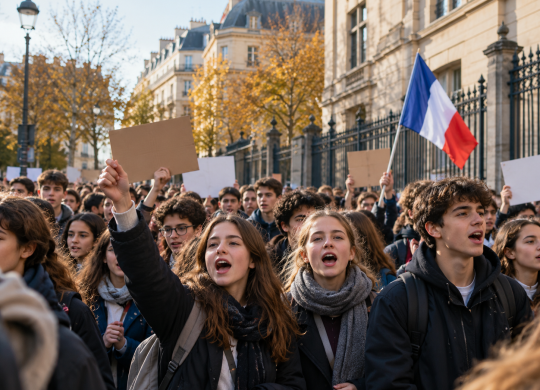
French high school students are blocking schools and taking to the streets to demand better educational conditions. Learn more about the reasons behind the protests, the protesters’ demands, the government’s response, and the impact on schooling and travel in France

Missed classes due to teacher shortages, overcrowded classrooms, and dilapidated buildings sparked protests by French high school students. In the fall of 2026, the discontent spread beyond school grounds: students began blocking the entrances to high schools and gathering for street demonstrations. The protesters are demanding more teachers and proper school facilities.
The government promises to resolve the issues, but the protesters are waiting for concrete solutions. Meanwhile, clashes during some protests have escalated the situation. For families living in France, this has become a matter of their children’s daily education, and for travelers, it’s a reason to check local news before their trip.
Planning a trip abroad?
Insurance from the Visit World portal will help you avoid unnecessary risks. The policy covers the costs of medical treatment, emergency assistance, and unforeseen situations abroad, so that even in the event of delays or route changes, you remain protected and can focus on your trip rather than on problems.

Why did students in France take to the streets?
The Antoine de Saint-Exupéry high school in Créteil, near Paris, has become the epicenter of student protests in France. On September 17, 2026, its teachers went on strike due to a staff shortage: about 10 positions remained unfilled at the school. The next day, the students joined them. One graduate said he started the school year without a math teacher, and the previous year he had such a teacher for only three months.
The blockades at high schools in France spread to other schools, where students reported similar problems:
- A shortage of teachers and substitutes. Classes are canceled due to vacancies or the absence of teachers for whom no substitutes can be found
- Overcrowded classrooms and an overloaded schedule. Students complain about school days that can last from 8:00 a.m. to 6:00 p.m.
- Poor condition of school buildings. Among the complaints are dilapidated facilities and inadequate learning conditions
Behind these complaints lies a broader issue—inequality in educational opportunities. Students link the conditions at their high schools to their chances of preparing for final exams and continuing their education. Students from prestigious schools have also joined the protests, supporting their peers from less affluent neighborhoods.
In our previous article, we reported thatlarge-scale labor strikes are expected in Belgium on October 9 and 12.
Which cities were affected by the protests, and how many people participated?
The student protests in France quickly spread beyond the Paris region. Demonstrations and blockades of high schools took place in Paris, Lille, Lyon, Marseille, Nice, Nantes, Rennes, Bordeaux, and Tours. High school students were joined by university students, teachers, and union representatives.
The scale of the protests grew over the course of several weeks:
- September 28 – disruptions to classes were reported at 180 schools
- September 29 – 410 protest actions were recorded at high schools across France
- October 1 – protests affected 1,027 educational institutions, including 222 blockades
- October 2 – the number of institutions with disrupted classes stood at 735
- October 6 – nationwide demonstrations drew 266,000 participants according to the Ministry of the Interior and up to 450,000 according to organizers’ estimates
- October 8 – authorities counted 71,500 participants in street demonstrations, including 24,500 in Paris. Another approximately 55,000 people joined the protests near educational institutions.
The largest demonstration took place on October 6. In Paris alone, about 56,000 people took to the streets. However, these figures include not only high school students but also college students, education workers, and other participants in the protest movement.
On October 8, the Ministry of Education reported that 157 high schools had been closed. At the same time, representatives of student organizations claimed that the scale of class suspensions was significantly larger. The discrepancies stem from different counting methods. Official statistics on closed schools do not include all partial blockades, class boycotts, and short-term protest actions.
Learn more about transportation strikes in Europe in October 2026 by following the link.
What are students demanding, and how is the French government responding?
French students are demanding increased funding for education, the hiring of additional teachers, the renovation of high schools, and a reform of the university admissions system. Student organizations have presented a plan consisting of 10 urgent measures, for which they are demanding 10 billion euros in funding.
One of the main points of contention is the Parcoursup platform, through which high school graduates apply to higher education institutions. Protesters believe the system exacerbates social inequality: students from high schools with teacher shortages are forced to compete for university spots with graduates from better-resourced schools. Some organizations are calling for the complete abolition of Parcoursup, while others are insisting on more transparent selection rules.
In response, Prime Minister Sébastien Lecornu’s government announced five areas of reform for the school system:
- Prioritizing the replacement of teachers who have been absent for long periods
- Renovating and modernizing school buildings in collaboration with regional authorities
- Revising schedules to reduce excessively long school days
- Increasing the transparency of Parcoursup during the 2027 admissions cycle
- Involving students in decision-making regarding learning conditions
On October 6, the Ministry of Education launched a nationwide survey of students on the Agora platform. Until October 23, students can anonymously report issues and suggest changes. About 40,000 responses were received in the first 24 hours.
The government promises to present the first concrete decisions by the end of October. The government also announced a planned increase in the education budget of 1.2 billion euros, part of which is to be allocated to the needs of high schools.
However, student organizations consider the proposed measures insufficient. They insist on guaranteed funding, specific timelines for hiring staff, and systemic changes to the university admissions process. Due to the lack of final agreements, the protest movement continues.
Earlier, we reported that Portugal was swept by a wave of strikes in the public sector and aviation.
What is known about the clashes, arrests, and casualties?
Some of the student protests in France were accompanied by clashes with police, arson, and property damage. The most serious incidents were reported in Paris, Lille, Bordeaux, Nantes, and Saint-Étienne. At the same time, many demonstrations took place peacefully, without clashes with law enforcement.
The scale of arrests and injuries was significant:
1. More than 6,600 arrests have been recorded since the start of the protest movement. Most of those arrested are minors
2. 488 people were arrested on October 6 during another nationwide protest
3. At least 215 schoolchildren and 85 education workers were injured during the protests. Hundreds of law enforcement officers were also reported to have been injured
4. At least 24 educational institutions sustained damage as a result of arson or vandalism
5. 18 investigations were launched following reports of possible police misconduct
Cases of children being injured during the dispersal of demonstrations sparked particular outrage. In particular, a 14-year-old teenager sustained facial injuries from a tear gas grenade, and a 15-year-old student lost his hand in an explosion caused by a special grenade.
The human rights organization Amnesty International criticized the use of force against minors and called on the authorities to de-escalate tensions. The French Ministry of the Interior, however, emphasizes the need to stop the violence and protect public safety. The authorities have also suspended the use of certain types of grenades against minors.
It is important to distinguish between peaceful demonstrations and violent incidents. Most participants are voicing demands related to education, while arson, assaults, and property damage are being investigated separately.
How are the protests affecting schooling and travel in France?
Student protests in France have led to canceled classes, temporary closures of high schools, and disruptions at some universities. Educational institutions in Paris and the Île-de-France region, as well as in Lille, Lyon, Marseille, and other major cities, have been hit the hardest.
On October 2, more than 400 high schools remained closed, and on October 6, disruptions to the academic process were reported at 891 schools. By October 8, about 96% of schools were operating, although partial blockades continued.
For students and parents, the main consequences were canceled classes, difficulty accessing school buildings, and schedule changes. Some schools switched to a partial operating schedule for safety reasons. Parents are advised to check announcements from their high school’s administration, as the situation may vary even within the same city.
For tourists, the protests do not mean a complete shutdown of transportation services in France. However, during demonstrations, there may be temporary street closures, restrictions on bus and tram service, and delays in public transportation near protest routes.
Before traveling, check the following:
- SNCF Connect – schedules and possible changes to intercity and regional train service.
- RATP – metro, bus, and tram service in Paris and the suburbs.
- Île-de-France Mobilités – transportation restrictions in the Paris metropolitan area.
- Official prefecture websites – announcements regarding road closures, protest routes, and safety measures.
Special attention should be paid to travel to the centers of major cities on days of mass demonstrations. At the same time, there are no confirmed grounds to suggest a nationwide suspension of train or airport operations specifically due to student protests.
Student organizations have not ruled out further demonstrations, so any future changes to high school operations and public transportation will depend on announced protests and agreements with the authorities.
Are you preparing for a trip abroad in 2026?
Medical insurance from the Visit World portal will provide reliable support during your trip, especially in the context of flight changes and unstable schedules. The policy covers medical expenses, emergency assistance, and other unforeseen situations outside the country, so you can feel confident even when plans have to be adjusted at the last minute.
We remind you! High incomes, affordable housing, and life expectancy determine how comfortable a city can be for its residents. Read more about the 10 European cities leading in quality of life in 2026, their advantages, and the nuances of moving there.
Products from Visit World for a comfortable trip:
Travel guide for 200 countries;
Legal advice from a local specialist on visa and migration issues;
Travel insurance around the world (please select the country of interest and citizenship to receive services);
Medical insurance all over the world.
We monitor the accuracy and relevance of our information, so if you notice any errors or inconsistencies, please contact our hotline
Frequantly
asked questions
Why are students protesting in France?
In which French cities are protests taking place?
Are schools in France open during the protests?
Is it safe to travel in France during the protests?
Recommended articles
2 min
Popular
Shopping on Temu and Shein May Get More Expensive Starting in November: A New Shipping Fee
Orders from Temu, Shein, and other international platforms may become more expensive for shoppers in the EU. A separate handling fee will be added to the existing customs duties on low-cost imported goods. Learn more about the changes taking effect in November, how payments are calculated, and what to check before paying for your order
29 Sep. 2026
More details3 min
Transport
Transportation Strikes in Europe in October 2026: Where Flight and Train Cancellations Are Possible
Strikes by airline staff, railroad workers, and public transportation employees may disrupt travel plans in Europe in October. Learn more about the dates of transportation strikes in October 2026, possible disruptions, and what passengers should do if their trip is canceled
30 Sep. 2026
More details2 min
Popular
Strike in Portugal: Schools Closed and easyJet Flights Canceled
A wave of strikes has swept across Portugal in the public sector and the aviation industry. Learn more about school closures, service disruptions, and easyJet flight cancellations
05 Oct. 2026
More details2 min
Transport
Strikes in Belgium on October 9 and 12: How Public Transportation Will Be Affected
Large-scale labor union protests are expected in Belgium on October 9 and 12, which will affect public transportation, rail service, and some flights. The most significant disruptions are expected in Brussels. Learn more about which modes of transportation will operate with restrictions and what passengers should keep in mind
07 Oct. 2026
More detailsAll materials and articles are owned by VisitWorld.Today and are protected by international intellectual property regulations. When using materials, approval from VisitWorld.Today is required.