

Working in the USA in 2026: Visa Types, Required Documents, and Application Costs
Table of contents
- What work visas are valid in the USA in 2026?
- H-1B: a visa for qualified specialists
- H-2B and Seasonal Work
- J-1, L-1, and O-1: Alternative Paths
- Green card and diversification lottery
- How to look for a job in the USA?
- Resume, interview and documents
- SSN, Taxes and Practical Details
- How much is paid in the US: salaries, workweek and vacation

Legal employment in the USA requires the right visa category, a complete package of documents, and an understanding of the current rules for 2026. Find out what work visas are valid in the USA this year, how much they cost, and how to look for work abroad

The dream of working in America remains perhaps the most ambitious career goal for many – a large labor market, high salaries compared to most countries in the world, and the opportunity to gain experience in international companies. However, obtaining a US work visa is one of the most complex and expensive processes in the world of immigration law: the rules change every year, each category has its own quotas and deadlines for submission, and the amount of fees can surprise even a prepared candidate. Before making plans, it is worth understanding which visas are valid in 2026, who they are suitable for, and what has already changed compared to previous years.
Planning to work abroad, but getting lost among the requirements of different countries? Visit World’s “Work Guide” includes step-by-step instructions for obtaining a visa or work permit, a complete list of required documents, and practical advice – all in one PDF file sent to your email. Just select the destination country and your citizenship, and the necessary information will arrive in a few minutes. Don't spend weeks searching for disparate data - get a proven algorithm of actions right away.
Choose your direction and order the “Work Guide” today.

What work visas are valid in the USA in 2026?
There is no single “work visa” in the United States of America - there is a set of separate categories for specific situations, and almost all of them are tied to the employer who agrees to act as a sponsor. The main directions are as follows:
- H-1B - for specialists with specialized higher education (IT, engineering, finance, medicine);
- H-2B - for temporary seasonal work in non-agricultural industries (hotels, restaurants, landscape design);
- L-1 - for employees who are transferred to the USA by a branch of their own international company;
- O-1 - for people with outstanding achievements in science, business, art or sports;
- J-1 – for cultural exchange programs, internships and seasonal work for students.
Each of these categories has its own selection logic, and that is why you should start your preparation by determining which one your situation actually falls under.
Visit World services for tourists, migrants, and expats: Insurance | Guides | Legal advice
H-1B: a visa for qualified specialists
The H-1B remains the most popular work visa for university graduates and experienced specialists, but getting it has become even more difficult. The annual quota is 85,000 places (65,000 general plus 20,000 for holders of master's and doctoral degrees from American universities), while applications are submitted several times more each year. Employers usually open registration in the spring, closer to March, and the visa itself begins to operate on October 1.
Since 2025, the selection has changed: instead of a simple lottery, USCIS weighs applications by salary level. The highest-paying positions (Level IV) receive four “tickets” to the selection process and, according to the agency, have a chance of selection of about 60%, while entry-level positions (Level I) have only one “ticket” and about 15% chance. The registration fee is $215 per candidate, and this is just the first step - the filing of the petition itself adds state fees, attorney fees and, if necessary, expedited processing.
A separate story for 2026 is the additional fee of $100,000 for new H-1B petitions filed for candidates outside the United States through a consulate. It was introduced by presidential order in September 2025, in June a federal court declared the fee illegal, but within a few days the decision was temporarily suspended, and at the time of writing the issue is in litigation. If you are changing status while already in the US, or extending an existing H-1B with the same company, this fee does not apply to you – but it is worth checking the status of your case immediately before submitting, as the situation may change before this material is published.
H-1B Visa 2027: Registration Dates, New Selection Rules and Changes in US Fees at the link.
H-2B and Seasonal Work
For those considering temporary work without a college degree – in the hospitality industry, resorts, landscaping or seasonal manufacturing – there is the H-2B. The quota is 66,000 visas per year, divided in half between the first and second half of the year, and it traditionally runs out within a few weeks of opening.
In 2026, due to the shortage of seasonal workers, an additional 65,000 over-quota visas were opened, most of which were reserved for those who already had H-2B status within the last three years. You cannot apply on your own – all the paperwork is handled by the employer through certification with the Department of Labor, so the search for such a vacancy should begin a few months before the desired start of work.
J-1, L-1, and O-1: Alternative Paths
If the position does not qualify for H-1B or H-2B, other categories may be worth considering.
The J-1 is a cultural exchange visa for students, interns, teachers, and participants in programs such as Work and Travel. The employer is not a company, but an accredited sponsoring organization, and the work itself is often a secondary purpose to the study or internship. Some participants are required to return to their home country for two years before applying for some other visas, so before choosing a program, it is worth clarifying whether this applies to your field of study.
The L-1 is suitable for those who already work for an international company with an office in the United States - it is an intra-corporate transfer without a separate lottery, although the company must confirm actual activities in both countries.
The O-1 is designed for people with outstanding achievements - scientists, artists, athletes, entrepreneurs with notable publications or awards. There is no quota for it, but the threshold for proving achievements is quite high.
The United States is abolishing the “Duration of Status” system for student and exchange visas - read about the new restrictions that await F, J and I visa holders here.
Green card and diversification lottery
Work visas are mostly temporary, so some candidates immediately look towards permanent status. Employment can lead to a green card through the EB-2 or EB-3 categories, although the process often drags on for years due to queues by country of birth. A separate option is the Diversity Lottery (DV Lottery), which is open annually to citizens of countries with historically low levels of immigration to the United States; the list of such countries is updated annually by the State Department. In 2025–2026, the registration deadlines and the lottery procedure changed several times due to administrative decisions, so before registering, you should check directly with the official website travel.state.gov.
New US green card rules 2026 at the link.
How to look for a job in the USA?
The American labor market is largely based on LinkedIn - a profile there is more mandatory than desirable, and it is through it that recruiters most often reach out to candidates directly.
Indeed and Glassdoor remain the most popular general search platforms, USAJobs is the official portal for vacancies in the public sector, and for individual industries there are their own niche resources: Dice for IT, and profile associations often maintain their own job boards in medicine, finance or engineering.
Direct appeal to companies should not be underestimated - American employers are used to receiving letters of interest even for open vacancies.
Vacancies, salaries and a step-by-step strategy for foreigners looking for work in the USA in 2026 here.
Resume, interview and documents
The American resume is significantly different from the European one: without a photo, without a date of birth, usually one page, with an emphasis on specific results and numbers, rather than a list of responsibilities.
The cover letter should be adapted to each vacancy separately - recruiters immediately feel the template text. Interviews are increasingly held in several stages and online, with behavioral questions like "tell me about a situation when...", so it is worth preparing for them in advance, and not relying on improvisation.
The list of the highest-paid professions in the USA in 2026 is at the link.
SSN, Taxes and Practical Details
Upon arrival with a valid work permit, you need to go to the nearest Social Security Administration office and get an SSN – a social security number – without which your employer will not be able to register you officially and calculate your salary. During employment, you also fill out a W-4 form, which determines the amount of tax that your employer will withhold. Tax returns in the US are filed annually, usually by mid-April, and even those who have worked only part of the year will have to do this.
How much is paid in the US: salaries, workweek and vacation
The federal minimum wage remains at $7.25 per hour – it has not changed since 2009, although most states have set their own, much higher rates: in Washington it is over $17, in the District of Columbia – even more.
The average salary in the country, according to the Bureau of Labor Statistics, exceeds $ 6,000 per month before taxes, although the difference between states and industries is huge. The standard workweek is 40 hours, overtime is paid one and a half times the base rate. Unlike most European countries, the United States does not have a law on mandatory paid vacation - the number of days off depends entirely on the policy of a particular employer, and on average it is 10-15 days per year.
Applying for a work visa in the United States is a process that requires accuracy at every stage: the right category, a complete package of documents and careful monitoring of the deadlines for submission. A mistake at any of these steps can postpone the move for a whole year. Therefore, it is worth familiarizing yourself in advance with step-by-step instructions and a list of documents that will be needed in your particular situation.
Visit World’s “Work Guide” will help you figure out which visa category is right for your situation – H-1B, H-2B or other – and what documents you need to prepare at each stage: from the visa application to registering with local authorities upon arrival. The guide also includes information on visa fees, approximate application processing times and life hacks that will help you avoid typical refusals. All you need to do is enter your citizenship and select the USA as your destination country, and the full guide will come to your email in PDF format.
Prepare for the move wisely – order the “Work Guide” for the USA now.
Reminder! The technical talent market in 2026 is one of the most competitive in history. We have already told you which countries offer IT specialists the most favorable conditions in terms of salary, taxes, visa programs and quality of life.
Photo – generated by Gemini
Products from Visit World for a comfortable trip:
Checklist for obtaining a visa and necessary documents in the USA;
Legal advice on immigration to the USA;
Travel insurance for foreigners in the USA;
Medical insurance all over the world.
We monitor the accuracy and relevance of our information, so if you notice any errors or inconsistencies, please contact our hotline.
Frequantly
asked questions
Can I get a Green Card directly without first obtaining a work visa?
What if an employer is willing to hire me but does not want to sponsor a visa?
Do I need to speak English at a native level?
Recommended articles
2 min
Travels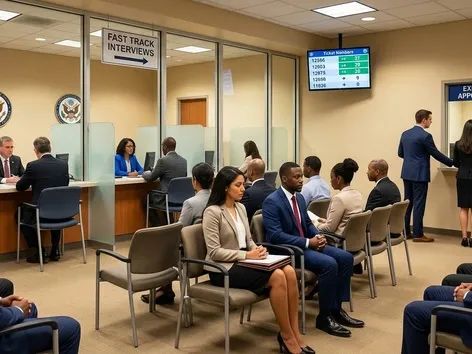
U.S. Launches Paid Expedited B-1/B-2 Visa Interview Appointments: What Changes Starting July 1, 2026
The United States is launching a new expedited appointment program for B-1/B-2 visas. Find out who will be eligible, how much it will cost, and how the new mechanism will work starting in July 2026
09 Jun. 2026
More details2 min
Work
Best Countries to Work Abroad in 2026: Visas, Salaries and Cost of Living
Working abroad opens up new opportunities for professionals and beginners in 2026. Find out which countries offer the easiest visas, best salaries, and comfortable cost of living for foreign workers
06 Jul. 2026
More details2 min
Investment
USA Updates EB-5 Investor Visa Rules in 2026: Key Changes for Foreign Investors
The US is preparing a major update to the EB-5 investor visa program. Learn what requirements may change, what the new DHS regulation entails, when the new rules may take effect, and how they will affect foreign investors.
07 Jul. 2026
More details2 min
Work
The U.S. Is Losing Ground in the Labor Market: What New Employment Studies Have Revealed
Job creation in the U.S. has slowed sharply, while the eurozone has kept unemployment at a record low. This has drawn increased attention to how the balance between the U.S. and European economies is shifting. Learn more about why the U.S. labor market is losing momentum and what this means for the global economy
09 Jul. 2026
More detailsAll materials and articles are owned by VisitWorld.Today and are protected by international intellectual property regulations. When using materials, approval from VisitWorld.Today is required.