

Bulgaria Adopts the Euro: Key Dates, Payment Rules, and What Tourists Should Know
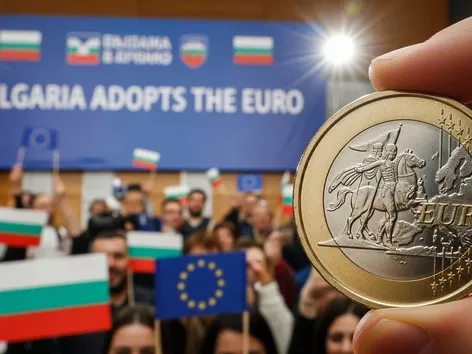
Bulgaria will adopt the euro between 2025–2026 with dual pricing, fixed exchange rates, and clear rules for consumers and tourists. Learn key dates, payment rules, and what the transition means for travelers

Bulgaria is preparing for one of its most significant economic transitions in recent history – the adoption of the euro.
The changeover will take place gradually between August 8, 2025, and December 31, 2026, during which prices will be displayed in both Bulgarian lev (BGN) and euro (EUR).
The step-by-step approach is designed to ensure transparency and prevent confusion for consumers, businesses, and international visitors.
Planning a trip abroad? Choose a reliable health insurance policy on the Visit World portal.

Timeline of the Euro Transition
- August 8, 2025 – December 31, 2025
All prices must be shown in both BGN and EUR, but payments will only be accepted in lev. The purpose is to help consumers get used to euro prices.
- January 1 – January 31, 2026
Payments can be made in both lev and euro. However, change will primarily be given in euro (lev may only be returned if no euro change is available).
Importantly! Returning change in both currencies at the same time will be prohibited.
- From February 1, 2026
The euro becomes the only accepted currency for payments. Dual price display will continue until the end of 2026 to maintain clarity for consumers.
Payment Rules During the Transition
- Until the end of 2025: Payments allowed only in lev.
- January 2026: Both currencies accepted, but merchants should give back change mainly in euro.
- After February 2026: Only euro will be accepted as legal tender across Bulgaria.
Dual Pricing Requirements and Exceptions
Every product and service offered to consumers must display prices in both lev and euro. However, there are a few exceptions where dual pricing is technically impossible or restricted by law, including:
- Books and printed materials with pre-printed prices.
- Bearer shares and certain financial instruments.
- Tobacco products with excise tax stamps.
- Motor fuel prices shown on external gas station displays.
- Taxi meter fares.
- Issued invoices, debit notes, and credit notes.
Even in these cases, businesses must provide alternative ways to show dual prices — such as stickers, signage at gas stations, or published prices on taxi websites and apps.
Conversion and Rounding Rules
The exchange rate is fixed at €1 = 1.95583 BGN.
Prices must be converted and rounded to two decimal places:
- If the third digit is 0–4, round down.
- If the third digit is 5–9, round up.
Examples:
- A product costing 5 BGN equals €2.56 (rounded from 2.556459).
- A product costing 50 BGN equals €25.56 (rounded from 25.56459).
Standards for Transparency and Presentation
Both physical and online shops are required to display prices in BGN and EUR clearly, using the same font size and visibility. Currency symbols and abbreviations must be distinct and not misleading.
Special rules apply to certain cases:
- Advertising and marketing: Before official euro introduction, prices can be stated only in lev; after adoption, only in euro.
- Unit pricing (per kilogram, liter, etc.): Both currencies must be shown.
- Discounts and promotions: Only the final price must be displayed in both currencies.
Example:
A refrigerator originally priced at 839.99 BGN is discounted to 713.99 BGN / €365.06.
Price comparisons should always be based on the final displayed amount in both currencies.
Tools for Consumers
To support consumers and businesses, an official euro conversion calculator is available at euro.bg / evroto.bg. The tool automatically converts prices between lev and euro using the fixed exchange rate, ensuring accuracy and avoiding mistakes.
This resource will be especially helpful for foreign visitors and tourists during the transition period, making payments and budgeting easier.
What It Means for Tourists and Expats
For international travelers, Bulgaria’s transition to the euro means greater clarity and convenience:
- No hidden fees – dual pricing ensures transparency.
- Smooth travel experience – from August 2025 to January 2026, tourists will see both currencies everywhere.
- January 2026 advice – it is recommended to carry both lev and euro during this short overlap month.
- After February 2026 – only euro will be accepted for payments across the country.
Bulgaria’s carefully planned euro adoption process aims to make the changeover smooth, transparent, and consumer-friendly. With dual pricing, strict rounding rules, and official conversion tools, both locals and international visitors will be able to adapt easily.
The transition marks not only a practical shift in daily payments but also a symbolic step toward deeper integration within the European Union.
Planning a trip or moving abroad? A travel insurance policy is an important component of a successful trip, as it guarantees high-quality medical care anywhere in the world and can protect you from unnecessary expenses during your trip.
Buy insurance from trusted agents on the Visit World portal!
Recall! Bulgaria attracts expats with its reasonable prices, developed social sphere, rich culture and picturesque landscapes. We have already talked about the prices of housing rental, food, utilities and transport, as well as the monthly budget in Bulgaria in 2025.
Products from Visit World for a comfortable trip:
Checklist for obtaining a visa and necessary documents for Bulgaria;
Legal advice on immigration to Bulgaria;
Travel insurance for foreigners in Bulgaria;
Medical insurance all over the world.
We monitor the accuracy and relevance of our information, so if you notice any errors or inconsistencies, please contact our hotline.
Frequantly
asked questions
When will Bulgaria switch to the euro?
Can I pay in both lev and euro during the transition?
What is the official exchange rate between lev and euro?
Recommended articles
3 min
Work
Bulgaria is a country in Eastern Europe that is a member of the European Union. In recent years, the state has become increasingly popular among expats looking for work abroad. Find out how to get a work visa in Bulgaria and what are the features of working here
03 Jun. 2025
More details2 min
Residence permit
Moving to Bulgaria for permanent residence: pros and cons of immigration and real estate prices
Moving to Bulgaria attracts foreigners because of its affordable cost of living, beautiful nature, rich culture and friendly locals. Find out what are the pros and cons of living in Bulgaria and what are the real estate prices here
24 Nov. 2024
More details1 min
Travels
The Schengen area, a symbol of free travel within Europe, is preparing to expand. According to official reports, Romania and Bulgaria will join the visa-free zone from January 1, 2025. This decision will allow people to travel freely without passport control at internal borders with other members of the zone. Find out how such innovations could affect tourists and what benefits you can expect
17 Dec. 2024
More details1 min
Residence permit
Bulgaria is a European country that is a promising destination for expats to move to. Find out how foreign business owners who will open a representative office in the country can obtain a residence permit in the country
17 Nov. 2024
More detailsAll materials and articles are owned by VisitWorld.Today and are protected by international intellectual property regulations. When using materials, approval from VisitWorld.Today is required.