

EU Blue Card in the Czech Republic: Requirements, salary and procedure for obtaining it
Table of contents
- What is the EU Blue Card and how does it work in the Czech Republic?
- Who can get a Blue Card in the Czech Republic?
- What salary is required for a Blue Card in the Czech Republic?
- Step-by-step procedure for obtaining the Blue Card in the Czech Republic
- Validity of the Blue Card and the possibility of its extension
- What opportunities does the EU Blue Card provide?
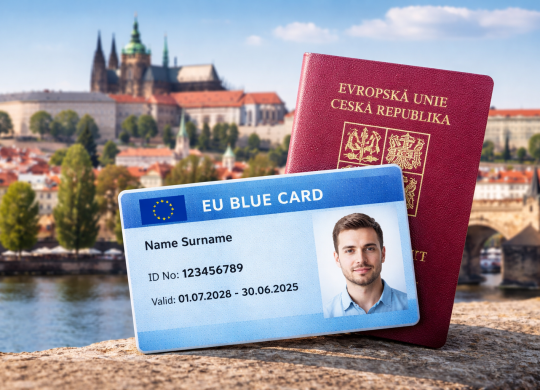
The EU Blue Card offers foreign specialists the opportunity to work and live legally in the Czech Republic and to obtain a long-term residence permit in Europe. This permit is intended for highly qualified specialists who have a contract with an employer and meet the requirements of the program. Find out more about the conditions for obtaining the EU Blue Card in the Czech Republic, eligibility requirements and the application procedure

The Czech Republic remains one of the most popular countries in Europe for foreign professionals looking for stable employment, competitive salaries and the possibility of long-term residence in the EU. One of the key instruments of legal employment for highly qualified specialists is the EU Blue Card, a special residence and work permit for non-EU nationals.
This program was created to attract qualified personnel in industries where there is a shortage of specialists. Holders of the Blue Card can work in their profession, travel to Schengen countries, and eventually obtain permanent residence in Europe.
In this article, we will consider who can obtain a Blue Card in the Czech Republic, what requirements must be met, what level of salary is required, and how the application procedure works.
Earlier, we talked about the new rules for the employment of foreign nationals in the Czech Republic.
Are you planning to work abroad in 2026? Visit World's Work Guide will help you quickly understand the requirements for a work permit, the list of necessary documents, and the application procedure. The guide contains current employment rules, the main types of permits, common mistakes made by applicants, and practical advice after moving. You will receive structured information in PDF format within a few minutes after ordering. Check out the guide and prepare for working abroad without any stress.

What is the EU Blue Card and how does it work in the Czech Republic?
The EU Blue Card is a special type of residence and work permit intended for highly qualified specialists from non-EU countries. The program was created by the European Union to attract professionals in areas where there is a shortage of personnel, such as IT, engineering, medicine, science, and management.
In the Czech Republic, this document is known as a Modrá karta. It allows foreign specialists not only to work in their specialty but also to obtain long-term legal status in the country. Unlike standard work permits, the Blue Card provides more opportunities for professional development and mobility within the European Union.
The main features of the Blue Card in the Czech Republic are:
1. A combined residence and work permit, which is issued in one document;
2. Designed for highly qualified specialists with proven education or professional skills;
3. The job must correspond to the candidate's qualifications;
4. The position must be included in the official register of vacancies for Blue Card holders;
5. The employer must offer a contract with an appropriate level of salary.
The Blue Card also gives foreigners more stability than other types of work permits. Holders of this status can change employers (subject to certain procedures), bring family members to the Czech Republic through the family reunification program, and travel to Schengen countries.
Another important advantage is the possibility of obtaining permanent residence in the EU. After several years of legal residence, Blue Card holders can apply for long-term EU residency, which opens up additional opportunities for work and residence in other EU countries.
In our previous article, we provided a detailed guide on possible ways to move to the Czech Republic legally.
Who can get a Blue Card in the Czech Republic?
The EU Blue Card is intended for foreign specialists who are highly qualified and have received a job offer from an employer in the Czech Republic. The program is targeted at specialists in fields where there is a shortage of personnel on the labor market, so the main condition is the availability of appropriate education or professional skills.
To apply for a Modrá karta in the Czech Republic, a candidate must meet several basic requirements:
1. Higher education or high professional qualification. Usually, a university degree after studying for at least three years is required. In some cases, significant professional experience in the relevant field may be taken into account.
2. An employment contract with a Czech employer. The contract must be concluded for at least one year and provide for work that meets the applicant's qualifications.
3. An appropriate level of salary. The salary must not be lower than the established minimum threshold for the Blue Card, which is calculated on the basis of the average salary in the country.
4. Vacancy from the official register. The position must be included in a special register of vacancies for Blue Card holders maintained by the Ministry of Labor and Social Affairs of the Czech Republic.
5. No serious violations of the law. A certificate of no criminal record must be provided when applying.
6. A valid passport and the required documents. Proof of residence, photographs and other standard documents for obtaining a residence permit may also be required.
Most often, the Blue Card is granted to specialists in areas where the demand for skilled workers is particularly high. Among them:
- IT specialists and programmers
- Engineers of various specializations
- Doctors and healthcare workers
- Scientists and researchers
- Managers and management specialists
It is also important that the job must match the candidate's qualifications. For example, if an applicant has an engineering degree, the position offered should be related to this professional field.
In the previous material, we provided a selection of countries for easy employment visa application in Europe.
What salary is required for a Blue Card in the Czech Republic?
One of the key conditions for obtaining the EU Blue Card is the level of salary, which must meet the established minimum threshold. This rule applies to all EU countries participating in the Blue Card program.
In the Czech Republic, the salary for Modrá karta holders must be at least 1.5 times the average annual salary in the country. As of 2026, the minimum salary for obtaining a Blue Card in the Czech Republic is approximately CZK 77,245 per gross month. This amount is regularly reviewed by the state in accordance with changes in the average income level in the country.
If an employer offers a salary below this threshold, it is not possible to apply for a Blue Card. In this case, a foreign worker can only apply for a standard work permit.
Step-by-step procedure for obtaining the Blue Card in the Czech Republic
The procedure for obtaining the EU Blue Card in the Czech Republic consists of several consecutive stages. If you break it down step by step, the process looks quite clear: first, you need to find a suitable job, then sign a contract, prepare documents, submit an application, and complete the procedure after arriving in the Czech Republic.
Step 1. Search for a job
The first step is to find a job that meets the conditions of the Blue Card program. It is not just any vacancy, but a position included in the official register of vacancies for Blue Card holders. This register is maintained by the Czech government authorities, and it is the employer who usually provides the vacancy number, which is then used when submitting documents.
At this stage, it is important to immediately check whether the position corresponds to your education or professional qualifications, as well as whether the salary offered allows you to apply for a Blue Card and not for another type of permit.
Step 2. Conclusion of an employment contract
After agreeing on the terms and conditions with the employer, you need to sign an employment contract. For the Blue Card, the contract must be concluded for at least one year if the application is submitted from abroad. If a person is already legally residing in the Czech Republic on another type of residence permit, a shorter period of six months or less is allowed in some cases.
The contract must clearly state the position, working conditions, and salary. This is one of the key documents in the entire procedure, so the data in it must fully comply with the requirements of the Blue Card program.
Step 3. Preparation of documents
After signing the contract, you need to prepare a package of documents. It usually includes a passport, photographs, an employment contract, a higher education diploma, a vacancy number from the official register, and a certificate of no criminal record. In some cases, you may also be asked to provide translations of documents, proof of residence, or other additional papers.
It is at this stage that you should be especially careful to check whether all documents are up-to-date, whether there are any discrepancies in the data, and whether the translations are correct. Even small inaccuracies can delay the application process.
Step 4. Submitting the application
If the applicant is outside the Czech Republic, the documents are submitted to the Czech consulate in the country of residence. If the person is already in the Czech Republic on the basis of another valid residence permit or a long-term visa, the application is submitted directly to the Ministry of the Interior of the Czech Republic.
At the time of submission, an administrative fee of approximately CZK 5,000 must be paid. After that, the application is officially accepted for consideration.
Step 5. Waiting for the decision
After submitting the documents, the standard review period begins. In most cases, it lasts up to 90 days. During this time, the authorities check the documents, whether the vacancy meets the program requirements, and whether the grounds for issuing the permit are legitimate.
If the decision is positive, the applicant receives a long-term visa type D/VR, which allows him or her to enter the Czech Republic and complete the registration procedure on the spot.
Step 6. Arriving in the Czech Republic and receiving the card
Upon arrival in the Czech Republic, you must register with the Ministry of the Interior within three days. Then the applicant submits biometric data, after which a plastic residence permit card is issued. The cost of issuing it is approximately 2,500 CZK.
After that, the procedure is considered complete: the foreign specialist receives an EU Blue Card and can officially work and reside in the Czech Republic under the conditions provided for by this program.
To learn more about the specifics of obtaining a Digital Nomad visa in the Czech Republic, please follow the link.
Validity of the Blue Card and the possibility of its extension
The EU Blue Card in the Czech Republic is issued for the duration of the employment contract plus three months, but not more than three years. If the contract is for two years, for example, the card will be valid for approximately two years and three months.
After the expiry date, the card can be extended if the applicant continues to work in the Czech Republic and meets the requirements of the program. To do so, a new application must be submitted to the Ministry of the Interior before the current permit expires. Practice shows that it is advisable to start the extension procedure no later than 120 days before the expiration of the card to avoid interruptions in the right to reside and work.
It is also important that the Blue Card holder can change employers, but in most cases, it is necessary to notify the migration authorities or obtain their approval, especially during the first years of stay.
In addition, the Blue Card opens up the possibility of long-term residence in the European Union. After five years of legal residence in the Czech Republic or other EU countries, holders of this permit can apply for permanent residence.
What opportunities does the EU Blue Card provide?
The EU Blue Card is not only a work permit, but also a long-term legal status that opens up more opportunities for foreign professionals to live and work in Europe. Compared to standard work permits, it provides more stable living conditions and broader rights.
Blue Card holders can legally work in the Czech Republic in their specialty and receive competitive salaries at the level of highly qualified specialists. In addition, this status allows them to travel freely to Schengen countries for a short period of time without the need to apply for additional visas.
Another important advantage is the possibility of family reunification. Family members of a Blue Card holder can obtain a residence permit in the Czech Republic and move to the country legally.
The Blue Card also creates the prospect of long-term residence in the European Union. After a few years of legal residence, holders of this permit can apply for permanent residence and, in the future, citizenship if they meet the relevant legal conditions.
If you are planning to work abroad in 2026 and want to better understand the rules of employment, work permits, taxes, and basic employee rights, it is worth preparing for the move in advance. Visit World's practical working guide will help you navigate the current requirements, types of work permits, and steps to take upon arrival to avoid common mistakes and feel confident in your new life abroad.
We remind you! New economic indicators show which countries have been able to increase their GDP and which have lost ground due to inflation and slowing growth. Ranking of the richest countries in the world in 2026 — follow the link.
Products from Visit World for a comfortable trip:
Checklist for obtaining a visa and necessary documents in Czech Republic;
Legal advice on immigration to Czech Republic;
Travel insurance for foreigners in Czech Republic;
Medical insurance all over the world.
We monitor the accuracy and relevance of our information. Therefore, if you see any error or discrepancy, please write to our hotline.
Frequantly
asked questions
Who can obtain the EU Blue Card in the Czech Republic?
What is the minimum salary required for a Blue Card in the Czech Republic?
How long does it take to process a Blue Card application?
Can a family move to the Czech Republic with a Blue Card holder?
Is it possible to obtain permanent residence in the Czech Republic with a Blue Card?
Recommended articles
3 min
Work
Minimum wage ranking in Europe 2026: leaders and outsiders
Minimum wages in European countries vary significantly: in some countries, they are more than two thousand euros, while in others they are several times less. In 2026, the difference between countries became even more pronounced, especially when the cost of living is taken into account. Learn more about where in Europe the minimum wage is the highest and what these figures mean in practice
13 Feb. 2026
More details3 min
Work
The European labor market is undergoing significant changes: some industries are actively looking for personnel, while others are gradually reducing open positions, and salary levels and job availability vary significantly from country to country. Understanding these trends helps you make informed choices when planning to work abroad. Learn more about the most in-demand professions in the EU, the countries with the highest salaries, and the regions where it is easiest to find a job
18 Feb. 2026
More details3 min
Work
Easy work visa in Europe: TOP countries for labor migration in 2026
European countries continue to actively attract foreign specialists by offering clear and relatively simple mechanisms for obtaining work visas. In 2026, countries with transparent rules and high chances of approval of applications remain the most accessible for migration. Learn more about the European countries where it is easiest to get a work visa and start a career abroad
01 Mar. 2026
More details2 min
Employment
Talent Shortage in Europe in 2026: The Hardest Jobs for Employers to Fill
European employers are increasingly facing a shortage of skilled workers, especially in technology and engineering. Find out which European countries have the most acute shortages, which professions are the hardest to close, and which skills companies will value most in 2026
08 Mar. 2026
More detailsAll materials and articles are owned by VisitWorld.Today and are protected by international intellectual property regulations. When using materials, approval from VisitWorld.Today is required.