

Portugal vs Italy Golden Visa: Investment Conditions, Costs and Path to EU Citizenship Compared
Table of contents
- What is a golden visa and how does it work?
- Advantages of the Golden Visa programs in Portugal and Italy
- Investment routes: common and distinctive features
- Requirements for applicants and family inclusion
- Costs: what is included in the total amount?
- Procedure and processing times
- Permanent residence, citizenship and taxes
- How to choose between the two programs?
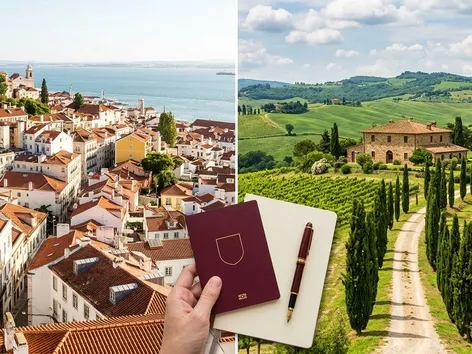
Portugal and Italy's Golden Visas are the two most popular investment routes to EU residency, with significantly different conditions and benefits. Learn about the investment thresholds, processing times, family inclusion rules, paths to citizenship and tax regimes of both programs

Choosing between the Portuguese and Italian Golden Visas is not a question of which program is better. It is a question of which one meets the specific goals of the investor: some seek to obtain residency as quickly as possible, others plan for future EU citizenship, and still others are looking for the optimal tax model.
Both programs open the door to residence in the European Union, grant the right to visa-free travel in the Schengen area and, over time, the path to an EU passport. However, behind this external similarity lie significant differences in structure, deadlines, presence requirements and investment mechanisms.
Golden visas remain one of the fastest ways to obtain a residence permit in Europe in 2026. Countries that still offer investment programs in this article.
Moving abroad, changing jurisdiction or starting a business in a new country is a process in which legal support plays a key role. A personal business lawyer from Visit World will help you understand the intricacies of the law, avoid risks and find optimal solutions - from tax advice to document processing. Regardless of whether you are just trying or are already scaling up - professional legal support is always at hand.
Contact a personal business lawyer today.

What is a golden visa and how does it work?
The Portuguese program is officially called Autorização de Residência para Investimento (ARI) and was launched back in 2012 as a tool to attract foreign capital after the financial crisis. It is managed by the AIMA agency.
The Italian program - Visto per Investitori - appeared later, in 2017, and is jointly administered by two ministries: MIMIT is responsible for the initial verification and issuance of the Nulla Osta permit, and the Ministry of Foreign Affairs is responsible for consular processing of the visa.
Both programs give the holder the right to live, work and study in the country of residence, travel freely within the Schengen area and after 5 years apply for permanent residence, and after 10 years for citizenship. But this is where the fundamental differences begin.
The current conditions of the Portuguese golden visa in 2026 and its strategic advantages are in our previous material.
Advantages of the Golden Visa programs in Portugal and Italy
The first and most obvious advantage is EU residency as a backup plan. For people from countries with an unstable political or economic situation, currency restrictions or problems with international mobility, having a residence permit in Portugal or Italy becomes a real asset, not a formality.
Visa-free access to the Schengen area allows you to stay in any participating country for up to 90 days within each 180-day cycle. The geographical location of the two countries is significantly different: Portugal is convenient for those focused on the Iberian Peninsula and the Atlantic, while Italy is more central in Europe, and most key Schengen cities can be reached in 1.5–2 hours of flight from Milan or Rome.
Both programs also provide access to public healthcare systems. The quality of healthcare in both countries is higher than the OECD average: avoidable mortality is 93 cases per 100,000 in Italy and 117 in Portugal. Private insurance is mandatory for obtaining a visa, but most residents use it as their main insurance, and public healthcare as an insurance network.
Education is available at the state school level for free, but teaching is conducted in the local language. Private schools will cost from 8,000 euros per year in Portugal and from 13,000 euros in Italy. University fees for residents are relatively moderate in both countries.
Investment routes: common and distinctive features
The minimum entry threshold in both programs starts at 250,000 euros, but the structure of the paths is significantly different.
The most popular route in Portugal is the purchase of investment fund units from 500,000 euros. Such funds usually invest in commercial real estate, Portuguese companies or industrial projects. The minimum holding period is 5 years, the realistic exit horizon is 6-10 years. Portugal also allows cultural and scientific donations: from 250,000 euros to support the arts or heritage restoration, and from 500,000 euros to research activities of accredited organizations. The business route requires from 500,000 euros and the creation of at least 5 jobs.
In Italy, the most popular route is through an innovative startup - the purchase of a share in a government-approved enterprise from 250,000 euros. This is the only path among both programs that is directly linked to the EU startup ecosystem. A business investment in an existing company requires from 500,000 euros, a cultural or scientific donation from 1,000,000 euros, and the purchase of government bonds from 2,000,000 euros. The latter option is the most conservative and is suitable for those who primarily want to preserve capital, not earn on it.
Comparison of the conditions of the “golden visa” program in Malta and Cyprus in 2026 at the link.
Requirements for applicants and family inclusion
The basic criteria in both programs are the same: citizenship of a country outside the EU/EEA, age of majority, no criminal record, health insurance and a clearly documented legal source of funds.
A significant difference is in the rules for family reunification. Portugal is more flexible: it recognizes partners without formal marriage (provided they have lived together for at least 2 years), allows children up to 26 years of age to be included, provided they are financially dependent and studying, and parents can join regardless of their age.
In Italy, only formal marriage is recognized, children over 18 years of age are included only if they have a confirmed total disability, and for parents over 65 years of age, additional justification of the lack of other sources of support in their homeland is required.
Golden visas open up new opportunities for moving the whole family. Read here which countries allow the inclusion of parents, adult children and relatives and what conditions they offer to investors in 2026.
Costs: what is included in the total amount?
In addition to the investment itself, both programs provide for mandatory administrative fees.
- In Portugal, each applicant pays €632.10 for submitting documents and €6,314.20 for a resident card.
- In Italy, the main applicant pays €3,406, each adult dependent pays €567, and a minor pays €313. In addition, in Italy, there are additional costs for a power of attorney (from €605) and obtaining a tax number and electronic signature (from €781). Health insurance will cost around €400 per year per person. If the Portuguese fund route is chosen, the investment fee can reach 7.5%. As a result, the total starting cost is approximately €257,000 for Portugal and €267,000 for Italy.
Procedure and processing times
The processing time is one of the most noticeable practical differences. The Portuguese route takes at least 12 months: first you need to obtain a NIF tax number, open an account with a local bank, complete the investment and only then apply to AIMA, which reviews the documents for up to 6 months. After approval, the family comes to take biometrics.
The Italian procedure is much faster - on average from 4 months. The fundamental difference is that the investment here is made after obtaining a visa: first an application for Nulla Osta is submitted, then a consular application for a visa, and after arriving in Italy, the investor completes the transfer of funds within 3 months and applies for a residence permit at the local immigration office.
Visit World services for tourists, migrants, and expats: Insurance | Guides | Legal advice
Permanent residence, citizenship and taxes
After 5 years, both Portugal and Italy can apply for permanent residence, but the conditions are fundamentally different. Portugal maintains a minimum of 7 days of stay per year, which is enough to obtain permanent status. Italy requires actual residence: no more than 6 months of absence in a row and no more than 10 months of absence in total over 5 years. That is, Italy effectively requires actual relocation.
Citizenship in both countries is available after 10 years. Portugal has maintained the minimum presence requirement even at this level, but in 2026 introduced new rules: the countdown is now from the date of issuance of the first permit, rather than from the date of application. The applicant is required to have knowledge of the Portuguese language and to pass an exam on culture and democratic values. In Italy, citizenship requires confirmed continuous residence and knowledge of the language at level B1. Both passports give you full access to EU citizen rights and visa-free entry to the US, UK, Canada, Japan and Singapore.
Regarding taxation: residency in itself does not make you a tax resident – you need to spend more than 183 days a year in the country or have your main residence there. If you do become a tax resident, progressive rates apply: in Portugal, from 12.5% to 48%, in Italy, from 23% to 43% plus regional surcharges. For new residents, both countries offer special regimes: Portugal – a fixed rate of 20% for highly qualified professionals under the IFICI regime for 10 years, Italy – a fixed annual payment of €300,000 on all foreign income for up to 15 years. The latter option is particularly advantageous for investors with very high incomes, as the effective rate can be minimal.
How to choose between the two programs?
If speed is the priority, the choice is obvious: Italy gives results in 4 months versus 12 in Portugal.
If maximum flexibility in including family members is important, Portugal definitely wins. For those looking for a path to EU citizenship with minimal physical stay, Portugal wins again.
If the goal is a real move with tax optimization, Italy with its fixed tax regime may be much more attractive. Investors interested in the venture sector and the EU startup ecosystem should pay attention to Italy, while for a passive portfolio approach, the Portuguese stock route is better suited.
Both programs carry certain risks: possible changes in legislation (Portugal has already removed real estate from the list in 2023), limited investment liquidity, strict document deadlines and the possibility of inadvertently becoming a tax resident due to accumulated visits.
Obtaining a golden visa in Portugal or Italy is not only an investment decision, but also a legal process with dozens of details: from checking the source of funds and preparing a package of documents to opening an account in a foreign bank and interacting with government agencies. Any mistake along the way can cost a month of waiting or additional costs. That is why more and more investors planning to relocate or open a business in the EU turn to a personal business lawyer for support. This specialist accompanies the company and private clients at every stage - from the initial consultation on the choice of programs to resolving current operational issues in a new jurisdiction. Having a proven legal partner is especially important when the stakes are high and the rules of the game are changing. Order a consultation with a personal business lawyer at Visit World and go through this confident.
As a reminder! In a world where digital assets are increasingly influencing global mobility, more and more countries are opening programs for obtaining citizenship or residence permits through investments in cryptocurrency. We have already told you which states allow the use of cryptocurrency as an investment tool, what minimum amounts need to be invested, as well as what benefits and risks await applicants.
Photo - generated by Gemini
Products from Visit World for a comfortable trip:
Travel guide for 200 countries;
Legal advice from a local specialist on visa and migration issues;
Travel insurance around the world (please select the country of interest and citizenship to receive services);
Medical insurance all over the world.
We monitor the accuracy and relevance of our information, so if you notice any errors or inconsistencies, please contact our hotline
Frequantly
asked questions
Which country is more profitable for a family with university-age children?
Can a residence permit obtained through a golden visa be lost?
Do I need to know the local language to get a golden visa?
Recommended articles
3 min
Popular
Non-CRS countries in 2026: where to open an account with greater privacy
More than 120 countries have already become members of the Common Reporting Standard (CRS) system. Therefore, it is becoming increasingly difficult to legally protect your financial position from prying eyes. Learn more about how to legally diversify your finances in non-CRS jurisdictions in 2026
17 Apr. 2026
More details3 min
Popular
Housing prices in the EU rose by 65% over 10 years: where it’s most expensive in 2026
Housing prices in the EU have risen by nearly 65% over the past decade, far outpacing the growth in rent. In some countries, property prices have tripled or quadrupled, and the market has returned to growth after a brief downturn. Learn more about where housing prices are rising the fastest and what’s happening in the market in 2026
15 Apr. 2026
More details3 min
Investment
Spain has topped the ranking of Europe’s most attractive countries for real estate investment for the first time. Investment volumes have already exceeded €18.4 billion, and demand continues to grow amid a housing shortage and economic stability. Learn more about why investors are flocking to Spain in 2026
16 Apr. 2026
More details2 min
Investment
Compact Apartments in Greece Are Rising Faster: A New Real Estate Trend
The Greek real estate market is shifting towards compact housing, which is seeing faster price and demand growth. Find out why small apartments are becoming more attractive to investors and buyers
16 Apr. 2026
More detailsAll materials and articles are owned by VisitWorld.Today and are protected by international intellectual property regulations. When using materials, approval from VisitWorld.Today is required.