

Australia's New Skilled Visa Priorities in 2026: Who Gets Faster Processing
Table of contents
- What visas are covered by the new processing system in Australia?
- Who now gets priority for visa applications in Australia?
- Regional applicants lose priority when applying for a visa in Australia
- Special conditions for family migration and innovation visas
- How will Australia’s new visa process affect the system?

Australia has changed the way skilled migration applications are processed, with the queue now based not only on occupation but also on the applicant's location. Find out which occupations and categories have been prioritised, what happened to regional applications and how the new rules could affect the timing of work visas

Australia has significantly revised the procedure for processing skilled migration applications, and from July 25, 2026, a new priority system - Ministerial Direction 119 - will come into effect. This is not a separate law or a new visa, but an administrative instruction that determines the sequence in which the Australian Department of Home Affairs will consider applications for work migration.
For those planning to move to Australia for work, this change means one thing: the queue for consideration of the application now depends not only on the profession, but also on where the applicant is at the time of submitting the documents.
How to get a work visa in Australia in 2026, read in our previous material.
Applying for a work visa is always about documents: correct, complete and submitted on time. A mistake or missing certificate can cost several months of waiting or even refusal, so before applying, it is worth knowing exactly what will be needed for your destination country.
The "Working Guide" from Visit World contains step-by-step instructions for obtaining a working visa and work permit for any country, with a list of documents, fees and processing times. All information comes to your email in PDF format within a few minutes.
Get a working guide and prepare your application without unnecessary questions.

What visas are covered by the new processing system in Australia?
The updated processing procedure covers most popular routes for skilled migration to Australia, including:
- Employer-nominated visa (subclass 186),
- Skilled Shortage Visa (subclass 482),
- Independent Skilled Visa (subclass 189),
- State-nominated Skilled Visa (subclass 190),
- Regional Skilled Visas (subclasses 491 and 494).
The rule applies to all applications submitted on or after 25 July 2026, and also affects applications that are already in process.
Who now gets priority for visa applications in Australia?
Unlike the previous system, where priority was determined mainly by specialty, the new structure takes into account two factors at once: the applicant’s profession and their physical location at the time of application.
Applications related to law enforcement and Australian defense have the highest priority, with those applicants already in the country being considered before those applying from overseas.
Applicants in the health, education and construction sectors are next – again, provided that they are already in Australia.
Only then are all other qualified applications from those in the country considered, and applicants outside the priority professions who apply from overseas are considered.
This means that being in Australia at the time of application itself increases your position in the queue – even if your occupation is not on the priority list.
Visit World services for tourists, migrants, and expats: Insurance | Guides | Legal advice
Regional applicants lose priority when applying for a visa in Australia
One of the most noticeable consequences of the new order is the abolition of the accelerated processing for regional vacancies and accredited sponsoring employers, which was in force before. Until recently, some regional applications under subclass 186 were processed in about 12-15 months precisely because of this advantage. Now there is no such acceleration, so applicants outside the new priority categories must expect a longer wait than before.
A step-by-step guide to help you move to Australia in 2026 is here.
Special conditions for family migration and innovation visas
The priorities for family migration have remained virtually unchanged, although applicants who are already in Australia still receive some priority here.
The National Innovation Visa, in turn, continues to focus on internationally recognized specialists and candidates with exceptional achievements in critical technologies, renewable energy, and healthcare - there have been no significant changes here.
How will Australia’s new visa process affect the system?
If your profession falls under one of the priority categories and you are already in Australia at the time of application, the chance of a faster processing does increase. But it is worth understanding: the accelerated queue does not guarantee approval - the applicant must still meet all the requirements for qualifications, language, work experience and points. The department also notes that further adjustments to priorities are possible in the future, so the situation may change throughout 2026.
For professionals considering Australia as a destination for work, the main practical conclusion is this: before applying, it is worth checking whether your profession is on the priority list and whether the location factor affects your situation. If neither of these is in your favor, it is wise to plan for more time to wait for a decision.
The Australian skilled migration system is changing faster than ever in the past few years, and it is quite difficult to keep track of all the nuances – from priority professions to income thresholds – on your own.
The "Work Guide" from Visit World takes into account the details of obtaining a permit: step-by-step instructions for filling out a visa application form, a complete list of necessary documents for a visa and work permit, information on visa fees and approximate processing times, as well as practical advice for your first steps in a new country. The guide comes to your email in PDF format immediately after registration.
Order a work guide for Australia and prepare to submit an application correctly the first time.
Reminder! Canada has updated the conditions for attracting foreign workers under the Temporary Foreign Worker Program (TFWP) and established new minimum hourly wage rates for the low-paid segment. The changes affect employers in all provinces and territories, and expand the list of cities with hiring restrictions. We’ve already covered the new salary thresholds, geographic restrictions, Canadian business requirements, and the role of the LMIA in the employment process.
Photo – Generated by Gemini
Products from Visit World for a comfortable trip:
Checklist for obtaining a visa and necessary documents in Australia;
Legal advice on immigration to Australia;
Travel insurance for foreigners in Australia;
Medical insurance all over the world.
We monitor the accuracy and relevance of our information. Therefore, if you see any error or discrepancy, please write to our hotline.
Frequantly
asked questions
Do I need to submit a new application because of the changes to processing rules?
Can I change my status from “outside Australia” to “in Australia” to receive a higher priority?
Do the new priorities affect the minimum income threshold for skilled visas?
Recommended articles
2 min
Education
Australia Student Visa Cost Reaches Record 2000 AUD in 2026: New Rules for International Students
Australia has tightened rules for international students in 2026, raising the cost of a student visa to a record AUD 2000. Find out how entry requirements, application requirements and post-study employment opportunities have changed
24 Jun. 2026
More details2 min
Work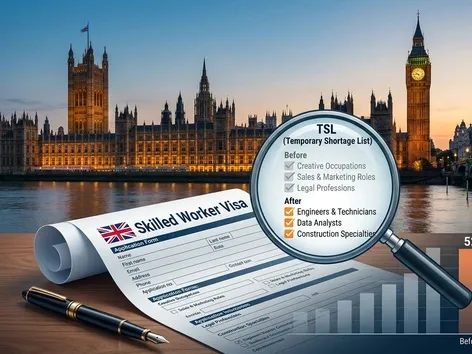
UK to Cut Shortage Occupation List for Skilled Worker Visas to 28 Roles From 2027
The UK is considering reducing its temporary list of shortage occupations from 52 to 28. Find out which occupations could remain on the list and which will lose their eligibility for a simplified work visa from 2027
29 Jul. 2026
More details1 min
Work
Canada Tightens C20 Work Permit Rules in 2026: What Changed for Employers
Canada has introduced new C20 work permit requirements for foreign professionals. Find out exactly what has changed in the rules from July 2026, who will be affected by the new criteria, and what alternative work permits remain available to employers
05 Aug. 2026
More details2 min
Work
Top 5 EU Countries to Open an Offline Business in 2026
The choice of country affects the success of an offline business in Europe no less than the idea itself or the start-up capital. Find out what tax rates, registration forms and premises requirements apply in 2026 in Poland, the Czech Republic, Germany, Estonia and Lithuania
09 Aug. 2026
More detailsAll materials and articles are owned by VisitWorld.Today and are protected by international intellectual property regulations. When using materials, approval from VisitWorld.Today is required.