

The Top 20 Largest Economies in the World in 2026: Who Topped the List
The United States remains the world's largest economy in terms of nominal GDP, but China surpasses it in terms of purchasing power parity. Learn more about the world's 20 largest economies in 2026, their GDP figures, and their rankings in the international rankings

According to forecasts by the International Monetary Fund (IMF) for 2026, the United States remains the world’s largest economy by nominal GDP, at $32.6 trillion. China ranks second with $21.5 trillion, and Germany ranks third with $5.5 trillion. At the same time, in terms of purchasing power parity, China surpasses the U.S., and India rises to third place. We’ll explain which countries made the list of the world’s largest economies in 2026 and why the results differ depending on the calculation method.
Earlier, we talked about the European countries where it is easiest to get a work visa and start a career abroad.
Are you planning to work abroad in 2026? Visit World's Work Guide will help you quickly understand the requirements for a work permit, the list of necessary documents, and the application procedure. The guide contains current employment rules, the main types of permits, common mistakes made by applicants, and practical advice after moving. You will receive structured information in PDF format within a few minutes after ordering. Check out the guide and prepare for working abroad without any stress.

Top 20 Largest Economies in the World in 2026
According to the International Monetary Fund (IMF) forecast, the U.S. and China will remain the undisputed leaders of the global economy in 2026. Their combined nominal GDP exceeds $54 trillion. Germany ranks third, remaining Europe’s largest economy.
Ranking of the world’s 20 largest economies in 2026 by nominal GDP:
1. United States – $32.6 trillion
2. China – $21.5 trillion
3. Germany – $5.5 trillion
4. Japan – $4.3 trillion
5. United Kingdom – $4.3 trillion
6. India – $4.1 trillion
7. France – $3.6 trillion
8. Russia – $2.9 trillion
9. Italy – $2.7 trillion
10. Brazil – $2.7 trillion
11. Canada – $2.5 trillion
12. South Korea – $2.2 trillion
13. Mexico – $2.2 trillion
14. Australia – $2.1 trillion
15. Spain – $2.1 trillion
16. Turkey – $1.8 trillion
17. Indonesia – $1.5 trillion
18. Netherlands – $1.4 trillion
19. Saudi Arabia – $1.3 trillion
20. Switzerland – $1.1 trillion
European countries occupy eight spots in the top twenty, if Turkey is counted as a transcontinental country. Germany, the United Kingdom, and France remain the region’s largest economies.
At the same time, India, despite having the world’s largest population, ranks only sixth in terms of nominal GDP. Brazil tops the list of Latin American countries, while Indonesia is the largest economy in Southeast Asia.
It is important to note that nominal GDP reflects the value of goods and services in U.S. dollars at current exchange rates. When economies are compared using purchasing power parity (PPP), the rankings of many countries change significantly.
Learn more about the world’s richest countries in 2026 by following the link.
How does the ranking of economies change based on purchasing power parity?
If economies are assessed not by nominal GDP but by purchasing power parity (PPP), the global ranking changes significantly. This metric accounts for price differences between countries and allows for a comparison of the actual volumes of goods and services produced.
According to the IMF’s forecast for 2026, the world’s largest economies by PPP are as follows:
1. China – 44.6 trillion international dollars
2. United States – 32.6 trillion
3. India – 19.2 trillion
4. Russia – 7.5 trillion
5. Japan – 7.3 trillion
6. Germany – 6.6 trillion
7. Indonesia – 5.5 trillion
8. Brazil – 5.3 trillion
9. United Kingdom – 4.8 trillion
10. France – 4.8 trillion
China’s GDP, adjusted for purchasing power parity (PPP), exceeds that of the U.S. by approximately 12 trillion international dollars. India rises from sixth to third place, and Indonesia from seventeenth to seventh. Germany, on the other hand, drops from third to sixth place.
The main reason for these differences is the lower cost of goods and services in many Asian countries and other developing economies. For the same amount of money, one can purchase more goods or services there than in the U.S. or Western Europe.
Important: A higher GDP based on PPP does not mean that a country’s population automatically has higher incomes or a higher standard of living. To determine this, one must separately assess GDP per capita, real wages, and household purchasing power.

The world’s largest economies in 2026 by nominal GDP and purchasing power parity. Source: Visual Capitalist
In our previous article, we discussed the countries with the most millionaires in 2026.
Which countries have seen the biggest shifts in their global rankings?
A comparison of nominal GDP and GDP at purchasing power parity shows how much the difference in domestic prices affects a country’s economic weight. The most notable differences are observed among countries in Asia, Latin America, and other emerging markets.
The biggest differences between the two rankings in 2026:
- Indonesia – rises from 17th to 7th place. Based on PPP, its economy is valued at 5.5 trillion international dollars, compared to 1.5 trillion dollars in nominal GDP
- India – moves from 6th to 3rd place. Thanks to its large domestic market and lower prices, its GDP based on PPP stands at 19.2 trillion international dollars
- Turkey—ranks 11th by PPP instead of 16th by nominal GDP. The figure rises from 1.8 trillion to 4 trillion in the respective units of measurement
- Russia—ranks 4th in terms of PPP instead of 8th in nominal terms, with a figure of 7.5 trillion international dollars
- Brazil—moves up from 10th to 8th place. Its GDP at PPP is 5.3 trillion international dollars
In contrast, some developed economies rank lower in terms of PPP. Japan drops from fourth to fifth place, Germany from third to sixth, and the United Kingdom from fifth to ninth.
These shifts do not mean that countries have suddenly become richer or poorer. Both rankings describe economies for the same year—2026—but use different calculation methods. Nominal GDP better reflects economic weight based on market exchange rates, while PPP allows for comparing output levels while accounting for local prices.
Learn more about the best countries in Europe for obtaining a Golden Visa by following the link.
What does the ranking of the world’s largest economies in 2026 show?
In 2026, the U.S. and China together account for over $54 trillion in nominal GDP. The U.S. economy is approximately 1.5 times larger than China’s, while China’s GDP is nearly four times that of Germany’s.
Other notable findings from the ranking include Germany’s third-place ranking by nominal GDP, the high positions of India and Indonesia by purchasing power parity (PPP), and the presence of eight European countries among the twenty largest economies, including Turkey.
At the same time, the size of an economy does not determine the level of its citizens’ well-being. For example, Switzerland, with a GDP of $1.1 trillion, ranks only 20th, yet has a significantly higher GDP per capita than India or China. Therefore, to assess the standard of living, it is important to consider not only total GDP but also household income and the cost of living.
If you are planning to work abroad in 2026 and want to better understand the rules of employment, work permits, taxes, and basic employee rights, it is worth preparing for the move in advance. Visit World's practical working guide will help you navigate the current requirements, types of work permits, and steps to take upon arrival to avoid common mistakes and feel confident in your new life abroad.
We remind you! New economic indicators show which countries have been able to increase their GDP and which have lost ground due to inflation and slowing growth. Ranking of the richest countries in the world in 2026 — follow the link.
Products from Visit World for a comfortable trip:
Travel guide for 200 countries;
Legal advice from a local specialist on visa and migration issues;
Travel insurance around the world (please select the country of interest and citizenship to receive services);
Medical insurance all over the world.
We monitor the accuracy and relevance of our information, so if you notice any errors or inconsistencies, please contact our hotline
Frequantly
asked questions
Which country will have the world’s largest economy in 2026?
Which country will have the largest economy in Europe in 2026?
Where does India rank in the global economy?
How does nominal GDP differ from GDP at PPP?
Does a high GDP mean that the country’s residents are wealthy?
Recommended articles
3 min
Popular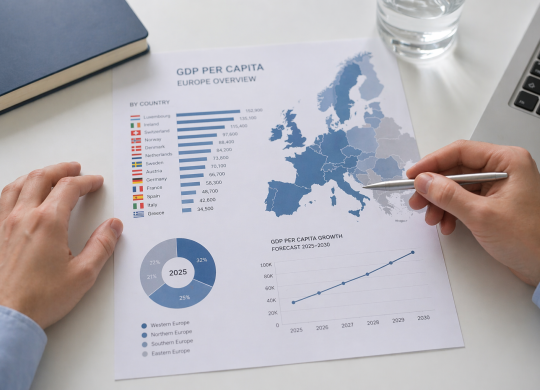
Europe's Richest Countries by 2030: Rankings, IMF Forecasts, and Income Gaps
By 2030, most European economies will be growing, but the balance of power will remain largely unchanged. The leaders will remain the same, while the gap between wealthy countries and EU candidate nations will only widen. Learn more about which European countries will become the wealthiest and what this means for living and working abroad
25 Apr. 2026
More details3 min
Popular
Countries with the Most Millionaires in 2026: Global Ranking
Over the past year, nearly 1 million new dollar millionaires have emerged worldwide, bringing their total number to 57.5 million. More than 40% of them live in just one country. Learn more about the world’s leaders in terms of the number of millionaires and the distribution of private wealth across regions
16 Jul. 2026
More details3 min
Popular
The World's Richest Countries in 2026: A New Ranking of Population Well-Being
The average wealth per adult in Switzerland exceeds €777,000, while in Eastern Europe the regional figure is about €53,000. Learn more about the world’s richest countries and the difference between average and median household income
27 Jul. 2026
More details3 min
Investment
The Best Countries to Obtain a Golden Visa in Europe in 2026
Spain has already discontinued its Golden Visa program, while other European countries are revising the terms of their investment residency programs. At the same time, there are still programs in Europe in 2026 with a minimum investment threshold of €250,000. Learn more about where else you can obtain residency through investment and what conditions apply to investors
03 Oct. 2026
More detailsAll materials and articles are owned by VisitWorld.Today and are protected by international intellectual property regulations. When using materials, approval from VisitWorld.Today is required.