

Lunar Eclipse on August 28: Where to Watch It in Europe
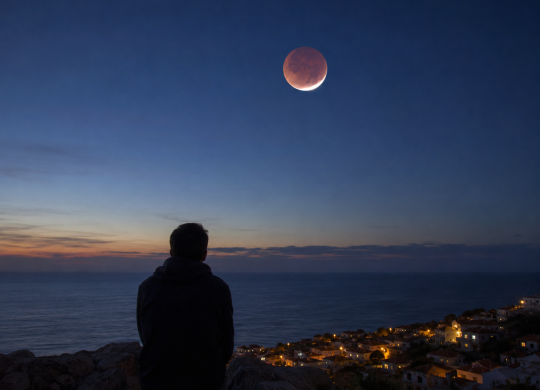
On the night of August 28, the Earth's shadow will cover more than 96% of the Moon's disk. Learn more about the timing and the best viewing locations in Europe

On the night of August 27–28, 2026, a deep partial lunar eclipse will occur in the sky. During the maximum phase at 04:13 UTC, the Earth’s shadow will cover approximately 96.3% of the Moon’s disk, so it may take on a dark red or coppery hue. In Europe, the event will coincide with dawn and the setting of the Moon, so the best viewing conditions will be in western and southwestern regions with an unobstructed horizon and clear skies.
Planning a trip abroad?
Insurance from the Visit World portal will help you avoid unnecessary risks. The policy covers the costs of medical treatment, emergency assistance, and unforeseen situations abroad, so that even in the event of delays or route changes, you remain protected and can focus on your trip rather than on problems.

What will happen in the sky on August 28?
The eclipse will begin when the full Moon enters the Earth’s penumbra and subsequently plunges almost entirely into its dark central part—the umbra. At its peak, the shadow will cover about 93% of the Moon’s diameter, or 96.3% of the visible area of the lunar disk. That is why the phenomenon is called a nearly total eclipse.
Key phases according to Coordinated Universal Time (UTC):
- 01:24 – start of the penumbral phase; changes are still barely noticeable
- 02:34 – start of the partial eclipse
- 04:13 – maximum phase
- 05:52 – end of the partial eclipse
- 07:02 – the Moon fully exits the Earth’s penumbra
At the peak, most of the Moon may turn dark red or coppery. This color is caused by sunlight passing through the Earth’s atmosphere: short blue wavelengths are scattered more strongly, while red wavelengths reach the Moon’s surface. At the same time, a small edge of the disk will remain outside the umbra, so officially the eclipse will be partial, not total.
Where in Europe is the best place to view the eclipse?
The best viewing conditions are expected in western and southwestern Europe. In these regions, the maximum phase will occur before sunrise, and the Moon will remain above the western horizon longer. However, visibility will ultimately depend on cloud cover in a specific city.
1. Spain. The eclipse will be visible throughout the country, including the Balearic and Canary Islands, Ceuta, and Melilla. The phenomenon will be observable the longest in the western regions, the Canary Islands, and Ceuta. In the central and eastern parts of the country, the Moon will set before the end of the partial phase.
2. Portugal. Thanks to its western location, the country will have some of the best viewing conditions in continental Europe. According to the latest forecast, the least cloud cover is expected in Lisbon and Amador. Residents of Braga and Coimbra will also have a good chance of seeing the eclipse.
3.Great Britain and Ireland. The maximum phase will be visible before the Moon sets. However, it will be low on the southwestern horizon, so houses, trees, and hills may obstruct the view. It’s best to choose coastal areas or high ground with an unobstructed view of the sky.
4. France. The eclipse will be visible across almost the entire country, but clouds and rain may worsen viewing conditions. The best chances are forecast for Marseille and Strasbourg. At its peak, the Moon will be only about 8° above the horizon, and the morning light will already be reducing the contrast.
5. Italy. Among major cities, Rome, Naples, and Venice have the most favorable forecasts. Conditions may be slightly worse in Bologna and Turin, while more clouds are expected over Milan and Genoa. The maximum phase will occur at dawn, when the Moon will already be low in the sky.
6. Germany. The greatest eclipse will be visible in the western regions, where the Sun rises and the Moon sets later. In the east of the country, the Moon may disappear below the horizon before the maximum phase. Therefore, it is best to choose western areas and locations with an unobstructed view of the horizon for observation.
What time should you observe the eclipse in Europe?
The time will depend on the local time zone. The faint penumbral phase will begin first, but a noticeable eclipse of the lunar disk will start approximately 70 minutes later, when the Moon enters the Earth’s dark shadow.
Spain, France, Italy, and Germany – CEST:
- 03:24 – start of the penumbral phase
- 04:34 – start of the visible partial eclipse
- 06:13 – maximum phase
- 07:52 – end of the partial phase
- 09:02 – end of the entire event
Portugal, the United Kingdom, Ireland, and the Canary Islands – WEST/BST/IST:
- 02:24 – start of the penumbral phase
- 03:34 – start of the partial eclipse
- 05:13 – maximum phase
- 06:52 – end of the partial phase
- 08:02 – Moon exits the penumbra
It will not be possible to see all of these stages in most European cities: the Moon will set before it has completely left the Earth’s shadow. The most spectacular period will last approximately from the start of the partial phase until its maximum. You should arrive at your observation site at least 20–30 minutes early to find an unobstructed view of the western or southwestern horizon.
How to prepare for observing the eclipse?
No special protective glasses are required for observation: it is safe to view a lunar eclipse with the naked eye. Binoculars or a telescope will help you see the edge of the Earth’s shadow and the color change on the Moon’s surface more clearly, but the phenomenon will be clearly visible even without them.
To make sure you don’t miss the maximum phase:
- Find a spot with an unobstructed western or southwestern horizon
- Avoid tall buildings, trees, mountains, and dense urban areas
- Check the hourly cloud forecast right before you head out
- Arrive at your location 20–30 minutes before the partial phase begins
- Use a tripod, optical zoom, and manual exposure settings for photography
It’s not necessary to travel far from the city to find a dark sky, as the full Moon is bright enough. Clear skies and an unobstructed view low on the horizon are much more important. If the weather prevents observation, you can watch the eclipse via a live online stream.
When will the next visible lunar eclipse occur?
The next lunar eclipse visible in Europe is expected on February 20–21, 2027. It will be a penumbral eclipse: the Moon will dim only slightly, so the changes will be almost imperceptible without careful observation. The partial eclipse on January 12, 2028, will also be faint—only a small edge of the Moon’s disk will enter the Earth’s dark shadow.
A much more pronounced partial eclipse will occur on July 6, 2028, when the Earth’s shadow will cover about 39% of the Moon’s diameter. And on December 31, 2028, residents of Europe will be able to see a total lunar eclipse. Its total phase will last approximately 71 minutes, making this event the next true “blood moon” following the eclipse of August 2026.
Are you preparing for a trip abroad in 2026?
Medical insurance from the Visit World portal will provide reliable support during your trip, especially in the context of flight changes and unstable schedules. The policy covers medical expenses, emergency assistance, and other unforeseen situations outside the country, so you can feel confident even when plans have to be adjusted at the last minute.
We remind you! Croatia is stepping up its fight against drunken tourists by introducing new restrictions in popular resort cities. Split became the first city in the country to introduce strict rules on alcohol sales this summer. Read more about the new bans, hefty fines for tourists, and changes in Croatia's tourism strategy.
Products from Visit World for a comfortable trip:
Travel guide for 200 countries;
Legal advice from a local specialist on visa and migration issues;
Travel insurance around the world (please select the country of interest and citizenship to receive services);
Medical insurance all over the world.
We monitor the accuracy and relevance of our information, so if you notice any errors or inconsistencies, please contact our hotline
Recommended articles
3 min
Expats
The World's Best Cities for Remote Work in 2026 Have Been Named
Seoul topped the ranking of the world’s best cities for digital nomads, while Japan claimed three spots in the top 10. Find out where high-speed internet, affordable prices, a functional infrastructure, and a comfortable lifestyle come together best
24 sie. 2026
More details3 min
Popular
Nowe zasady dla zagranicznych banków w UE od 2027 roku
Aktualizacje europejskiego prawa bankowego wpłyną na miliony mieszkańców UE, którzy korzystają z usług zagranicznych instytucji finansowych. Nowe wymagania CRD VI ustanawiają jasne ramy dla usług transgranicznych i przewidują kilka wyjątków, o których warto wiedzieć z wyprzedzeniem. Dowiedz się więcej o zasadach UE dotyczących zagranicznych banków od 2027 roku i jak wpłyną na posiadaczy kont
26 sie. 2026
More details3 min
Investment
Top 5 rynków nieruchomości do inwestycji w 2026 roku: Ceny, zwroty i ryzyka
Próg wejścia na obiecujące zagraniczne rynki nieruchomości zaczyna się od 70 000 €, a prognozowany zwrot z wynajmu osiąga 18% rocznie. Dowiedz się więcej o cenach, kosztach, zwrotach i ryzykach związanych z inwestowaniem w Hiszpanii, Turcji, Rumunii, Zanzibarze i Malediwach
28 sie. 2026
More details3 min
Travels
Tanie miejsca do odwiedzenia w Europie tej jesieni: 13 miast na wakacje poniżej 100 € dziennie
W 13 europejskich miastach zakwaterowanie, posiłki, transport i rozrywka kosztują nie więcej niż 100 € na osobę dziennie. Dowiedz się więcej o najtańszych destynacjach na jesienną podróż i wydatkach wchodzących w skład codziennego budżetu
29 sie. 2026
More detailsAll materials and articles are owned by VisitWorld.Today and are protected by international intellectual property regulations. When using materials, approval from VisitWorld.Today is required.