

Most Expensive and Cheapest EU Countries to Live In: Eurostat 2025 Rankings
Table of contents
- Where is the most expensive place to live in Europe in 2026?
- Which EU countries are the cheapest to live in?
- Housing is the largest and most uneven item of expenditure
- Food: the most stable category
- Education: the smallest category with the biggest gap
- Energy and other categories
- What is important to remember about the cost of living indicator?
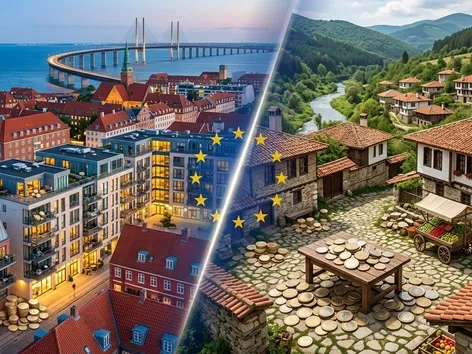
Eurostat has published data on the level of consumer prices in the 27 EU countries for 2025 - find out where it is most expensive and cheapest to live in the European Union, how much housing, food and education cost in different countries of the bloc

How much does everyday life really cost in different parts of the European Union? This is a question that worries both tourists and those considering moving or staying abroad for a long time. Eurostat regularly publishes price level indices that allow you to compare the cost of the consumer basket between countries - and the difference is striking.
According to Eurostat data, published in June 2026 based on 2025 figures, the level of prices for final household consumption in the 27 EU countries ranges from 63% to 140% of the average for the bloc. That is, the difference between the cheapest and most expensive countries is more than twice as large - and this is only within one economic union.
The most interesting data from the Eurostat rating, as well as where in Europe it is most expensive to live and where it is cheapest, are described in this article.
If you are planning a trip to Europe by car, take care of all the necessary documents in advance. An electronic toll vignette is a digital permit for toll motorways, which is mandatory in most EU countries. Without it, the driver faces a fine, even if he did not suspect that he had to pay a toll. You can quickly and conveniently apply for an e-vignette online - without queues and paper documents.

Where is the most expensive place to live in Europe in 2026?
The leader in terms of price levels is Denmark - its index is 140% of the EU average, which means that goods and services here are 40% more expensive than the European average. Ireland is in second place with an index of 136%, and Luxembourg is in third place with 132%. It is noteworthy that these three countries have traditionally held the top positions in the ranking for several years in a row. Outside the EU, it is even more expensive: Iceland, which is part of the EFTA group of countries, records the index at 174%.
Which EU countries are the cheapest to live in?
At the opposite pole is Bulgaria, where the consumer basket costs only 63% of the European average. Romania ranks second with an index of 65%, Poland third with an index of 73%. Together, these countries form a zone where the costs of everyday life are the lowest among all EU member states.
Visit World services for tourists, migrants, and expats: Insurance | Guides | Legal advice
Housing is the largest and most uneven item of expenditure
The most significant component of the household budget - housing costs - also shows the greatest variation between countries. In Ireland, this category exceeds the EU average by 90%, reaching 190% of the European average. In contrast, in Bulgaria, similar costs are only 41% of the average - almost five times less.
This gap is primarily explained by the difference in rental and maintenance costs, as well as climatic conditions that affect heating costs. The Irish property market remains one of the most expensive in Europe - a chronic housing shortage has been pushing up rental rates for years.
Read also: where is the most expensive place to buy an apartment in Europe.
Food: the most stable category
The second most important item of expenditure - food and non-alcoholic beverages - turned out to be the least volatile of all categories. Food prices in the EU vary, but not so strikingly: the highest level was recorded in Luxembourg - 122% of the European average, the lowest - in Romania, where products cost 20% less than the bloc average (80%).
Compared to 2024, when the range in this category ranged from 76% in Romania to 125% in Luxembourg, there have been no significant changes - the food market remains relatively stable even against the backdrop of general inflationary processes.
Education: the smallest category with the biggest gap
Education accounts for the smallest share of household spending at EU level, but it is the one that shows the biggest price contrasts. In Luxembourg, educational services cost 334% of the EU average – more than three times more expensive than the average. In Romania, it is only 42%, which is almost half the European benchmark.
This gap is due to different models of financing education: in some countries, private educational institutions form a significant share of the market and dictate the corresponding prices, while in others the state system covers the majority of needs.
Find out at what age Europeans buy their first home in the article at the link.
Energy and other categories
In the energy category among EU countries in 2025, Germany was the most expensive – 122% of the EU average, while Hungary was the cheapest with a figure of 39%. This significant gap reflects differences in the structure of the energy market, the level of subsidies and geographical dependence on certain sources of supply.
In 2024, total household spending at the EU level increased by 1.5% compared to 2023. The most noticeable increase was in spending on information and communication - by 5.7%, as well as on recreation, sports and culture and transport - by 3%.
In which countries does the population pay the most for electricity, why tariffs differ significantly and how the development of green energy affects prices, read our previous article.
What is important to remember about the cost of living indicator?
Price level indices do not take into account differences in income and wage levels between countries. This means that a formally “cheap” country may not be so profitable to live in if local wages are also significantly lower than the European average. At the same time, for those who receive income in euros and choose a place for a long stay or move, such comparisons become a practical guideline in budget planning.
In which European countries will there be the most vacancies in 2026, we tell you here.
Are you going to drive through several EU countries - from Poland to Austria or Luxembourg? It is worth knowing that the toll road system in each country is different, and the check for the presence of an e-vignette is carried out automatically by the vehicle's license plate. The lack of a valid document can result in a significant fine - especially in countries with strict control, such as Austria or Switzerland. That is why experienced travelers apply for an e-vignette before departure - it takes a few minutes, and it insures against troubles for hundreds of kilometers of the road
You can apply for an e-vignette for any of the countries on the route on the Visit World portal, quickly and without unnecessary stress.
Let us remind you! The European Union is getting closer to a decision on whether to end seasonal clock changes. We've already covered the stage the reform is at, when the final time changes could take place, and how the new rules will affect the lives of millions of Europeans.
Photo - generated by Gemini
Products from Visit World for a comfortable trip:
Travel guide for 200 countries;
Legal advice from a local specialist on visa and migration issues;
Travel insurance around the world (please select the country of interest and citizenship to receive services);
Medical insurance all over the world.
We monitor the accuracy and relevance of our information, so if you notice any errors or inconsistencies, please contact our hotline.
Frequantly
asked questions
Does a low price level index mean a country is good for relocation?
How often does Eurostat update price level data for EU countries?
Which spending categories have the biggest impact on the overall consumer price index?
Recommended articles
2 min
Travels
Obtaining a Schengen visa in 2026 remains an important step in preparing for a trip to Europe. Find out which Schengen countries have the highest visa refusal rates, why applicants receive negative decisions, and how to prepare documents to increase your chances of approval
12 Jun. 2026
More details2 min
Work
Finland Allows Employees to Stay Home During Drone Threats While Keeping Their Salary in 2026
Finland has updated its recommendations for employers and employees in the event of a drone threat. Find out who is allowed to stay off work, whether wages are maintained, and how the new rules will affect the labor market in 2026
14 Jun. 2026
More details2 min
Air travel
EU Updates Air Passenger Rights: Free Cabin Baggage and Flight Delay Compensation Remain
The European Union has agreed to a major update to air passenger protection rules. Find out how the rules for carrying hand luggage, compensation for flight delays and booking conditions will change
17 Jun. 2026
More details2 min
Blog
Child benefits in Europe in 2026 vary significantly by country, from one-off birth benefits to monthly income support. Find out what amounts are available in France, Poland, the Czech Republic, Germany, Ireland and the Netherlands and what conditions must be met to receive them
20 Jun. 2026
More detailsAll materials and articles are owned by VisitWorld.Today and are protected by international intellectual property regulations. When using materials, approval from VisitWorld.Today is required.