

At What Age Do Europeans Buy Their First Home: New RE/MAX Study

For many people, buying their own home is one of the most important financial milestones. However, the age at which Europeans first become homeowners varies significantly from country to country. Find out where Europeans buy property the earliest and why, in some countries, this step is postponed until nearly age 35

Homeownership remains one of the main financial goals for millions of Europeans. However, rising real estate prices, the high cost of living, and the difficulty of saving for a down payment are increasingly affecting when people can afford to buy an apartment or a house.
A new study, the RE/MAX European Housing Trend Report, found that the average age for purchasing a first home in Europe is 31.3 years. At the same time, the difference between individual countries reaches nearly seven years, reflecting significant variations across European real estate markets.
In the previous article, we reported on the most expensive cities in the world to live in in 2026, according to Numbeo.
Are you planning to buy real estate abroad? Before concluding a deal, it is important to consider not only the price per square meter, but also tax liabilities, restrictions for foreigners, title checks, and additional costs. Visit World's real estate lawyers will help you analyze the property, assess legal risks, and accompany you at all stages of the transaction: from the initial consultation to the signing of the contract. Get professional support and confidence in every step.

At what age do Europeans buy their first home?
The age at which a person becomes a homeowner for the first time often depends not only on personal income but also on the overall situation in the real estate market. Mortgage availability, apartment prices, wage levels, and government support programs can significantly influence how quickly young people can afford their own home.
According to the RE/MAX European Housing Trend Report 2025, the average age for purchasing a first home across 23 European countries is 31.3 years. At the same time, there are significant differences between individual countries: in the leading countries, people buy property before the age of 29, while in the lagging countries, this figure approaches 35 years.

Average age of first-time homebuyers in European countries. Source: RE/MAX European Housing Trend Report 2025, Euronews.
Top 10 countries where people buy their first home the earliest:
1. Malta – 28.0 years
2. United Kingdom – 28.4 years
3. Luxembourg – 28.4 years
4. Hungary – 28.5 years
5. Netherlands – 28.8 years
6. Austria – 29.1 years
7. Portugal – 29.8 years
8. Finland – 29.9 years
9. Romania – 30.5 years
10. Lithuania – 30.6 years
At the opposite end of the ranking are Switzerland and Greece, where the average age for the first home purchase is 34.7 years. Countries with the highest figures also include Turkey (34.1 years), Germany (33.6 years), and the Czech Republic (33.2 years).
The difference between the top and bottom of the ranking is nearly seven years. This indicates that the ability to purchase a home depends largely on a country’s economic conditions, access to credit, and real estate prices.
In our previous article, we reported that Spain has been named the best country for real estate investment in Europe for the first time.
In which European countries do people buy their first home the earliest?
The study’s findings show that the lowest average age for a first home purchase is primarily found in countries where young people have relatively better access to mortgage financing or can count on family support when buying a home. At the same time, even among the top-ranked countries, the reasons for early homeownership vary.
Malta topped the ranking
Malta is the country where people buy their first home the earliest—at an average age of 28. Experts attribute this to the high proportion of homeowners in the country, a compact housing market, and various support programs for first-time homebuyers.
In addition, for many Maltese, buying their own home remains one of life’s top priorities, which encourages young people to start saving early in their careers.
United Kingdom and Luxembourg
In the United Kingdom and Luxembourg, the average age for a first-time home purchase is 28.4 years. Despite high real estate prices, young buyers actively use mortgage programs and special financial instruments to cover the down payment.
At the same time, there is a significant difference in these countries between metropolitan areas and smaller cities. While buying a home in London or Luxembourg is extremely difficult due to high prices, conditions for buyers in other regions are often much more affordable.
The Netherlands and Hungary
The group of countries with the lowest average age for first-time homebuyers also includes Hungary (28.5 years) and the Netherlands (28.8 years).
In Hungary, government programs supporting families and young homebuyers play an important role. In the Netherlands, the situation is somewhat different: despite a housing shortage and high prices, a well-developed mortgage market allows many young people to enter the real estate market earlier.
Overall, the countries at the top of the ranking share one common feature: young people there have more opportunities to finance a home purchase than their peers in many other European countries.
In our previous article, we discussed where apartment prices are rising the fastest, how much housing costs in different cities across Hungary, and what to expect from the market.
Why do people in some countries buy their first apartment only after age 34?
While in some European countries young people become homeowners before the age of 30, in others this process can be delayed for many years. Most often, the reason is a combination of high real estate prices, expensive loans, and significant living expenses, which make it difficult to save up for a down payment.
Switzerland: One of the Most Expensive Countries to Buy a Home
Switzerland ranked last in the survey alongside Greece—the average age for a first-time home purchase here is 34.7 years.
One of the main reasons is the extremely high real estate prices. In addition, the country has one of the lowest home ownership rates in Europe. Many Swiss people rent apartments for years, as this is often more cost-effective and simpler than buying their own property.
Greece: The Consequences of Economic Hardship
Although housing prices in Greece are lower than in many Western European countries, the average age at first home purchase is also 34.7 years.
Experts attribute this to the effects of the prolonged economic crisis, which has impacted household incomes and young people’s ability to save money. An additional factor has been the rapid rise in real estate prices in the country’s popular tourist regions in recent years.
Germany, the Czech Republic, and Turkey
Among the countries where people also buy their first home relatively late are Turkey (age 34.1), Germany (age 33.6), and the Czech Republic (age 33.2).
In Germany, the culture of long-term renting plays an important role. Many families rent for years and do not consider buying an apartment a necessary life goal. In the Czech Republic and Turkey, the decision to purchase real estate has been significantly influenced by the rapid rise in housing prices and the increasing cost of borrowing.
The study shows that a country’s high level of economic development does not always mean early homeownership. In many cases, the decisive factors are mortgage accessibility, the structure of the real estate market, and the population’s housing habits.
In our previous article, we discussed what to look for before buying an apartment in Poland and how to avoid common mistakes.
What trends are shaping the housing market in Europe?
The age at which people buy their first home depends not only on household income or the cost of apartments. The decision to purchase real estate is increasingly influenced by the economic and social changes observed in most European countries. These changes explain why, for many young people, home ownership becomes achievable much later than it was for previous generations.
Rising real estate prices outpace income growth
In recent years, housing costs in many European countries have risen faster than wages. As a result, even middle-income earners are forced to save longer for a down payment or look for housing in more remote regions.
This trend has become particularly noticeable in large cities, where demand for housing remains high due to the concentration of jobs, universities, and businesses.
Young people are staying in rental housing longer
Due to high real estate prices, many Europeans are renting for increasingly longer periods. For some young people, renting has become not a temporary phase but a long-term alternative to buying an apartment.
This practice is particularly common in Germany, Switzerland, Austria, and some Scandinavian countries, where the rental market is well-developed and provides a high level of tenant protection.
We previously covered the most expensive EU capitals for renting in 2026.
Stricter Mortgage Lending Requirements
Following periods of high inflation and rising interest rates, banks in many countries have begun to assess borrowers’ creditworthiness more carefully. As a result, buyers must save up a larger down payment and demonstrate a stable income.
For young professionals just starting their careers, this often becomes an additional barrier to buying their own home.
Changing Life Priorities
Experts also note the influence of social factors. Today’s young people are more likely to postpone starting a family, having children, and buying a home until later in life. Many people initially seek to complete their education, build a career, or gain life experience in different cities and countries.
As a result, the average age of first-time homebuyers in Europe is gradually rising, and home ownership is increasingly becoming a goal that people pursue only after achieving professional and financial stability.
Buying a home in another country is not only an investment but also a serious legal procedure. Mistakes in documents, unaccounted taxes or restrictions for foreigners can lead to financial losses. Consultation with a real estate lawyer from Visit World will help you to safely complete the transaction, check the seller and avoid hidden risks. Contact the experts to make your real estate purchase abroad as transparent and secure as possible.
We remind you! The Cypriot parliament is considering draft laws that could significantly change the conditions for buying real estate for citizens of countries outside the European Union. The initiatives include quantitative limits on properties, geographical bans and transparency requirements for transactions. Read more about the proposed restrictions, foreign purchases statistics and how to prepare for possible changes in the Cyprus real estate market.
Products from Visit World for a comfortable trip:
Travel guide for 200 countries;
Legal advice from a local specialist on visa and migration issues;
Travel insurance around the world (please select the country of interest and citizenship to receive services);
Medical insurance all over the world.
We monitor the accuracy and relevance of our information, so if you notice any errors or inconsistencies, please contact our hotline.
Frequantly
asked questions
At what age do Europeans most often buy their first home?
In which European countries do people buy their first home the earliest?
Why are young Europeans delaying home purchases?
Can foreigners buy a home in Europe?
What should you consider before buying real estate abroad?
Recommended articles
3 min
Investment
Spain has topped the ranking of Europe’s most attractive countries for real estate investment for the first time. Investment volumes have already exceeded €18.4 billion, and demand continues to grow amid a housing shortage and economic stability. Learn more about why investors are flocking to Spain in 2026
16 Apr. 2026
More details3 min
Popular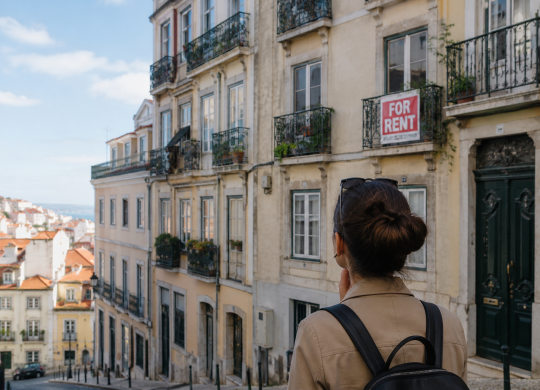
Most expensive EU capitals for renting housing in 2026: where it is hardest to rent an apartment
In many EU capitals, rental prices reached record highs in 2026, and in some cities, the minimum wage is no longer enough to cover rent. The situation is worst in Prague, Lisbon, and Dublin, where the housing crisis continues to worsen. Learn more about Europe’s most expensive capitals for renting, current prices, and the reasons behind the rapid rise in apartment costs
12 May. 2026
More details2 min
Popular
Best Housing Rental Platforms in Europe in 2026: Where to Find an Apartment Without an Agent
Finding a place to live in a new country is often one of the most challenging parts of moving or taking a long trip. Today, dozens of online platforms let you rent an apartment, a room, or a house remotely before you even arrive in the country. Learn more about the best services for renting housing in Europe and what makes them unique
05 Jun. 2026
More details2 min
Travels
Cheapest European Cities for a Weekend Getaway in 2026: Where to Travel on a Budget
European cities continue to compete for tourists, but the cost of a vacation there varies significantly. A new ranking has identified destinations where you can enjoy a fun-filled weekend without breaking the bank. Learn more about the most affordable European cities to visit in 2026
07 Jun. 2026
More detailsAll materials and articles are owned by VisitWorld.Today and are protected by international intellectual property regulations. When using materials, approval from VisitWorld.Today is required.