

7 Countries That Still Don't Share Your Financial Data in 2026: Residency and Citizenship by Investment
Table of contents
- USA: the world's biggest "financial secret" - by design
- Egypt: Citizenship by Investment without Residency Requirements
- El Salvador: zero tax on foreign income and a passport for bitcoin
- Serbia: Affordable Entry Through Real Estate or Business
- Philippines: A large economy without automatic exchange
- Cambodia: Second ‘direct’ citizenship on the list – and new, higher thresholds for 2026
- Paraguay: the newest and cheapest program – but also the least “reliable” status
- What is really worth taking away from this?

The automatic exchange of financial information (CRS) has now reached 116 countries around the world, but several jurisdictions are still outside the system. Find out which countries do not automatically share account information and how to get a residence permit or citizenship by investment there in 2026

Twenty years ago, the question "where to open an account so that no one finds out about it" had dozens of answers. Today, there are only a few. The automatic exchange of financial information, which the OECD launched in 2014 under the name CRS (Common Reporting Standard), has engulfed almost the entire world: according to OECD data, by 2026, the system will include 116 jurisdictions, which annually transfer data on more than 171 million accounts and almost 13 trillion euros in assets. During this time, more than 135 billion euros in unpaid taxes have been returned to the budgets thanks to the exchange.
The mechanism works quietly and without unnecessary formalities: a bank in country A automatically sends information about the account holder, who is a tax resident of country B, to the tax office of country B every year. Name, address, tax number, account balance, accrued interest, dividends, proceeds from the sale of assets - all this goes without requests, without court orders and without the knowledge of the account holder himself. In the past two years, Thailand, Kenya, Uganda, Moldova, Ukraine and Armenia have joined the network - gaps that privacy-conscious investors had recently counted on have been closed one by one.
And yet, even in 2026, there remains a small group of countries where automatic exchange has not yet reached, IMI experts say. The reasons are different: some have deliberately chosen their own path, others simply never received an "invitation" from the OECD, and still others are delaying, and it seems that they are doing it for no reason. Let me make a caveat right away: this is not an instruction on how to hide money from the tax authorities. The lack of automatic exchange does not cancel tax obligations in the country of your tax residency, and "not reporting" is not at all the same as "invisible". It is rather about legal tools for asset diversification, changes in tax residency and investment migration - about which countries combine non-CRS status with real programs for obtaining a residence permit or citizenship.
Find the seven jurisdictions that are best suited for starting a business in 2026 at the link.
Are you planning an investment migration or opening an account in another jurisdiction? Such decisions always have tax, corporate and migration consequences, which are better to calculate in advance, and not after submitting documents.
A personal business lawyer from Visit World will help you understand taxation, support the registration of structures abroad and assess the risks specifically for your case. This is a specialist who works with both local and international business issues - from tax planning to company relocation.
Contact us for a consultation today so that your investment decision does not turn into legal problems tomorrow.

USA: the world's biggest "financial secret" - by design
The United States has never signed the CRS. Instead, it introduced its own law in the 2010s - FATCA, which requires foreign banks to report to the US Internal Revenue Service about US citizens' accounts abroad. The asymmetry here is obvious: the US collects data on its taxpayers around the world, but does not share information about foreigners who hold money in US banks in return, as CRS participants do. As a result, the banking business of non-residents in the US is effectively left out of the automatic exchange - which is why, by some estimates, the US, and not some island offshore, is the world's largest financial secrecy jurisdiction for non-residents. There is currently no sign that Washington will join the CRS: FATCA has served as a political alternative to the multilateral agreement for years.
For those who consider the US not only as a financial but also as an immigration destination, there is the EB-5 program - an investor green card in exchange for investing in a commercial enterprise that creates at least ten jobs. The standard threshold is $1 million, for projects in targeted employment areas with high unemployment - from $800,000. This is a path to permanent residence, not citizenship directly, but the green card opens up standard naturalization after five years.
The US is preparing a major update to the rules of the EB-5 investment visa program, read here.
Visit World services for tourists, migrants, and expats: Insurance | Guides | Legal advice
Egypt: Citizenship by Investment without Residency Requirements
Egypt is on the list of developing countries that the OECD has “not asked” to set a start date for the exchange – the status is more administrative than principled, and could theoretically change if the organization’s position on the region changes. So far, information about Egyptian bank accounts is not automatically transferred anywhere.
Egypt’s main advantage on this list is that it is one of two directions where you can get not just a residence permit, but full citizenship directly. The citizenship by investment program, which has been in effect since 2019, offers four options to choose from: a non-refundable contribution of $250,000 to the state treasury, the purchase of real estate for $300,000 with retention of ownership for five years, an investment in a business for $350,000 along with a donation of $100,000, or a bank deposit of $500,000 with a return after three years. Any option comes with a $10,000 state fee, and there are no requirements for actual residence in the country at all.
El Salvador: zero tax on foreign income and a passport for bitcoin
El Salvador is simultaneously absent from both the list of CRS participants and the list of countries with a FATCA agreement with the US – a rare combination that makes the country one of the most closed to automatic exchange jurisdictions in the Western Hemisphere. This is reinforced by the decision in 2024 to completely exempt any income from foreign sources from taxation.
The flagship program here is the Freedom Visa/Freedom Passport: citizenship in exchange for an investment of $1 million in bitcoins or US dollars. The entry threshold is high and effectively cuts off the mass investor, but it is one of the few options in the world where citizenship is granted quickly and directly to those who are willing to invest such funds.
Serbia: Affordable Entry Through Real Estate or Business
Serbia is also on the list of countries that the OECD “did not ask” to set an exchange date. But the context is important here: Serbia is a candidate for EU accession, and candidate countries usually align their tax policies with European transparency standards over time. Therefore, Serbia’s “non-participation” should be seen as a temporary step on the path to accession rather than a permanent characteristic.
Serbia’s investment visa is one of the most affordable entry formats in Europe. The real estate route does not have a fixed minimum threshold: you can purchase residential or commercial real estate in any region of the country for any amount and receive a temporary residence permit for 30–60 days. In parallel, there is a route through company registration – approximately 50 thousand euros in a Serbian bank account. Residence under any of these options can turn into permanent residence after three years, and after another three – into citizenship. An added bonus for those looking further: Serbia has an E-2 agreement with the US, which opens a separate path to US residency for Serbian citizens.
Read also who can obtain non-dom status in Greece, what investments are required for this, and how to combine the regime with the "Golden Visa".
Philippines: A large economy without automatic exchange
The Philippines is one of the largest markets on this list, and that’s because it’s not reporting because it operates as a micro-offshore, but because the OECD has yet to set a date for it to start exchanging within the developing country category.
The Special Resident Investor Visa (SIRV) grants perpetual, renewable residency in exchange for an investment of $75,000 or more in securities listed on the Philippine Stock Exchange or in a local business that meets the program’s requirements. There’s also a separate visa for foreign investors with a broader list of eligible assets. Physical presence in the country is not required for either option – the visa remains valid as long as the investment is maintained.
Read here how the FIV investor visa works in 2026.
Cambodia: Second ‘direct’ citizenship on the list – and new, higher thresholds for 2026
Cambodia is also on the OECD’s list of ‘non-invited’ jurisdictions with no set exchange date and has long been on the advisory lists of banks that do not disclose information, although opening an account there is becoming increasingly difficult due to the general tightening of compliance requirements around the world.
This is the second country on the list where citizenship can be obtained directly, rather than just a residence permit. The 1996 Citizenship Law allows qualified investors and donors to obtain a passport without the standard residency and Khmer language requirements. At the end of 2025, the thresholds were significantly increased: now it is either $1 million in an approved industry project or $3 million in direct contributions to the state budget. Instead, citizenship is usually obtained in about six months, without prior residence in the country, and Cambodia allows dual citizenship.
Paraguay: the newest and cheapest program – but also the least “reliable” status
Paraguay stands out a bit here. Formally, it is not on the list of “uninvited” OECD countries, but in fact, information about Paraguayan accounts is not automatically transferred anywhere yet. According to data for 2026, Paraguay has already given preliminary consent to join the CRS, with an estimated start of exchange in the 2026–2027 cycle, and currently operates only in the exchange mode on request – that is, data is transferred exclusively for specific, legally justified criminal or tax investigations. This is the least stable status of the entire list: the OECD directly calls Paraguay a “jurisdiction of interest” for the future implementation of the standard.
In April 2026, the Investor Pass – a program that immediately grants permanent residence, without an intermediate stage of temporary status – was launched in the country. There are three ways: $150,000 in an approved tourism project or $200,000 in real estate or securities on the Asuncion Stock Exchange. In parallel, the older SUACE program continues to operate, requiring about $70,000 in investment in a business that creates local jobs. Not only is the entry threshold low, but also the territorial tax system that does not tax foreign income, as well as one of the shortest paths to citizenship in the hemisphere – just three years.
Paraguay Investor Pass 2026: how to get a PMP through investment in Paraguay, read the link.
What is really worth taking away from this?
Of the seven countries on this list, four give a passport, not just a residence permit: full-fledged citizenship-by-investment programs operate in Egypt, Cambodia, and (partly) El Salvador through an accelerated procedure.
But here lies the main nuance that is often overlooked. CRS reports based on where you are tax resident, not where you have an account. That is, obtaining a residence permit in Serbia or the Philippines while remaining tax resident in a CRS member country does not change much in itself: banks abroad will continue to report to where you officially pay taxes. Only jurisdictions that combine non-exchange status with a territorial or zero-taxation system really “break” this chain – which is why Paraguay and El Salvador have attracted disproportionate attention, despite all the reservations about the stability of their status.
It is also worth remembering about the new factor of 2026 – CARF, a crypto-asset reporting framework, which has been in operation since January 1 and is gradually covering more and more jurisdictions: the first wave has already affected 48 countries, the second is planned for 2028. A country can simultaneously be outside the CRS, but already participate in the CARF for cryptocurrencies - so for those who operate in digital assets, these two statuses should be checked separately.
Let us emphasize once again: none of the above is tax advice and is not a way to evade declaration obligations. The legal use of these jurisdictions is asset diversification, geographical hedging of risks and legal tax planning, coordinated with a real change of tax residency. And any change of this magnitude is, first of all, a legally correct structure, and not just an account opened in another country.
The ranking of the best countries for real estate investment in 2026 is here.
Each of the programs described in this article – whether it’s EB-5 in the US, citizenship by investment in Egypt, or Investor Pass in Paraguay – is not only about the amount of the investment, but also about the correctly built legal and tax structure around it. A mistake at the stage of business registration, choosing a taxation system, or drawing up notarial documents can cost much more than the investment itself.
A personal business lawyer from Visit World accompanies this entire process: from company registration and document management to minimizing tax risks and relocating the business abroad. If there is one among the options in the article that interests you, start by consulting a lawyer, not by transferring funds.
Let us remind you! Opening a company abroad in 2026 means simultaneously entering a new market, optimizing taxation and opening the way to residency or citizenship. We have already told you which countries offer the most favorable conditions for business registration, the lowest corporate tax rates and real programs for investors - from Latvia and Hungary to the Caribbean islands and Vanuatu.
Photo – generated by Gemini
Products from Visit World for a comfortable trip:
Travel guide for 200 countries;
Legal advice from a local specialist on visa and migration issues;
Travel insurance around the world (please select the country of interest and citizenship to receive services);
Medical insurance all over the world.
We monitor the accuracy and relevance of our information, so if you notice any errors or inconsistencies, please contact our hotline.
Frequantly
asked questions
Is it legal to hold a bank account in a non-CRS country?
What is the difference between CRS and the new CARF standard?
Can I obtain citizenship by investment and still keep my Ukrainian citizenship?
Recommended articles
2 min
Investment
The Iranian strikes on Dubai in 2026 have shattered the city's reputation as a safe haven for big money. Find out where wealth is moving, what alternatives wealthy expats are choosing, and what a reliable "Plan B" really takes
28 Jun. 2026
More details2 min
Investment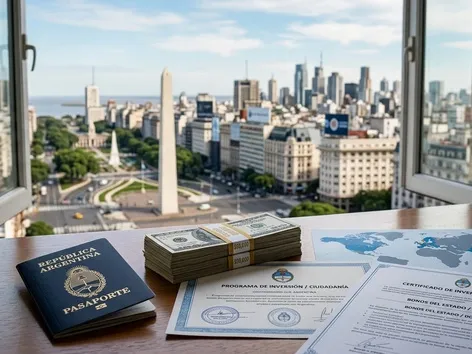
Argentine Citizenship by Investment 2026: Conditions, Cost, Risks
Argentina launches citizenship by investment program with a non-refundable deposit of $500,000. Find out what the government is offering, how much a passport costs, and how this scheme differs from its counterparts in Europe and New Zealand
01 Jul. 2026
More details3 min
Investment
Over the past five years, Portugal has welcomed 725 new ultra-high-net-worth residents, and the number of people with a net worth of over €25 million has grown by nearly 50%. Experts attribute this trend not only to the pleasant climate and high quality of life, but also to the active development of the real estate market, the influx of international capital, and the sale of local companies to major investors. Find out why Portugal has become one of the most attractive destinations for the world’s wealthiest individuals
30 Jun. 2026
More details2 min
Investment
The Estonian government has adopted a decision that will change the real estate market for foreign buyers from certain countries. The new rules will affect both individuals and companies with specific ownership structures, and will also determine the fate of properties that have already been purchased. Learn more about Estonia’s new bill, the groups of people subject to the restrictions, and the reasons for imposing the ban
07 Jul. 2026
More detailsAll materials and articles are owned by VisitWorld.Today and are protected by international intellectual property regulations. When using materials, approval from VisitWorld.Today is required.