

New Individual Tax Programme Residency Rules in Malta 2027: What Foreigners Need to Know?
Table of contents
- What exactly unites the new tax residency program in Malta?
- How much does it cost to participate in the Malta tax program now?
- How to apply under the new tax residency rules of Malta?
- What will happen to those who have already received the status of tax resident of Malta?
- Why is the tax reform important for those planning to move to Malta?
Malta is completely revamping its tax residency system for foreigners from 2027. Find out what thresholds, fees and categories of applicants will apply under the new Individual Tax Programme and what will happen to those who have already obtained status under the old rules

For years, Malta has remained one of the most convenient European havens for those looking for moderate taxation along with the English language, EU membership, and a stable financial system. From January 1, 2027, this model will change: instead of several parallel regimes, a single tax residency of Malta in the format of the Individual Tax Programme (ITP) will come into effect, and applications under the old rules will be completely stopped.
Read also, zero income OSVČ in the Czech Republic: which contributions remain mandatory in 2026.
Are you planning to move, open a business abroad, or simply want to understand the new tax or migration legislation - finding out the details on your own can be difficult.
A personal lawyer for business will help you understand the issues of company registration, document management, reporting, and minimizing tax risks. A specialist accompanies clients at any stage - from the first consultation to resolving disputes with counterparties or government officials.
This is a convenient way to get a clear legal view of the situation without spending weeks searching for information on your own. Learn more about the service and contact a lawyer at Visit World.

What exactly unites the new tax residency program in Malta?
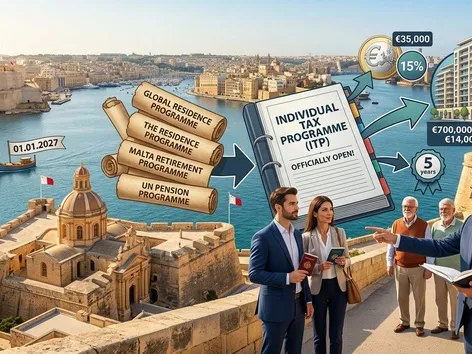
Previously, foreigners could choose one of four regimes depending on their status - Global Residence Programme, The Residence Programme, Malta Retirement Programme or the UN pension program. Each had its own requirements, fees and minimum tax payments, which complicated the choice and administration. The new Individual Tax Programme combines all four areas into a single legislative framework, dividing applicants into four categories: global residents (Global Residents), residents from the EU, EEA or Switzerland, pensioners and UN pensioners.
It is important to understand: despite the unification, access to the program is also maintained for EU citizens - a separate category with its own conditions is provided for them, rather than a complete exclusion from the system.
The basic principle of taxation remains recognizable. Foreign income that a participant in the program transfers to Malta is taxed at a flat rate of 15% instead of a progressive scale of up to 35%. Income left outside the country is not subject to this rate.
Visit World services for tourists, migrants, and expats: Insurance | Guides | Legal advice
How much does it cost to participate in the Malta tax program now?
The main noticeable change is the financial threshold for entry.
- The minimum annual tax for the category of world residents and applicants from the EU, EEA and Switzerland will increase to 35 thousand euros per year.
- For pensioners, the minimum payment is set at 15 thousand euros, and for UN pensioners - 20 thousand euros.
This is significantly higher than the current conditions, where most applicants paid from 7.5 to 15 thousand euros depending on the program.
The administrative fees for submitting an application have also increased - from 6 thousand euros (GRP/TRP) and 2.5 thousand euros (MRP) to a single rate of 8.5 thousand euros for any category. The special tax status will now be issued for five years with the possibility of extension for subsequent five-year periods for an additional administrative fee of 2.5 thousand euros - previously the status did not have a clear validity period.
The requirements for real estate are also changing: the threshold for purchasing housing has risen to 700 thousand euros, and for renting - to 14 thousand euros per year. At the same time, the authorities announced a more detailed check of the origin of capital and sources of income of applicants.
Countries with low taxes in 2026: where it is profitable for foreigners to register a business and conduct activities read here.
How to apply under the new tax residency rules of Malta?
Submitting documents on your own will no longer work. All applications for the Individual Tax Programme will be accepted exclusively through licensed representatives accredited by the Maltese authorities (Authorised Registered Mandatory). This brings the Maltese procedure closer to the practice of other European jurisdictions with similar regimes, where the preparation of the application always goes through an authorised firm or lawyer.
For businessmen considering relocation with a company, this means another level of preparation: in parallel with the tax status, it is worth considering in advance the legal structure of the business itself, document flow and the issue of taxation of corporate income separately from personal income.
Read also who can obtain non-dom status in Greece, what investments are required for this and how to combine the regime with the “Golden Visa”.
What will happen to those who have already received the status of tax resident of Malta?
The reform does not retroactively affect those who already use the current programs. If the special tax status is granted before December 31, 2026, the applicant continues to work under the old conditions until December 31, 2031 - provided that the requirements of the relevant program are met. This gives time to both those who have already submitted documents and those who want to catch up on more favorable conditions by the end of 2026.
New tax relief rules for foreign professionals in the Netherlands at the link.
Why is the tax reform important for those planning to move to Malta?
The reform shows a pan-European trend: countries with attractive tax regimes are gradually raising the entry threshold, focusing on a less mass, but more financially stable audience. For potential applicants, this means that the decision to move should be made with a clear calculation of the costs up front – fees, minimum tax and property value together amount to a sum that is significantly different from the conditions that were in force a few years ago.
Malta’s tax residency reform is an example of how quickly conditions can change for businesses and individuals planning to relocate abroad. New financial thresholds, mandatory work through licensed representatives and clear transitional periods mean that the decision to move should only be made after a detailed legal analysis of the specific situation.
A personal business lawyer will help you assess which organizational and legal form and taxation system will suit your company, will accompany the process of relocating your business abroad and will take on the processing of a work visa or the remote launch of a representative office. The specialist is also responsible for minimizing tax risks and supporting notarial services, freeing you from the need to understand the bureaucratic intricacies yourself. If you are considering Malta or any other jurisdiction for business development, consulting with a personal lawyer is the first step to a confident and safe decision. View the details of the service and contact a lawyer.
Reminder! Switzerland has topped the Henley & Partners ranking of the most reliable countries for capital preservation for the second time in a row. We have already told you which countries made it to the top 10, why the USA ended up only in 24th place and how the positions changed in the spring update of the index.
Photo - generated by Gemini
Products from Visit World for a comfortable trip:
Travel guide for 200 countries;
Legal advice from a local specialist on visa and migration issues;
Travel insurance around the world (please select the country of interest and citizenship to receive services);
Medical insurance all over the world.
We monitor the accuracy and relevance of our information, so if you notice any errors or inconsistencies, please contact our hotline.
Frequantly
asked questions
Can you remain a tax resident of another country after obtaining Individual Tax Programme status?
How does taxation under the special status differ from ordinary tax residency in Malta?
What happens if a programme participant no longer meets the property or minimum tax requirements?
Recommended articles
2 min
Investment
15 Crypto Tax Havens in 2026: Legal Ways to Minimize Your Crypto Taxes
Crypto investors around the world are looking for legal ways to reduce their tax burden. Find out which 15 countries will offer zero or minimal tax on cryptocurrency in 2026, how to get residency there, and which jurisdictions to avoid
31 May. 2026
More details2 min
Investment
New York Pied-à-Terre Tax 2026: Who Pays the Luxury Second Home Surcharge and How Much
New York has introduced an annual levy on luxury second homes – the pied-à-terre tax will take effect on July 1, 2026. Find out which properties are subject to the new surcharge, what rates are set for apartments and houses, who is exempt from paying, and how this norm fits into the nationwide American trend of taxing empty luxury homes
04 Jun. 2026
More details3 min
Investment
Tax Holidays in Turkey 2026: 20-Year Tax Exemption and Real Estate Investments in Istanbul
Turkey has introduced one of the world’s longest-running special tax regimes for foreign investors, offering a 20-year tax exemption on foreign income. At the same time, the Istanbul real estate market remains the primary focus for participants in Turkey’s citizenship-by-investment program. Learn more about the terms of the new tax regime, investment options, and the features of serviced apartments in Istanbul
12 Jul. 2026
More details2 min
Travels
Vienna Has Raised Its Tourist Tax: How Much Will You Have to Pay in 2026?
Staying in Vienna has become more expensive: the city has raised the tourist tax and plans to increase it again in 2027. Learn more about the new rates, how the tax is calculated, and additional costs when booking a hotel
20 Jul. 2026
More detailsAll materials and articles are owned by VisitWorld.Today and are protected by international intellectual property regulations. When using materials, approval from VisitWorld.Today is required.