

Greece Will Open 126 Tourist Attractions for Free: What to See on August 28
Table of contents
- Why will Greece’s landmarks be open for free on August 28?
- Which famous Greek landmarks will be open at night?
- Delphi and Ancient Olympia: Top Destinations for Tourists
- What will be available in Athens and at the Acropolis Museum?
- Unusual Places Worth Seeing During a Full Moon
- Concerts, opera, and night tours: what else is on the agenda
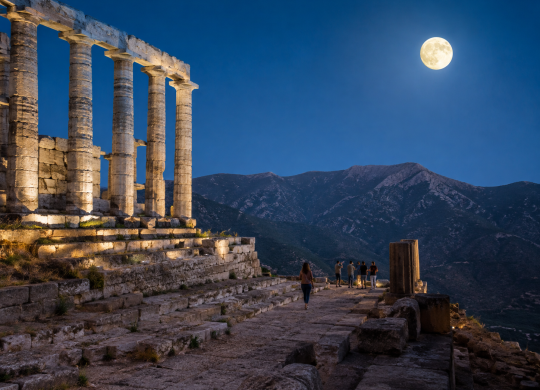
In late August, tourists in Greece will have a rare opportunity to see ancient temples, archaeological sites, and museums after sunset—and for free. On August 28, 2026, 126 historic sites across the country will open to the public to celebrate the August full moon, and many locations will host concerts, guided tours, and cultural events. Here’s where to go and what you need to know before your visit

It’s not every day that you get to see Delphi, Ancient Olympia, or the Minoan palaces bathed in the light of a full moon. On Friday, August 28, 2026, Greece will hold its traditional cultural event to celebrate the August full moon: after dark, 126 archaeological sites, museums, and monuments across the country will open to visitors. Admission to many of them will be free, and the most famous sites will be open from approximately 7:30–8:00 p.m. until midnight.
This isn’t just an opportunity to save on admission fees. Some of these historic sites are not usually open to tourists at such late hours, so this August event offers a completely different way to experience ancient Greece: without the midday heat, in the evening light, and against the backdrop of a full moon. In addition, musical performances, choral concerts, opera, and special guided tours led by archaeologists are scheduled at select sites.
Participants in the program include Delphi, Ancient Olympia, medieval Mistra, the sanctuaries of Dodona and Acheron, the archaeological sites of Crete, and other lesser-known places that may be reason enough to alter your itinerary while traveling through Greece. However, the terms and hours for free admission vary by location, so travelers should check the schedule for their chosen site in advance.
Are you planning a trip and looking for reliable insurance for an extended stay in Greece?
A medical insurance policy from the Visit World portal covers medical expenses in Schengen Zone countries and can be purchased online in just a few minutes.

Why will Greece’s landmarks be open for free on August 28?
The free opening of museums and archaeological sites is part of the traditional celebration of the August full moon, which the Greek Ministry of Culture has been organizing for the 27th consecutive year. In 2026, the main night of the event falls on Friday, August 28.
A total of 126 archaeological sites, historical locations, museums, and monuments throughout Greece will participate in the event. A special cultural program is planned at 61 locations, while another 65 sites will simply remain open for free visits in the evening. The approximate hours for most sites are from 7:30–8:00 p.m. to 11:00 p.m.–midnight, though exact times depend on the specific location.
The program will not be limited to just one night. Some of the concerts, theater performances, dance shows, exhibitions, and guided tours will also take place on August 26, 27, 29, and 30. The events are organized by the regional offices of the Ministry of Culture in collaboration with local authorities and cultural organizations.
This is a particularly exciting opportunity for tourists: many archaeological sites close earlier than usual, so seeing them after sunset and during the full moon is only possible as part of these special events. At the same time, it’s worth checking the schedule for your chosen site before your trip—opening hours, event formats, and admission requirements may vary, and the Ministry of Culture notes that the schedule is subject to change.
Read this article to learn about Greece’s little-known islands in 2026, where you can find an authentic vacation away from the crowds.
Which famous Greek landmarks will be open at night?
Among the 126 sites joining the program on August 28 are both world-famous archaeological complexes and less touristy locations. Some of them will be open to the public for free until midnight, while concerts, guided tours, and other events are scheduled at select venues.
Among the most interesting places:
1. Delphi—an archaeological complex on the slopes of Mount Parnassus, where the famous Sanctuary of Apollo and the Delphic Oracle were located in antiquity. On August 28, access to part of the complex—specifically the terrace of the Temple of Apollo—will be free from approximately 7:30–8:00 p.m. until midnight.
2. Ancient Olympia—the birthplace of the ancient Olympic Games. Both the archaeological site and the museum will be open free of charge, and guided tours with archaeologists are also planned for visitors.
3. Mystra—a medieval city near Sparta, listed as a UNESCO World Heritage Site. The archaeological complex will be open from approximately 8:00 p.m. to midnight, and the evening program will feature a musical performance.
4. Dodona—one of the oldest oracles of Ancient Greece in Epirus, known for its large ancient theater and the sanctuary of Zeus.
5. Necromantion of Acheron—an archaeological site traditionally associated with ancient beliefs about the entrance to the underworld.
6. Malia on Crete—one of the island’s major Minoan palace complexes. In 2025, the Minoan palace centers of Crete, including Malia, were inscribed on the UNESCO World Heritage List.
7. Ancient Gortyna — one of Crete’s most important archaeological sites, where remains from various historical periods—from antiquity to early Christianity—have been preserved.
8. Nafpaktos Castle — a fortification complex overlooking the Gulf of Corinth, offering a panoramic view of the city and the coastline.
It is precisely this diversity of locations that makes the program appealing to travelers across the country’s various regions. You don’t have to go to Athens or the most popular resorts: free evening visits are scheduled on the Greek mainland, in the Peloponnese, on Crete, and on other islands. The Greek Ministry of Culture continues to update the full list of participating sites and the current schedule, so it’s worth checking the specific site before your trip.
Delphi and Ancient Olympia: Top Destinations for Tourists
Among the dozens of locations that will open on the evening of August 28, Delphi and Ancient Olympia deserve special attention. Both archaeological sites are among Greece’s most famous landmarks, but during the August full moon, tourists will be able to see them at an unusual time—after sunset.
Delphi: The Temple of Apollo in the Light of the Full Moon
Delphi is located on the slopes of Mount Parnassus, about 180 km from Athens. In Ancient Greece, it was one of the most important religious centers, where people came to seek prophecies from the famous Delphic Oracle.
On August 28, admission to the archaeological site up to the terrace level of the Temple of Apollo will be free from approximately 7:30–8:00 p.m. until midnight. This is a rare opportunity to see the complex after the usual daytime tourist crowds have dispersed and in a completely different light.
If your trip to Delphi happens to fall on August 28, it’s worth arriving a little early: the evening program traditionally attracts many visitors, and access to certain areas of the complex may be limited.
Ancient Olympia: Free Museum and Guided Tours by Archaeologists
Another key destination for the evening is Ancient Olympia in the west of the Peloponnese, where the Olympic Games were held in ancient times. The ruins of temples, athletic facilities, and the famous stadium have been preserved here, and the Archaeological Museum of Olympia is located nearby.
On August 28, free admission will be available to both the archaeological site and the museum. Visitors will be welcomed from approximately 8:00 p.m. until midnight, and guided tours led by archaeologists are scheduled throughout the evening.
Olympia itself may be one of the most interesting options for those who want not just to stroll through a historical site, but to learn more about it from experts. Plus, in a single evening, you can combine a visit to both the archaeological complex and the museum without having to buy separate admission tickets.
What is the summer quiet period in Greece 2026 — we explain it here.
What will be available in Athens and at the Acropolis Museum?
In Athens, one of the main highlights of the program will be the Acropolis Museum, but there’s an important caveat: free admission on August 28 will not apply to all exhibits. The museum itself will operate on extended hours—from 9:00 a.m. to midnight—but visitors will need to purchase a standard admission ticket to view the permanent collection. Ticket offices and museum shops will close at 11:30 p.m.
Visitors will be able to enter the temporary exhibition “Inspirations. Ancient Greek Art Living in Italy” for free; it will run through August 30. The exhibition features 38 ceramic, bronze, and marble artifacts that demonstrate the influence of ancient Greek art on Italy from the Iron Age to the 20th century.
In addition, on August 28 at 6:00 p.m., the museum will host a special guided tour of the temporary exhibition led by an archaeologist. The tour will last about 45 minutes and is limited to a maximum of 30 participants, so advance online reservations are required to attend.
Even without a special program, an evening visit to the Acropolis Museum can be interesting precisely because of its extended hours. Its panoramic windows offer a view of the illuminated Acropolis and Parthenon, and the restaurant on the second floor will also be open until midnight on August 28. Advance reservations are required for dinner at the restaurant.
Unusual Places Worth Seeing During a Full Moon
In addition to Delphi and Olympia, the program will cover dozens of less obvious locations that may be even more interesting for travelers who have already seen Greece’s main tourist landmarks. Some of them are located far from the beaten path, so the evening of August 28 could be a great opportunity to discover a completely different side of the country.
Among the most atmospheric places, be sure to check out:
1. The Necromanteion of Acheron in Epirus — an archaeological complex associated with ancient beliefs about the realm of the dead. The site is located near the Acheron River, which in ancient Greek mythology was considered one of the rivers of the underworld.
2. Dodona—an ancient sanctuary of Zeus and one of Greece’s oldest oracles. The complex’s main attraction is a large ancient theater that has been preserved at the foot of the mountains.
3. Mystra near Sparta — a well-preserved medieval town with a fortress, palaces, monasteries, and Byzantine churches. During an evening visit, the panoramic views of the valley from the upper part of the complex are particularly striking.
4. Malia on Crete—the ruins of one of the island’s major Minoan palaces. This is a good option for tourists staying in the Heraklion, Hersonissos, or Agios Nikolaos areas who don’t want to travel far for an evening outing.
5. Gortyna — a large-scale archaeological complex in central Crete, where you can see the remains of Roman structures, early Christian churches, and the famous stone slabs inscribed with the laws of ancient Gortyna.
6. Nafpaktos Castle — a medieval fortress overlooking the Gulf of Corinth. Unlike many archaeological sites, this one is worth visiting not only for its history but also for its views: the fortifications offer a panoramic view of the city, the harbor, and the coastline.
Another interesting option is the Sanctuary of Ammon Zeus in Kallithea on the Chalkidiki Peninsula, located practically right by the sea. This is one of those locations where ancient architecture blends with the resort coastline, making it a convenient addition to the itinerary for tourists already staying in Chalkidiki.
5 unique places in Greece that are worth visiting at least once in a lifetime—listed here.
Concerts, opera, and night tours: what else is on the agenda
Free access to attractions is just part of the program. On the night of the August full moon, concerts, musical performances, guided tours with archaeologists, and special cultural events are scheduled at many locations throughout Greece, so some archaeological sites will effectively be transformed into open-air evening stages.
One of the most interesting events will be a performance of the opera “Orpheus and Eurydice” at the Sanctuary of Ammon Zeus on the Kassandra Peninsula in Chalkidiki. The ancient sanctuary is located right on the coast, so the performance will take place outdoors against the backdrop of the sea and the full moon.
A musical program is also being prepared in Crete. A performance by Greek singer Manolis Mitsis, accompanied by a large choir, is scheduled at the Minoan palace complex in Malia. Another musical evening will take place in Gortyna, one of the island’s largest archaeological complexes.
Those more interested in history should check out Ancient Olympia. On the evening of August 28, guided tours led by archaeologists will be held there, so visitors will not only be able to explore the site and museum for free but also learn more about the history of the ancient Olympic Games and the complex itself.
A special tour is also planned at the Acropolis Museum in Athens: at 6:00 p.m., a museum archaeologist will guide visitors through the temporary exhibition “Inspiration: Ancient Greek Art in Italy.” Space is limited, so advance online registration is required to participate.
Get your policy online in just a few minutes and head to the Greek island with confidence in your own safety!
We remind you! We previously reported that seven islands in Greece have declared a state of emergency due to water shortages.
Products from Visit World for a comfortable trip:
Checklist for obtaining a visa and the necessary documents in Greece;
Legal advice on immigration to Greece;
Travel insurance for foreigners in Greece;
Medical insurance around the world.
We monitor the accuracy and relevance of our information, so if you notice any errors or inconsistencies, please contact our hotline.
Frequantly
asked questions
When will it be possible to visit archaeological sites in Greece for free?
How many sites will participate in the program?
How late will the sites stay open?
Will the Acropolis Museum in Athens be free?
Do I need to book a free visit in advance?
Recommended articles
2 min
Travels
Hidden Greek Islands 2026: Where to Experience Authentic Greece Without Crowds
Greece is a whole different place beyond the popular resorts. Find out which islands to choose for a peaceful and authentic holiday without the crowds of tourists
20 Apr. 2026
More details2 min
Investment
Greece €100,000 Flat Tax: Non-Dom Requirements and How to Apply in 2026
Greece offers one of the most stable tax regimes for wealthy investors in the EU – a flat tax of €100,000 per year on all foreign income for up to 15 years. Find out who can obtain non-dom status in Greece, what investments are required for this and how to combine the regime with a Golden Visa
29 Jun. 2026
More details2 min
Popular
Seven Greek islands have declared a state of emergency due to drought and a severe shortage of fresh water. Learn more about the affected areas, possible restrictions for tourists, and how to prepare for your trip
22 Jul. 2026
More details3 min
Travels
Volunteering on the Greek island of Syros: Caring for Cats with Free Housing in 2027
Syros Cats, an organization based on the Greek island of Syros, will begin accepting applications for its 2027 volunteer program in September. Participants will receive a private bedroom, breakfast, and partial coverage of living expenses in exchange for five days of work at a shelter for stray animals. Learn more about the terms of participation, list of responsibilities, and requirements for applicants
04 Aug. 2026
More detailsAll materials and articles are owned by VisitWorld.Today and are protected by international intellectual property regulations. When using materials, approval from VisitWorld.Today is required.