

Best Countries for Digital Nomads: 2026 Ranking
Table of contents
- The best countries for digital nomads: who made the ranking?
- Cyprus: why did the island pull ahead?
- Malta: second place by a narrow margin
- Portugal: third place and a rising income threshold
- Spain: a tax break and limits on local clients
- Dubai: no taxes, but the terms are not for everyone
- Thailand and Bali: why are they at the bottom of the list?
- What should a digital nomad consider before moving?
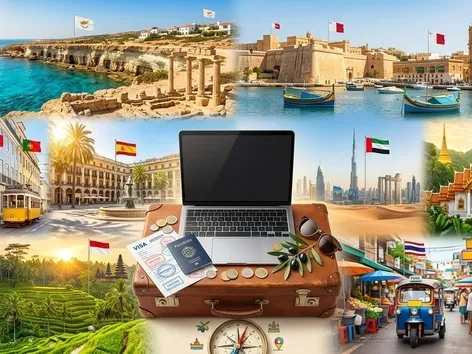
Cyprus has topped the latest ranking of countries for remote work. Find out why it outranked Malta, Portugal and Spain, and how much it costs to live there

Working from a laptop is possible even on a beach, but when it comes to an actual move, the romance quickly runs into taxes, visas and rent. These were exactly the questions the Cyprus-based company Domenica Group set out to answer when, in September 2026, it compared seven popular destinations for remote workers. The results were reported by Travel + Leisure. Cyprus scored 8.17 out of ten and topped the list, while Bali, which for years was associated with the digital nomad lifestyle, ended up in last place. If you are looking for the best countries for digital nomads, this order may come as a surprise, so let’s see what is behind the numbers and where things stand in 2026.
Read also about the best countries for digital nomads according to the Global Relocation Index here.
Dreaming of working abroad but put off by the number of documents? The Work Guide from Visit World puts everything in one PDF: step-by-step instructions, a list of documents, visa fees and processing times. Enter your citizenship and destination country, and the file will arrive in your inbox within minutes.
Get your Work Guide on Visit World and prepare for your move without mistakes.

The best countries for digital nomads: who made the ranking?
The analysts scored each destination on six equally weighted criteria: flight time from the UK, EU access and visa rights for Britons, tax on income earned abroad, living costs, ease of settling in together with English-language accessibility, and, finally, the prospects for property ownership and long-term residence. Each criterion was rated out of ten, and an average score was then calculated. The result looks like this:
- Cyprus – 8.17
- Malta – 8.0
- Portugal – 7.17
- Spain – 7.0
- Dubai (UAE) – 6.33
- Thailand – 5.0
- Bali (Indonesia) – 4.0
One important caveat: the study was carried out from the perspective of remote workers based in the UK. For citizens of other countries, visa and tax conditions differ, so this ranking should not be copied blindly. Domenica Group’s own business development manager, Michalis Doukanaris, stressed that taxes rarely decide everything. In his view, it matters more to work out where you really want to build a life than merely to change your tax residency.
Visit World services for tourists, migrants, and expats: Insurance | Guides | Legal advice
Cyprus: why did the island pull ahead?
Cyprus won not through a single trump card but through a set of practical advantages. It is about four and a half hours by air from London, English is spoken almost everywhere, and settling in is easy. Add the prospects for buying property and staying long term. The only thing that dragged the average score down was the cost of living.
Even so, according to Immigrant Invest, it is still lower than in the UK or the US. One person spends roughly 2,025–2,251 dollars a month including rent, and a family of four about 5,063 dollars. Housing takes the biggest share, and approximate prices are as follows:
- a one-bedroom apartment outside the centre – 787–900 dollars a month;
- similar housing in the centre – 1,012–1,125 dollars;
- basic utilities – about 225 dollars;
- home internet – around 40 dollars.
The final amount depends on the city, the neighbourhood and the type of property. In return, the island offers roughly 640 kilometres of coastline, hiking and cycling routes, and some of the cleanest bathing spots in Europe.
What about the visa in 2026?
For citizens of non-EU countries, Cyprus offers a dedicated digital nomad visa. It is designed for people who work for a foreign employer or serve clients outside the island, while income from Cypriot companies automatically rules an application out. The income benchmark is 3,500 euros net per month, with a higher threshold for families. The permit is issued first for a year and can be extended. By itself it does not make you a tax resident: the 183-day rule applies here, so it is best to sort out taxes with a specialist.
Top 5 tropical islands for remote work: see the link.
Malta: second place by a narrow margin
Malta scored exactly 8 points and trails the leader by just 0.17. It is also an EU country where English has official status. The island additionally offers a special permit, the Nomad Residence Permit, issued by the Residency Malta Agency. According to official data, you need a gross annual income of at least 42,000 euros, that is 3,500 euros a month. Only active earnings count: dividends and rental income do not. The application costs 300 euros, and working for Maltese companies on this permit is prohibited.
The tax side is attractive. According to reports on the tax authority’s guidance, income from permitted work is not taxed for the first 12 months, after which a flat rate of 10% applies instead of the usual progressive scale of up to 35%. The rules are clarified from time to time, so check the programme’s official page before applying.
Portugal: third place and a rising income threshold
Portugal received 7.17 points. Its D8 visa for remote workers became more demanding in 2026. The minimum income is tied to four times the minimum wage, and after the rise of the minimum wage to 920 euros, it now stands at 3,680 euros a month, up from about 3,040. Only active income counts. Those who live on a pension or passive income are usually pointed towards the D7 visa.
There is also a practical difficulty: the bottleneck is not the income threshold but the appointments and processing at the immigration agency AIMA. On the other hand, as specialist reviews note, after a few years it is possible to apply for permanent residence.
Digital visas without tax residency: find them here.
Spain: a tax break and limits on local clients
Spain scored 7 points. It requires an income equal to 200% of the minimum wage, roughly 2,800 euros a month. Sources give slightly different figures, from 2,762 to 2,849 euros, so it is best to check the exact amount at the time of application. No more than 20% of income may come from Spanish clients.
The main benefit is a special tax regime known as the “Beckham law”. According to reviews, it is a flat 24% on Spanish-source income of up to 600,000 euros for six years. However, it usually applies to employees rather than freelancers.
Dubai: no taxes, but the terms are not for everyone
Dubai has 6.33 points, and its main argument is clear: the UAE has no personal income tax. The Virtual Working Programme grants a one-year stay to those who work for a foreign employer or their own business outside the country. You need health insurance valid in the UAE and proof of income, and the fee is about 287 dollars. Working for UAE-based clients on this visa is not allowed.
A separate note on the income threshold: most reviews give 3,500 dollars a month, but there are reports of an increase to 5,000. It is worth checking this figure on the programme’s official portal.
EU countries leading in remote work: find them here.
Thailand and Bali: why are they at the bottom of the list?
Thailand (5 points) and Bali (4 points) did not lose for lack of sun. Judging by the methodology, they were pulled down by the long flight from Britain, the lack of EU access and weaker prospects for long-term residence and property. That does not mean working there is inconvenient. If you do not need the EU and what matters most is climate and everyday costs, the result could have been quite different.
What should a digital nomad consider before moving?
The ranking works well as a starting point, but not as an instruction manual. Most programmes for remote workers are designed for citizens of non-EU countries, while the final decision depends on your citizenship, the consulate, your documented income and insurance. Tax residency is a separate question. The permit itself does not create it, but six months of living in a country usually does. So before moving, it is worth calculating not only the rent but also how many days you will actually spend in the country and where your clients’ money will come from. Remote work abroad is first and foremost about legal soundness, and only then about the view from the window.
Among all the destinations for digital nomads, Cyprus and Malta currently look the most balanced, while Portugal and Spain suit those prepared for longer procedures. Dubai attracts with its zero tax, and Asia remains an option for those who put climate and budget first.
The Domenica Group ranking shows that income requirements and working conditions differ from country to country. If you are considering formal employment abroad, start with the right set of documents. The Work Guide from Visit World, for any country and citizenship, contains instructions on obtaining a work visa and work permit, lists of documents, visa fees and processing times. Enter your destination country and citizenship and receive a ready PDF in your inbox.
Reminder! The UAE has updated its remote work visa for 2026. Read our guide to find out who can apply for the Remote Working Visa, what the income and document requirements are, and how to move with your family.
Photo: generated by Gemini
Products from Visit World for a comfortable trip:
Travel guide for 200 countries;
Legal advice from a local specialist on visa and migration issues;
Travel insurance around the world (please select the country of interest and citizenship to receive services);
Medical insurance all over the world.
We monitor the accuracy and relevance of our information, so if you notice any errors or inconsistencies, please contact our hotline.
Frequantly
asked questions
Can you work for local companies on this type of visa
Does a remote worker automatically become a tax resident of the country?
Can you relocate with your family on this type of visa?
Recommended articles
3 min
Residence permit
Turkey Residence Permit in 2026: A Complete Guide
A residence permit in Turkey is obtained through the e-ikamet system. Find out about the types of residence permits, required documents, fees, and application steps in 2026
16 Oct. 2026
More details3 min
Expats
The Best Cities in the Czech Republic for Expats to Live in 2026
The Czech Republic attracts expats with its high quality of life, well-developed infrastructure, and career opportunities. Learn more about the 5 best cities in the Czech Republic to move to in 2026, their advantages, and what life is like there
16 Oct. 2026
More details3 min
Expats
How can a foreigner get a mortgage in Germany in 2026?
Foreigners can purchase a home in Germany with a mortgage, but banks thoroughly review borrowers’ income, credit history, and financial stability. Learn more about current interest rates, requirements for foreigners, down payments, and additional costs associated with buying real estate in 2026
17 Oct. 2026
More details1 min
Residence permit
Moving to Athens in 2026: Rent, Golden Visa and Taxes
Athens is increasingly being compared to Dubai. Discover rental prices, Golden Visa requirements, visas for remote workers and tax benefits
17 Oct. 2026
More detailsAll materials and articles are owned by VisitWorld.Today and are protected by international intellectual property regulations. When using materials, approval from VisitWorld.Today is required.