

Tourist destinations set to disappear due to rising sea levels: 17 destinations at risk by 2100
Table of contents
- Why does “last-chance” tourism make the situation worse?
- The Maldives: The Lowest Country in the World
- Kiribati: Islands Where Sea Levels Are Rising Four Times Faster
- The Bahamas: Threats from Within and Without
- Fiji: A Tropical Paradise Under Siege by Natural Disasters
- Samoa: The Disappearance of Coral Reefs as a Harbinger of Disaster
- Seychelles: A Luxury Resort on the Brink of Disappearance
- Tuvalu: 95 percent of the territory at risk of flooding
- Marshall Islands: Land is Disappearing Right Now
- The Solomon Islands and Vanuatu: A Threat to Oceania
- Venice: the legendary city slowly sinking into the water
- Full list of 17 tourist destinations at risk
Rising sea levels are already changing the world map, and dozens of popular tourist destinations are at risk. Scientists predict that by 2100, some island nations and coastal cities may become uninhabitable or disappear entirely. Learn more about the 17 destinations that are under threat and why experts are warning against “last-chance” tourism

Climate change is already reshaping the world map, and some popular tourist destinations could disappear entirely by the end of this century. The Daily Mail recently published an article about resorts and island nations threatened by rising sea levels. According to forecasts by the Intergovernmental Panel on Climate Change, by 2100 the average global sea level will rise by 32–84 centimeters, and the consequences of this process are already being felt in various parts of the world.
The most vulnerable remain the low-lying island nations of the Pacific and Indian Oceans, as well as iconic cities with centuries-old histories. Which specific places are at risk and why experts are warning against so-called “last-chance” tourism—we’ll explore further in this article.
Planning a trip to an island nation or a coastal resort?
Unpredictable weather conditions and sudden floods are a reality you should prepare for in advance. Get travel insurance on the Visit World portal and travel without unnecessary risks.

Why does “last-chance” tourism make the situation worse?
The desire to see disappearing places while they still exist seems understandable. However, experts emphasize that this approach puts additional pressure on already vulnerable ecosystems. Izzy Nichols, founder of The Gap Decaders, highlights the direct link between the increase in long-haul flights and the acceleration of climate change. Additional flights for “last-chance travel” increase the carbon footprint, which is one of the causes of rising sea levels.
André Robles, owner of Voyagers Travel Amazon, also points to the practical consequences of the mass influx of tourists. Vulnerable island territories have limited fresh water supplies, weak transportation infrastructure, and insufficient capacity to respond to emergencies. The sharp increase in visitor numbers leads to overloaded sewage systems, resource shortages, and a decline in the quality of life for local residents. In fact, every additional tourist brings closer the moment they hope to see “before it’s too late.”
Visit World services for tourists, migrants, and expats: Insurance | Guides | Legal advice
The Maldives: The Lowest Country in the World
The Maldives archipelago, located south of India, has long been synonymous with luxury vacations. However, its geographical location makes this country extremely vulnerable: the average elevation above sea level is just 1.5 meters, and the highest point reaches 2.3 meters. It is the lowest-lying country on the planet.

Photo: Tripadvisor
More than 500,000 people live in the Maldives, a significant portion of whom are concentrated in the capital, Malé—a densely populated city on a small low-lying stretch of land. According to forecasts, by 2050, about 80 percent of the archipelago’s 1,100 islands may become uninhabitable due to rising sea levels.
Kiribati: Islands Where Sea Levels Are Rising Four Times Faster
The Republic of Kiribati stretches across three million square kilometers of the Pacific Ocean northeast of Australia. This country is known as one of the first places on Earth where a new day begins. However, its average elevation above sea level is only three meters.
The pace of change is particularly alarming: according to Active Sustainability, sea levels here are rising by approximately 1.2 centimeters each year—four times faster than the global average. The combination of minimal elevation and accelerated sea-level rise places Kiribati among the countries threatened with complete submersion within the coming decades.
The Bahamas: Threats from Within and Without
The Bahamian archipelago faces a threat of a dual nature. On New Providence, the most populous island and home to the capital Nassau, the highest point reaches only about five meters. A map created by researchers at the University of California shows that a significant portion of the island could be underwater within 75 years, with the formation of new inland lagoons.

Photo: iStock
The situation is complicated by a geological feature of the Bahamas. The limestone rock that makes up the islands allows seawater to seep through the ground. This means that flooding occurs simultaneously from two sides—both from the coast and from below through the rock. According to BBC Wildlife Magazine, it is this dual threat that makes the Bahamas particularly vulnerable.
Fiji: A Tropical Paradise Under Siege by Natural Disasters
Fiji covers an area of about 1.3 million square kilometers in the southern Pacific Ocean. In addition to rising sea levels, the archipelago faces a growing threat from extreme weather events. The severe floods of 2009 claimed the lives of 19 people, forced thousands of residents to leave their homes, and caused significant damage to infrastructure.
The consequences of natural disasters are felt far beyond the immediate destruction. Fiji’s key economic sectors—tourism and sugar production—have suffered serious losses, clearly demonstrating how climate events undermine the economic stability of island nations.
Samoa: The Disappearance of Coral Reefs as a Harbinger of Disaster
Samoa, with an area of less than 3,000 square kilometers, gained independence from New Zealand in 1962. The country remains relatively untouched by mass tourism for now, but the threat is of a different nature.
According to Active Sustainability, Samoa’s main environmental problem is the loss of coral reefs due to rising ocean temperatures.

Photo: Depositphotos
Coral reefs act as a natural barrier that protects the coastline from powerful waves. Their disappearance leaves the coastline unprotected, leading to increased erosion and more frequent flooding. In fact, the destruction of the reefs triggers a chain reaction, the end result of which could be the loss of a significant portion of the territory.
Seychelles: A Luxury Resort on the Brink of Disappearance
The Seychelles archipelago consists of 115 islands in the Indian Ocean, many of which are low-lying and vulnerable to any fluctuations in sea level. Most of the 130,000 residents, as well as the country’s key infrastructure, are concentrated along the coast.
This location means that even a slight rise in water levels or an increase in storm surges could have devastating consequences for the entire country. Experts estimate that a significant portion of the Seychelles could be underwater within the next 50 to 100 years.
Tuvalu: 95 percent of the territory at risk of flooding
Tuvalu is one of the most striking examples of the impact of climate change on island nations. Over the past 30 years, sea levels there have risen by approximately 21 centimeters—nearly twice the global average.

Photo: Supplied
UN projections are extremely alarming: by 2100, up to 95 percent of the country’s territory could be submerged. The paradox is that Tuvalu contributes virtually nothing to global greenhouse gas emissions, yet it is this nation that is the first to feel the consequences of industrialized countries’ activities. Limited resources prevent Tuvalu from confronting the threat on its own.
Marshall Islands: Land is Disappearing Right Now
The Marshall Islands have a total area of just 181 square kilometers, and this figure is shrinking year by year. Unlike other countries on the list, the consequences of rising sea levels are already evident here: in the capital, Majuro, areas of land that were once above water are now submerged.
For the Marshall Islands, the loss of territory is a process that can be observed in real time. Land is being lost gradually every day, and without large-scale international intervention, this process is irreversible.
The Solomon Islands and Vanuatu: A Threat to Oceania
The Solomon Islands stretch across nearly 30,000 square kilometers and are home to over 800,000 people. Rising sea levels have already caused significant coastal erosion, and in some cases, small islands have disappeared entirely. Scientists express serious concern about the long-term survival of this nation.

Photo: iExplore
The Republic of Vanuatu, located in Melanesia, faces a double threat—rising sea levels combined with regular powerful cyclones. In March 2015, Cyclone Pam damaged 90 percent of the buildings in the capital, demonstrating the scale of the destructive potential of natural disasters. As sea levels rise and weather anomalies intensify, the risks for Vanuatu continue to grow.
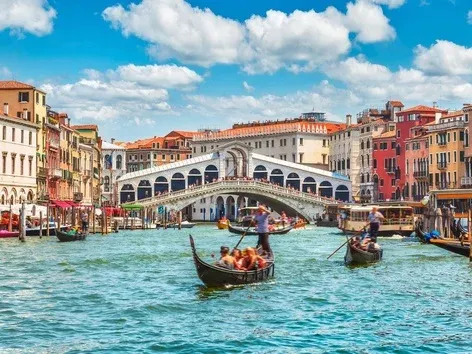
Venice: the legendary city slowly sinking into the water
Venice attracts millions of tourists from around the world every year thanks to its unique system of canals. However, the city faces a
double problem: over the past two decades, 18 severe floods have been recorded here, and researchers from the National Institute of Geophysics and Volcanology have determined that Venice is sinking by approximately 1–2 millimeters each year.
Possible solutions include the use of large flood barriers to isolate parts of the city from the lagoon and the dismantling of infrastructure to relocate it further inland. In the worst-case scenario, some parts of the city could become completely uninhabitable. Experts recommend that those seeking similar experiences consider less-visited Italian cities, such as Matera in the Basilicata region—one of the oldest continuously inhabited cities in the world—or the port city of Trieste, located a 1.5-hour train ride from Venice.
Full list of 17 tourist destinations at risk
In summary, here are 17 destinations that, according to scientists’ forecasts, may disappear or undergo critical changes by 2100:
- Maldives—average elevation 1.5 m; up to 80% of the islands may become uninhabitable by 2050.
- Kiribati—sea levels are rising four times faster than the global average.
- Bahamas—threat of flooding both from the coast and due to limestone terrain.
- Fiji—extreme weather events and sea-level rise.
- Samoa—the disappearance of coral reefs is weakening the coast’s natural defenses.
- Seychelles—most of the population and infrastructure are concentrated along the coast.
- Tuvalu—up to 95% of the territory could be flooded by 2100.
- Marshall Islands—land loss is already occurring.
- Solomon Islands—some islands have already disappeared.
- Vanuatu—a combination of sea-level rise and destructive cyclones.
- Venice—sinking by 1–2 mm per year, with regular severe flooding.
- Palau—the coastline is receding, and roads are becoming vulnerable to flooding and wave action.
- Torrés Strait Islands—sea levels rose by 6 cm over the decade from 1993 to 2019.
- Bangladesh—could lose up to 17% of its territory and face the displacement of 20 million people.
- The Netherlands—more than a quarter of the territory is below sea level; the level could rise by one meter by 2100.
- Miami— its porous limestone bedrock allows water to seep up from the ground, leading to frequent urban flooding.
- Nauru— 80% of the territory has been destroyed by phosphate mining, and the island sits at a low elevation above sea level.
Travel to island nations and regions affected by climate change requires special preparation. Unpredictable weather conditions, sudden floods, and flight cancellations—these are all real risks travelers face in such destinations. Reliable travel insurance will help protect you from financial losses and ensure you receive the necessary assistance in an emergency.
On the Visit World portal, you can quickly and conveniently purchase travel insurance that covers medical expenses, trip cancellations, and other unforeseen circumstances.
Get your insurance in advance and travel with confidence, no matter where you’re headed!
Reminder! TripAdvisor has released its ranking of the world’s best attractions for 2026 based on millions of traveler reviews. The list includes historical monuments, museums, modern architectural landmarks, and natural sites visited by millions of travelers every year. Read more about the world’s best tourist attractions that are worth seeing at least once in a lifetime by following the link.
Photo: Viator
Products from Visit World for a comfortable trip:
Travel guide for 200 countries;
Legal advice from a local specialist on visa and migration issues;
Travel insurance around the world (please select the country of interest and citizenship to receive services);
Medical insurance all over the world.
We monitor the accuracy and relevance of our information, so if you notice any errors or inconsistencies, please contact our hotline
Frequantly
asked questions
Which countries could disappear due to rising sea levels?
How much will sea levels rise by 2100?
Recommended articles
3 min
Travels
Europe's Best Beaches in 2026: Top 10 Summer Vacation Destinations
Greek coves, Spain’s hidden beaches, Ireland’s wild coastlines, and Croatia’s famous spots—in 2026, European beaches once again made the list of the world’s best. Experts evaluated water quality, natural landscapes, crowd levels, and the overall vacation atmosphere. Find out which European beaches made the Top 10 and what makes them particularly appealing to tourists
09 May. 2026
More details3 min
Travels
Where to go in Croatia in 2026: 5 places without crowds of tourists
Most tourists in Croatia choose Dubrovnik, Split, or Hvar, but these cities are often overcrowded during peak season. At the same time, the country has dozens of less popular destinations with beautiful beaches, historic architecture, and the authentic atmosphere of the Adriatic—without the huge crowds and noise. Learn more about 5 places in Croatia where you can relax more peacefully and see the country from a different perspective
07 Jun. 2026
More details3 min
Travels
The world’s most popular tourist attractions in 2026, according to TripAdvisor
TripAdvisor has released its ranking of the world’s top attractions for 2026, based on millions of traveller reviews. The list includes historical monuments, museums, modern architectural landmarks and natural sites visited by millions of travellers every year. Find out more about the world’s best tourist attractions that are worth seeing at least once in a lifetime
10 May. 2026
More details3 min
Travels
Affordable European Destinations for Vacation in 2026: Where to Go Without the Crowds
In 2026, European tourists are increasingly opting for lesser-known destinations instead of expensive and overcrowded capital cities. Slovenia, Latvia, Montenegro, and Albania offer high-quality vacations at significantly lower prices. Learn more about the cost of accommodation, food, and the unique features of each of these countries
09 May. 2026
More detailsAll materials and articles are owned by VisitWorld.Today and are protected by international intellectual property regulations. When using materials, approval from VisitWorld.Today is required.