

Iran and Israel Escalate Tensions Again in June 2026: How the Crisis Is Affecting Travel, Flights, and Visa Rules
Table of contents
- What happened on June 7, 2026 between Israel and Iran?
- Why is this situation important for travelers?
-
Which countries are already responding to the crisis in the Middle East and changing migration rules?
- Canada supports Iranian citizens
- India helps foreigners stay legally
- Iraqi Kurdistan reduces fines for overstay
- Israel automatically extends some visas
- The Netherlands has introduced flexible rules for applicants from Iran
- Thailand will not fine some foreigners for delayed departure
- The United Kingdom applies special relaxations
- What else do tourists and expats need to know?
- What to do if you are already in the Middle East?
- What to expect next?
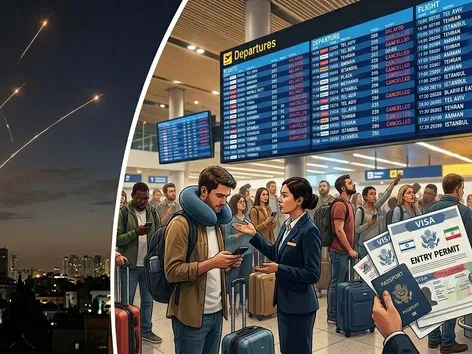
The renewed escalation between Iran and Israel may impact international travel and immigration procedures. Learn which countries have introduced visa relief measures, how travel rules are changing for foreign nationals, and what tourists, students, and expatriates should know in June 2026

The geopolitical situation in the Middle East has once again become the focus of the international community. On the evening of June 7, 2026, tensions between Iran and Israel sharply increased after a new missile incident, which forced the Israeli authorities to tighten security measures throughout the country.
For tourists, expats, students and international workers, this event is important not only from a security perspective. The previous months have shown that any escalation in the region can quickly affect air traffic, the work of consulates, visa processing and rules for the stay of foreigners.
The top of the safest countries in the world in case of World War III is here.
Moving, working, studying or living abroad for a long time is always associated with the processing of a large number of documents and compliance with migration rules. A migration lawyer will help you properly prepare an application, choose the appropriate visa category and avoid mistakes that can lead to refusal or delay in consideration. Professional support is especially important during times when entry and residence rules are changing rapidly due to international events.
Contact a migration lawyer today and receive reliable support at every stage of your move or paperwork!

What happened on June 7, 2026 between Israel and Iran?
According to the Israeli side, on the evening of June 7, two ballistic missiles launched from Iranian territory were intercepted by air defense systems over northern Israel.
After the incident, security measures were tightened in the country. Schools were closed in a number of regions and mass events were restricted. Citizens were advised to closely monitor the messages of civil defense services.
Political statements only emphasized the seriousness of the situation. Israeli National Security Minister Itamar Ben-Gvir said that “Tehran has wards,” while Iranian officials called the missile launch a response to Israeli actions in Lebanon and a warning to its adversaries.
At the time of publication, there were no major changes in international traffic, but most planes have already changed their routes and are bypassing the Middle East, and experts do not rule out further escalation.
Visit World services for tourists, migrants, and expats: Insurance | Guides | Legal advice
Why is this situation important for travelers?
In the spring of 2026, a previous escalation between Iran and Israel had already led to serious disruptions in the work of airlines and international airports.
At that time, a number of countries temporarily restricted the use of airspace, and international carriers were forced to change flight routes. As a result, thousands of passengers faced flight delays, additional transfers and difficulties returning home.
Although most airports in the region are operating normally today, the new escalation reminds us that the situation remains volatile, and travel conditions can change literally in a matter of hours.
Read about the economic consequences of the conflict between the United States, Israel and Iran on the global economy in our previous article.
Which countries are already responding to the crisis in the Middle East and changing migration rules?
According to Fragomen, one of the most important consequences of the crisis has been the temporary relaxation of migration rules for foreigners who, due to transport disruptions, could not leave in time or extend their status.
Canada supports Iranian citizens
The Government of Canada continues to apply special immigration measures for Iranian citizens temporarily staying in the country. Such individuals may receive additional support to extend their status and resolve migration issues in connection with the crisis in the Middle East.
India helps foreigners stay legally
The Indian Ministry of External Affairs has advised foreigners whose travel has been disrupted due to the situation in the region to contact the Foreigners Registration Regional Offices (FRROs). These offices can help extend visas, issue necessary documents and ensure legal stay in the country until normal transport services are restored.
Iraqi Kurdistan reduces fines for overstay
The regional authorities have introduced a special 90-day grace period for holders of expired visas and residence permits. Individuals wishing to renew their documents, apply for a residence permit or leave the territory of Kurdistan will pay only 25% of the standard fine for exceeding the permitted period of stay. In addition, additional sanctions and prosecutions related to such violations have been suspended for this period.
Israel automatically extends some visas
The Israeli authorities have automatically extended a number of visa categories and residence permits that were due to expire between February and May 2026 for three months.
The decision concerns tourist, student, humanitarian and some other categories of permits. At the same time, the issue of automatic extensions of certain work visas remains unresolved.
The world's largest airport will close in 2035: what is known?
The Netherlands has introduced flexible rules for applicants from Iran
The Dutch authorities have allowed foreigners who cannot leave the Schengen area due to transport disruptions to apply for extensions of short-term visas.
In some cases, the period of stay can be extended by up to 90 days. Mechanisms are also provided for the re-issuance of certain entry visas and simplification of procedures for applicants from Iran who are facing difficulties due to the limited work of consular institutions.
Thailand will not fine some foreigners for delayed departure
Foreign citizens who were unable to leave Thailand due to disruptions in air traffic can either apply for an additional extension of stay of up to 30 days, or leave after resuming travel without the standard fines for exceeding the permitted period of stay. To obtain an extension, you must contact the immigration service and provide documents confirming the reasons for the delay.
The United Kingdom applies special relaxations
The United Kingdom government also continues to use mechanisms to support certain categories of people affected by transport disruptions and the consequences of the crisis in the Middle East. The specific conditions depend on the type of visa and the individual situation of the applicant.
What else do tourists and expats need to know?
In addition to visa relaxations, international experts draw attention to a number of practical aspects:
- The work of individual consulates in the region may be temporarily limited;
- Visa application processing times may increase;
- Border services of some countries apply enhanced document checks;
- Additional requests for confirmation of the purpose of the trip may arise;
- Visa application before travel is becoming increasingly important, as some countries may temporarily restrict or complicate obtaining a visa upon arrival.
Experts also recommend registering your stay at the consulates of your country, if such an opportunity is provided.
Airfare prices to Asia have increased sharply due to the war in Iran, details here.
What to do if you are already in the Middle East?
International mobility experts advise:
- Regularly check flight status;
- Monitor local government announcements;
- Check the expiration date of your passport, visa, and residence permit;
- Prepare an alternative departure route;
- Keep contact information for your country’s embassy or consulate;
- Take out or update your medical and travel insurance.
What to expect next?
Most international routes through the Middle East are still operating. However, the new escalation between Iran and Israel demonstrates how quickly international travel conditions can change.
For tourists, students, workers, and expats, the key task remains to constantly monitor the situation and be ready to respond quickly to changes in the work of airlines, consulates, and migration services.
Events in the Middle East in 2026 once again show that international mobility depends not only on the availability of a visa or ticket. Changes in the work of consulates, closure of airspace, flight transfers or new requirements for foreigners can occur almost instantly. In such conditions, it is important to have access to professional advice and receive timely up-to-date information about your migration status.
A migration lawyer will help assess the risks, prepare documents for extension of stay, appeal a refusal or find alternative legalization options. This is especially important for expats, students, entrepreneurs and employees of international companies. Professional support allows you to avoid fines, violations of migration legislation and unnecessary financial losses.
Order a consultation with a migration lawyer and be prepared for any changes in international travel and migration procedures!
Reminder! The summer tourist season in Europe begins against the backdrop of large-scale strikes by aviation industry workers. Protests have already been announced in Portugal, Belgium, France and Italy, which could lead to hundreds of flight cancellations and significant delays. We've already told you where exactly disruptions are expected and how passengers can prepare for their journey.
Photo - generated by Gemini
Products from Visit World for a comfortable trip:
Travel guide for 200 countries;
Legal advice from a local specialist on visa and migration issues;
Travel insurance around the world (please select the country of interest and citizenship to receive services);
Medical insurance all over the world.
We monitor the accuracy and relevance of our information, so if you notice any errors or inconsistencies, please contact our hotline.
Frequantly
asked questions
Can countries extend visas again due to the renewed escalation?
Does the situation affect only Middle Eastern countries?
Why do countries extend visas during times of crisis?
Recommended articles
3 min
Popular
Is it safe to travel to Cyprus, Egypt and the Middle East now: what tourists know
Amid the escalating situation in the Middle East, travelers are increasingly asking whether it is safe to plan trips to popular tourist destinations in the region. In particular, we are talking about Cyprus, Egypt and a number of Middle Eastern countries where some events have already affected the operation of airports and flights. Learn more about the current travel advisory and the travel situation in the region
04 Mar. 2026
More details3 min
Investment
The global real estate market is experiencing a large-scale redistribution of capital, and investors are increasingly looking for more stable jurisdictions. Why is interest in the Middle East gradually declining, while Southeast Asia is taking the lead? Find out more about the most promising countries for investment in 2026 and why Indonesia has become a new safe haven for capital
13 Mar. 2026
More details3 min
Travels
Tourists cancel vacations in the Mediterranean because of the war in the Middle East
The war in the Middle East has begun to affect not only the political situation but also the global travel market. Some travelers are reconsidering their vacation plans and abandoning popular resorts in the Eastern Mediterranean. Find out more about which countries have lost tourists and which destinations are gaining popularity instead
18 Mar. 2026
More details3 min
Travels
10 alternatives to the Middle East for vacation in 2026
Due to the unstable situation in the Middle East, tourists are increasingly looking for alternative vacation destinations. Fortunately, there are dozens of locations around the world that are just as good—and sometimes even better—in terms of climate, nature, and service quality. Learn more about 10 destinations that could be the perfect alternative to popular Middle Eastern resorts in 2026
10 Apr. 2026
More detailsAll materials and articles are owned by VisitWorld.Today and are protected by international intellectual property regulations. When using materials, approval from VisitWorld.Today is required.