

Powerful Earthquake in Venezuela: Dozens Dead, Hundreds Injured, and Widespread Destruction
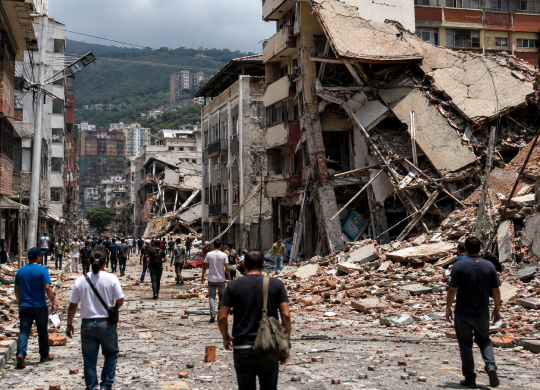
On June 24, Venezuela was rocked by two powerful earthquakes with magnitudes exceeding 7, which were among the strongest the country has experienced in recent decades. The disaster resulted in numerous casualties, widespread destruction, and disruptions to transportation and infrastructure. Learn more about the causes of the earthquake, its consequences, and the current situation in Venezuela

On June 24, 2026, Venezuela experienced one of the most devastating natural disasters in recent decades. In less than a minute, the country was rocked by two powerful earthquakes measuring 7.2 and 7.5 on the Richter scale, with epicenters located west of Caracas. The tremors were felt not only in the capital but also in neighboring countries, including Colombia and the Caribbean islands.
As a result of the disaster, dozens of buildings collapsed, and roads, hospitals, and other infrastructure were damaged. According to preliminary official data, at least 32 people were killed and more than 700 were injured; however, as rescue workers continue to clear the rubble, the death toll may rise.
In a previous article, we discussed new tourist taxes in Europe in 2026 and which countries will require tourists to pay more.
Planning a trip abroad and want to protect yourself from unforeseen situations?
Travel insurance from Visit World will cover medical expenses, flight delays, and lost luggage in any country. Get a policy online in a few minutes and travel with confidence!

What is known about the earthquake in Venezuela?
The earthquake struck on the evening of June 24, local time. According to the U.S. Geological Survey (USGS), a 7.2-magnitude tremor was initially recorded, followed approximately 40 seconds later by an even more powerful 7.5-magnitude earthquake. The epicenter of both quakes was located about 160 km west of Caracas, near the city of Morón in the state of Carabobo.
Due to the short interval between the two strong tremors, seismologists have termed this event an “earthquake doublet.” This type of earthquake is rare and significantly increases the scale of destruction, as buildings that withstood the first tremor may collapse after the second.
The tremors were felt across nearly all of Venezuela, as well as in Colombia, the Caribbean islands, and certain regions of neighboring countries. Due to the intense shaking, people rushed out of their homes, offices, and shopping centers en masse, fearing further tremors. A series of aftershocks was recorded following the earthquake, so authorities urged residents not to return to damaged buildings until they had been inspected.
The aftermath of the earthquake in Venezuela: what is known about the casualties and destruction
According to the latest official data, at least 32 people were killed in the earthquake, and more than 700 were injured. Rescue workers continue to operate at the sites of the collapses, so the death toll may rise. The state of La Guaira, Caracas, and communities near the epicenter were hit hardest.
The disaster caused widespread destruction. In Caracas and other cities, residential buildings, hotels, office buildings, and transportation infrastructure collapsed. In many areas, roads, bridges, water supply systems, and power grids were damaged, leaving thousands of people without electricity or communication services.
Following the earthquake, authorities declared a state of emergency. The Simón Bolívar International Airport near Caracas was temporarily closed, subway service and some public transportation were suspended, and schools and government offices were shut down until building inspections were completed. Temporary relief centers were set up for those affected, and the military, rescue workers, and medical personnel were mobilized to address the aftermath. Several countries and international organizations have already offered their support to Venezuela.
Is it safe to travel to Venezuela right now?
Following the earthquake, Venezuelan authorities urged residents and tourists to be prepared for aftershocks and to avoid damaged buildings. Seismologists warn that strong aftershocks may continue for several more days or even weeks after the main earthquake.
Currently, Simón Bolívar International Airport near Caracas is temporarily closed, and the metro and some public transportation services have been suspended. This may lead to flight delays or cancellations and make it difficult to travel within the country.
If you are already in Venezuela or are planning a trip there in the near future, you should:
- Follow announcements from local authorities and emergency services;
- Avoid entering buildings that may have been damaged;
- Regularly check with your airline for updates on your flight status;
- Be prepared for further aftershocks and temporary disruptions to electricity, communications, and transportation;
- If possible, postpone non-essential travel to the hardest-hit areas until the situation stabilizes.
Why do strong earthquakes frequently occur in Venezuela?
Venezuela is located at the boundary between the Caribbean and South American tectonic plates. These plates are constantly shifting relative to one another, building up stress in the Earth’s crust. When this stress is suddenly released along fault lines, earthquakes occur. This is why the northern part of the country, where most of the population lives, is one of the most seismically active regions in South America.
Over the past few decades, Venezuela has experienced strong earthquakes on multiple occasions. One of the most powerful occurred in 2018 off the coast of Sucre State—it had a magnitude of 7.3, and the tremors were felt as far away as Trinidad and Tobago, Guyana, and Colombia. Historically, the most tragic earthquake remains the one in 1812, which virtually destroyed Caracas and claimed thousands of lives.
Experts emphasize that modern science is not yet able to accurately predict another major earthquake. At the same time, following tremors as powerful as those that occurred on June 24, there is a high probability of numerous aftershocks, which can last from several days to several weeks. That is why residents and tourists are urged to monitor official announcements and avoid entering buildings that may have been damaged.
No matter how well thought-out your itinerary is, there is always room for force majeure when traveling. Unexpected medical expenses, transportation delays, or problems with luggage can ruin your plans and budget. Travel insurance helps you avoid unnecessary worries in such situations. You can apply for a travel insurance policy for a specific trip online at Visit World - quickly and without unnecessary bureaucracy!
Take out a policy online at Visit World and enjoy your trip without any unnecessary worries!
We remind you! Some countries are island states with political neutrality, which means that the likelihood of military conflict is quite low. Read more about the countries that are likely to participate in World War III and the top safest countries in the world.
Products from Visit World for a comfortable trip:
Travel guide for 200 countries;
Legal advice from a local specialist on visa and migration issues;
Travel insurance around the world (please select the country of interest and citizenship to receive services);
Medical insurance all over the world.
We monitor the accuracy and relevance of our information, so if you notice any errors or inconsistencies, please contact our hotline
Frequantly
asked questions
How many people died as a result of the earthquake in Venezuela?
How strong was the earthquake?
Is there a risk of aftershocks?
Are airports and public transportation operating in Venezuela?
Why is Venezuela prone to earthquakes?
Recommended articles
3 min
Popular
A powerful 7.4-magnitude earthquake struck Japan: tsunami warning, damage, and evacuation
A powerful 7.4-magnitude earthquake struck off the coast of Japan, triggering a tsunami warning and a mass evacuation of residents. Authorities quickly activated the warning system, while transportation and infrastructure were disrupted. Learn more about the scale of the disaster, its consequences, and the current situation
20 Apr. 2026
More details2 min
Air travel
EU Updates Air Passenger Rights: Free Cabin Baggage and Flight Delay Compensation Remain
The European Union has agreed to a major update to air passenger protection rules. Find out how the rules for carrying hand luggage, compensation for flight delays and booking conditions will change
17 Jun. 2026
More details1 min
Popular
France Heatwave 2026: Train Cancellations, Exam Disruptions and Emergency Safety Measures
France faced another heatwave in June 2026, which has already caused transport disruptions and widespread restrictions. Find out which regions were hit hardest, what was cancelled due to the heat and how tourists can prepare for travel during extreme temperatures
19 Jun. 2026
More details2 min
Travels
Venice Plans to Raise Tourist Entry Fee to €50: What Will Change in 2026?
Venice authorities are considering a significant increase in entry fees for day-trippers. If the initiative is approved, visiting one of Europe’s most popular cities could cost up to €50 on certain days. Learn more about who will be affected by the new rules, why the city is taking this step, and what to keep in mind when planning your trip
24 Jun. 2026
More detailsAll materials and articles are owned by VisitWorld.Today and are protected by international intellectual property regulations. When using materials, approval from VisitWorld.Today is required.