

The New Wolf Trail Route: 3,500 km on foot from Poland to Italy
Table of contents
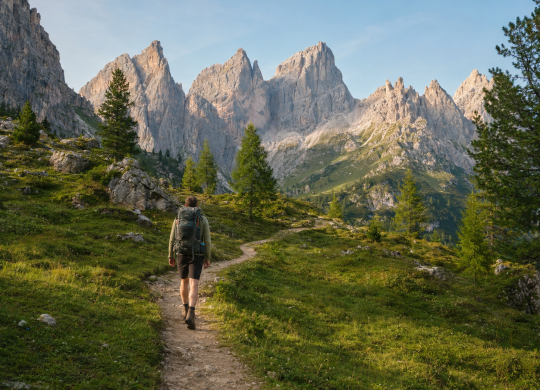
A new hiking trail called the Wolf Trail, nearly 3,500 km long, has opened in Europe. It connects the coasts of the Baltic and Adriatic Seas and passes through six countries. Learn more about the trail, its main stages, the duration of the trip, and conditions for hikers

It’s now possible to see nearly all of Central Europe on a single hiking trip thanks to the Wolf Trail. The new route begins on the Polish coast of the Baltic Sea, crosses plains, forests, and the Alps, and ends near the Adriatic Sea in Italy. According to Time Out, its total length is 3,494 km.
The route isn’t just for experienced travelers willing to spend several months on the road. The Wolf Trail is divided into seven separate sections, so hikers can choose a shorter stretch based on their fitness level and available time. GPX files have been developed for navigation, and the route passes through towns, official campgrounds, and mountain huts.
In our previous article, we discussed how to choose safe accommodation, avoid mistakes, and book a hotel without unnecessary expenses.
Planning a trip abroad and want to protect yourself from unforeseen situations?
Travel insurance from Visit World will cover medical expenses, flight delays, and lost luggage in any country. Get a policy online in a few minutes and travel with confidence!

From the Baltic Sea to the Adriatic Sea: Which Countries Does the Wolf Trail Pass Through?
The Wolf Trail begins on the Hel Peninsula in northern Poland and ends in Trieste on the Adriatic coast. The total length of the continuous route is approximately 3,494 km.
The trail passes through six countries:
- Poland
- Germany
- Austria
- Slovenia
- Italy
The first 428 km run along the flat Polish coast—through sandy beaches, pine forests, and the dunes of the Słowiński National Park. The route then leads through medieval German towns, the Lüneburg Heath, and the Palatinate and Black Forest regions to Lake Constance.
The southern section of the Wolf Trail is significantly more challenging. It covers Alpine passes, the Allgäu region, the Dolomites, and the Julian Alps, including the Triglav National Park in Slovenia. After lengthy mountain sections, the route descends to the Adriatic Sea and ends near Trieste.
In our previous article, we explained how to find cheap last-minute flights using Skyscanner’s tips.
The Seven Sections of the Wolf Trail: How the Route Is Structured
The Wolf Trail is not an entirely new trail built from scratch. Jack Wolfskin has combined existing hiking routes—including sections of the European trails E1, E9, and Via Alpina—into a single continuous route.
The entire trail is divided into seven major sections, each of which can be hiked separately:
1. Baltic Start – approximately 430 km. The route from Hel to Świnoujście runs along Polish beaches, dunes, and coastal pine forests.
2. Rivers and Plains – approximately 530 km. The trail leads from the island of Usedom through the Mecklenburg coast, lake districts, and the Elbe Valley.
3. The Green Heart – about 480 km. The section from Gestacht to Marsberg covers the Lüneburg Heath, fields, and low, wooded hills.
4. Forests and Wine-Growing Regions – about 570 km. Hikers pass through the Rothgar mountain region, nature parks, and the wine-growing areas of the Palatinate.
5. From the Palatinate to Lake Constance – over 570 km. The route crosses the Black Forest and gradually approaches the Alps.
6. The Alpine Gateway – about 390 km. The more challenging mountainous section begins, passing through the Lake Constance region, Switzerland, Austria, and the Allgäu Alps.
7. Crossing the Alps – over 550 km. The most challenging stage passes through high-altitude mountain passes, the Dolomites, and the Julian Alps, before descending to the Adriatic Sea.
Thanks to this division, travelers don’t have to complete the entire “Wolf Trail.” A single stage can be turned into a standalone trip lasting two to four weeks.
Learn more about the world’s most beautiful airports in 2026 according to the Prix Versailles ranking by following the link.
How long does it take to complete the route?
Completing the entire Wolf Trail takes approximately four to six months. The exact duration depends on your pace, the number of rest days, weather conditions, and your experience as a hiker. To cover 3,494 km during this period, you’ll need to hike an average of about 20–30 km per day, although your pace will be significantly slower in the mountains.
The main challenge of the route lies not only in its length. The total elevation gain exceeds 78,400 meters—which is roughly equivalent to climbing from sea level to the summit of Everest nine times. On the final stretches, hikers will have to tackle Alpine passes up to 2,500–3,000 meters high, steep ascents, and exposed mountain trails.
At the same time, the difficulty of the Wolf Trail increases gradually. The flat section along the Baltic Sea helps hikers acclimate to daily treks, while the most demanding physical challenges await in the Dolomites and the Julian Alps. Hikers without experience in multi-day treks are better off choosing a single shorter section rather than attempting the entire route at once.
In a previous article, we discussed Europe’s “trap airports”—the destinations where travelers actually end up after purchasing cheap airline tickets.
When is the best time to hike the Wolf Trail?
The best time to hike the Wolf Trail is considered to be from April through September. If a hiker plans to complete the entire route, starting in the spring will allow them to hike the flat sections of Poland and Germany in moderate temperatures and reach the Alps in the summer, when most high-altitude trails are free of snow.
Weather conditions vary significantly along different parts of the route. On the Baltic coast, hikers may encounter rain and strong winds, while in the southern regions, the main risks are heat, thunderstorms, and sudden weather changes in the mountains. Even in late summer, a sharp drop in temperature is possible at high mountain passes.
For a standalone trip through the Alps, it’s best to choose the summer months or early September, after checking trail conditions and the forecast in advance. Venturing into high-altitude areas in late fall or early spring without the proper experience is dangerous due to snow, ice, and the risk of pass closures.
Learn more about the Top 10 Best Airlines in the World by following the link.
Overnight Stops, Navigation, and Trip Preparation
GPX files are available for each section of the Wolf Trail; you can download them into a navigation app or add them to a digital topographic map. They help you track the route, elevation changes, water sources, settlements, overnight stops, and resupply points. Since part of the trail passes through remote areas, it’s a good idea to save the maps on your phone for offline use.
The route passes through cities, villages, official campgrounds, guesthouses, and mountain huts. In Germany and Poland, campgrounds, hostels, and small hotels are more commonly available, while in the Alps, hikers can stay in high-altitude huts and remote lodges. Popular mountain huts in Austria, Italy, and Slovenia are often fully booked in the summer, so it’s best to reserve a spot in advance.
Wild camping is regulated separately in each country and is often prohibited or significantly restricted. Before setting up a tent, be sure to check local regulations, as spending the night outside of designated areas can result in a fine.
When preparing, you should also:
- Check the forecast and conditions at mountain passes
- Download offline maps and GPX tracks
- Plan overnight stops and resupply points
- Pack waterproof, layered clothing
- Prepare a first-aid kit, a power bank, and a backup communication device
- Notify loved ones of your planned route
No matter how well thought-out your itinerary is, there is always room for force majeure when traveling. Unexpected medical expenses, transportation delays, or luggage problems can ruin your plans and budget. Travel insurance helps you avoid unnecessary worries in such situations. You can apply for a travel insurance policy for a specific trip online at Visit World - quickly and without unnecessary bureaucracy!
Take out a policy online at Visit World and enjoy your trip without any unnecessary worries!
We remind you! Popular European tourist destinations are becoming increasingly crowded, so travelers are looking for alternatives without the crowds. In 2026, attention is turning to countries that remain off the beaten path but offer unique experiences, affordable prices, and an authentic atmosphere. Read more about 5 European countries that are rarely visited by tourists.
Products from Visit World for a comfortable trip:
Travel guide for 200 countries;
Legal advice from a local specialist on visa and migration issues;
Travel insurance around the world (please select the country of interest and citizenship to receive services);
Medical insurance all over the world.
We monitor the accuracy and relevance of our information, so if you notice any errors or inconsistencies, please contact our hotline
Frequantly
asked questions
Where does the Wolf Trail begin and end?
Which countries does the Wolf Trail pass through?
Do you have to hike all 3,500 km?
Where can you stay overnight during the hike?
How challenging is the Wolf Trail?
Recommended articles
3 min
Travels
Ireland's Best Tourist Attractions: The Top 20 Attractions According to Travelers
The latest ranking of Ireland’s tourist attractions has revealed some surprising results—the legendary Guinness Storehouse and Blarney Castle fell well outside the top 20. The top spots went to atmospheric museums, distilleries, and natural sites that offer a true immersion into the culture of the Emerald Isle. Learn more about Ireland’s top 20 highest-rated attractions and the criteria used to compile the ranking
25 Jul. 2026
More details3 min
Travels
Where to Go in Slovakia This Summer: Itineraries to Castles, Caves, and Hot Springs
Slovakia lets you explore medieval castles, hike along mountain waterfalls, and relax in a natural thermal pool—all in a single trip. Learn more about the country’s most interesting summer destinations, perfect for day trips and a peaceful getaway far from the busiest resorts
26 Jul. 2026
More details3 min
Travels
Summer Vacation in Norway on a Budget: The Best Free Spots
Norway is considered one of the most expensive tourist destinations in Europe, but many of its natural attractions are free to visit. Here’s where to go swimming, which hiking trails to explore, how to see the fjords, and how to save money on your summer trip
01 Aug. 2026
More details3 min
Travels
Where to Go This Summer to Escape the Heat: 4 Cool Destinations in Europe
For a summer trip without the Mediterranean heat, consider Northern Europe and the Baltic coast. Here’s what to do in Helsinki, Bergen, Tallinn, and Gdańsk, which places to visit, and what kind of weather to expect
02 Aug. 2026
More detailsAll materials and articles are owned by VisitWorld.Today and are protected by international intellectual property regulations. When using materials, approval from VisitWorld.Today is required.