

Longyearbyen on Svalbard: What We Know About the World's Northernmost City and What Life Is Like There
Table of contents
- Where is Longyearbyen located, and what is the town’s infrastructure like?
- From coal mines to Arctic technologies: how the town’s economy has changed
- Polar Night and Polar Day: A Unique Rhythm of Light
- Polar Bears as a Constant Threat to Residents and Tourists
- Rules Unfound in Other Cities: Burials and Births
- The world’s northernmost school and university
- Snowmobiles and Dog Sleds: How Locals Get Around
- The Global Seed Vault: a unique facility near the town
- Travel Insurance for Remote Destinations
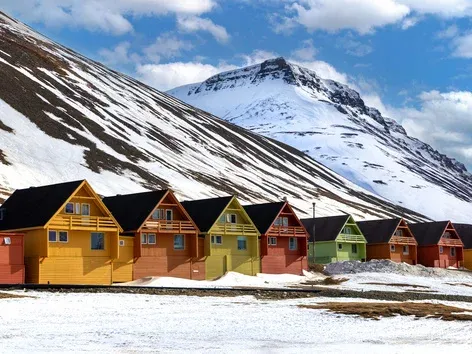
On the Norwegian archipelago of Svalbard lies a settlement recognized as the northernmost town on the planet. Life here is shaped by the Arctic climate—from a ban on burials in coffins to mandatory protection against polar bears outside the settlement. Learn more about what life is like in Longyearbyen

The northernmost city on the planet is located on the Norwegian archipelago of Svalbard and has a population of about 2,400. Business Insider recently reported on the unique way of life in Longyearbyen.
The town operates according to rules dictated by the Arctic climate and permafrost—ranging from a ban on burials to mandatory training on how to encounter polar bears. We’ll discuss Longyearbyen’s location, infrastructure, education, safety, and transportation further in this article.
Planning a trip to Norway or other countries with a challenging Arctic climate?
Health insurance from the Visit World portal covers medical treatment and medical evacuation costs even in remote regions.

Where is Longyearbyen located, and what is the town’s infrastructure like?
Longyearbyen is located approximately 1,300 km from the North Pole. You can get there by plane from Oslo—the flight takes about three hours.
Despite the extreme conditions, the town has a well-developed infrastructure for its size. Among the facilities available to residents and tourists are:
- a school and a university center;
- shops and restaurants;
- museums and a movie theater;
- bars and a nightclub.
About 5 medieval European towns that have remained off the tourist trail—read more at the link.
From coal mines to Arctic technologies: how the town’s economy has changed
Longyearbyen began as a mining settlement, and for a long time its economy relied on coal mining. Over time, this industry gradually declined.
Today, the city’s economy is based on tourism, scientific research, and development in the field of Arctic technologies.
Visit World services for tourists, migrants, and expats: Insurance | Guides | Legal advice
Polar Night and Polar Day: A Unique Rhythm of Light
From around mid-November to the end of January, Longyearbyen experiences polar night—the sun does not rise above the horizon for about four months. Residents celebrate the sun’s return with a special festival—Sun Festival Week.
In the summer, the situation is the opposite: for several months, the sun barely sets. The polar night makes the town one of the best places in the world to observe the Northern Lights.
Read also: Top 25 Countries for Retirees to Travel to in 2026.
Polar Bears as a Constant Threat to Residents and Tourists
About 300 polar bears live year-round in Svalbard. Some of them may approach settlements in search of food.
For this reason, residents and tourists are advised to carry a weapon or other means of deterring animals when venturing outside the city limits.
Rules Unfound in Other Cities: Burials and Births
In Longyearbyen, it is forbidden to bury the deceased in coffins—a rule that has been in effect since the 1950s. The reason is the thawing of the permafrost, which has caused remains to rise to the surface.
The town also has no maternity ward. Women in the late stages of pregnancy are referred to mainland Norway. Similarly, critically ill patients requiring specialized medical care are transported to the mainland.
Ranking of cities worldwide with the best street food — find it here.
The world’s northernmost school and university
Longyearbyen has a school attended by about 235 students aged 6 to 18. In addition to standard subjects, children are taught survival skills in Arctic conditions—including how to behave when encountering polar bears, safety during winter hikes, and what to do in the event of an avalanche.
The town is also home to the University Center in Svalbard—the world’s northernmost institution of higher education. Each year, about 700 students study here in fields such as Arctic biology, geology, geophysics, and technology.
Snowmobiles and Dog Sleds: How Locals Get Around
Snowmobiles are the main form of winter transportation for residents. As of the end of 2025, there were nearly 3,000 such vehicles on Svalbard—more than the number of residents in Longyearbyen.
Dog sleds remain another common mode of transportation. The archipelago is home to over a thousand polar dogs capable of covering significant distances in harsh conditions.
Read about the world’s most dangerous cities for tourists in this article.
The Global Seed Vault: a unique facility near the town
The Global Seed Vault is located near Longyearbyen. The facility is situated 120 meters deep inside a mountain and contains over 1.4 million seed samples from around the world.
The vault was designed to preserve the collection even in the event of major natural or man-made disasters.
Travel Insurance for Remote Destinations
Traveling to locations such as Longyearbyen involves specific risks—ranging from the effects of extreme weather to limited access to specialized medical care on site. The cost of treatment or medical evacuation in such cases can be substantial.
The Visit World portal offers travel health insurance that covers medical expenses abroad, including in remote regions.
Purchase a policy on the Visit World website to ensure you have financial protection in case of unforeseen situations while traveling!
Reminder! In a previous article, we explained how to find cheap last-minute flights.
Photo: Magnific
Products from Visit World for a comfortable trip:
Travel guide for 200 countries;
Legal advice from a local specialist on visa and migration issues;
Travel insurance around the world (please select the country of interest and citizenship to receive services);
Medical insurance all over the world.
We monitor the accuracy and relevance of our information, so if you notice any errors or inconsistencies, please contact our hotline
Frequantly
asked questions
Where is the world’s northernmost city located?
How many people live in Longyearbyen?
Recommended articles
2 min
Travels
Top 25 Countries for Retiree Travel in 2026
Japan has topped the ranking of the best countries for retiree travel in 2026. Find out which other countries made the top 25 and why Slovenia turned out to be the biggest surprise
22 Aug. 2026
More details1 min
Travels
Top 5 Most Winding Roads in Europe 2026
Avis research identified Europe's most winding roads by turns, elevation and popularity. Find out which routes topped the 2026 ranking
23 Aug. 2026
More details3 min
Travels
5 Medieval Towns in Europe That Have Been Left Off the Tourist Trail
Several European countries are home to medieval settlements with authentic architecture and few tourists. The Travel Off Path website has included five such towns in a special selection—from the Greek island of Chios to Gotland in Sweden. Learn more about these destinations and tips for travelers
23 Aug. 2026
More details2 min
Travels
Workation in Europe: The Best and Worst Cities
The workation format allows professionals to work from anywhere in Europe while exploring new locations. Analysts at Compare the Market examined European cities based on internet speed, cost of living, and the number of coworking spaces to identify the most and least suitable locations for this format. Learn more about the ranking of European cities for remote work and the criteria used to evaluate them
22 Aug. 2026
More detailsAll materials and articles are owned by VisitWorld.Today and are protected by international intellectual property regulations. When using materials, approval from VisitWorld.Today is required.