

The Big Mac Index: How a Burger Reveals Currency Exchange Rates
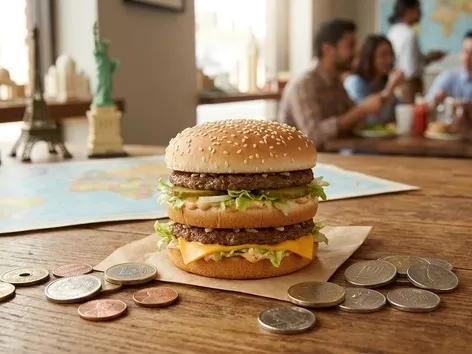
The Big Mac Index compares burger prices across countries to show whether currencies are overvalued or undervalued. Find out how the index is calculated and how to interpret it

In 1986, The Economist launched a joke for its readers that unexpectedly grew into a serious tool. The Big Mac Index is still quoted by economists, financial journalists and analysts, even though it rests on a single burger. The idea is credited to the magazine’s then economics editor, Pam Woodall: instead of complicated models, check currencies against the price of a product sold almost everywhere in the world.
The index comes out twice a year, in January and July, and covers several dozen economies. For readers, it is a quick way to see where life is expensive and where it isn’t, without opening a single statistical table.
Where food is most and least expensive in Europe, and what drives the cost, read here.
Travel medical insurance lets you stop worrying about hospital bills if something goes off plan. The policy covers medical care, emergency evacuation and other unforeseen situations, and runs from a few days to a year or longer. For foreigners, treatment abroad can be costly, so insurance helps you save. Enter your citizenship and destination country on Visit World and choose the policy that suits you.

How the Big Mac Index works: the logic behind the hamburger
At its core is the theory of purchasing power parity. It holds that an identical product should cost roughly the same in any country once the price is converted at the current exchange rate. When it doesn’t, the currency is considered undervalued or overvalued.
The difficulty is that comparing “just a product” is impossible: baskets differ, and so do tastes. The Big Mac removes that problem. McDonald’s operates in well over a hundred countries, and the recipe is almost the same everywhere.
What’s more, there is more behind the price of a Big Mac than meets the eye. According to The Economist, it contains more than sixty ingredients and materials, and its cost also reflects staff wages, rent and taxes. That is why the magazine named its method burgernomics, and the word stuck.
Read more about the specifics of the EU property market in our previous article.
Visit World services for tourists, migrants, and expats: Insurance | Guides | Legal advice
From burger price to exchange rate: a worked example
The formula is simple. Divide the local-currency price of a Big Mac by its price in the US, and you get an implied exchange rate, the rate at which burgers would cost the same. That figure is then compared with the actual market rate. If the market rate is weaker than the implied one, the currency is considered undervalued; if it is stronger, overvalued.
Take the January 2026 edition. In Japan, a Big Mac cost ¥480, in the US $6.12. The implied rate works out at about ¥78 to the dollar, while on the market a dollar bought around ¥160. By the index’s logic, the yen is undervalued by almost half.
Switzerland is the mirror image. A burger there cost roughly $9, some 48% more than in America, so the franc looks like one of the most overvalued currencies on the list.
What did the July 2026 edition show?
The latest edition came out at the end of July. The average price of a Big Mac in the US rose to $6.22, up from $6.12 in January and $6.01 last July. The most expensive burger is still in Switzerland, while second place unexpectedly went to Israel. In January the country ranked only eighth, but the price of a burger there jumped by roughly 15%, while the shekel strengthened noticeably against the dollar. As a result, a Big Mac there now costs $7.67. By comparison, in Taiwan it goes for just $2.42.
There are quieter stories too. According to July calculations, the Czech koruna was undervalued against the dollar by 12.6%, compared with 10.2% in January.
Interesting! The 10 most reliable electric cars, in the selection at this link.
Why the burger doesn’t always tell the truth
The Economist itself presents the index as a joke, and that isn’t modesty. In poorer countries, labour and rent are cheaper, so a burger costs less whether or not the currency is weak. In the “raw” version, such countries almost always look undervalued. Taxes, the chain’s pricing policy and the cost of beef also play a part.
To correct for this, in 2011 the magazine added an adjusted version, the GDP-adjusted Big Mac Index. It compares the burger’s price with GDP per person and shows how far a country deviates from the price expected for its income level. The difference can be striking. According to July data, the Hungarian forint looks cheap in the “raw” index: by its measure a dollar should cost around 267 forints, while the market rate was above 313. After adjusting for GDP, however, the undervaluation shrinks to 0.2%.
Why does this index matter for travellers and people who relocate?
A burger is no tool for budgeting: it won’t replace the bill for housing, transport or a doctor. But as a first point of reference, it works well. If a Big Mac in a given country costs almost twice as much in dollars as at home, don’t count on coffee, taxis and lunch in a café being cheap. With cheaper countries, the logic runs the other way.
The index is especially interesting to those who earn in a strong currency and spend in a weaker one. The magazine, incidentally, has gone further: in August 2026 it applied the same idea to salaries in the so-called McWages index, calculating how many Big Macs a year’s income buys in different countries.
So the next time you see a burger price abroad, look at it as more than the cost of lunch. It’s a small economic hint, just not one to take as a verdict.
The difference in a burger’s price may look trivial, but in countries with an expensive currency, doctors usually don’t come cheap either. In many countries, foreigners have to pay for treatment in full, and the bill for a single emergency can end up costing more than the whole trip. Medical insurance takes these costs on: the policy covers medical care, emergency evacuation, and trip cancellation and interruption. The term is chosen to fit your plans, from a few days to a year or more, so it suits both a short holiday and a long stay abroad. Peace of mind on the road and a protected budget are worth a few minutes of paperwork. Enter your citizenship and destination country on Visit World and pick a policy for your trip.
As a reminder! Five countries topped the global ranking for digital nomads in 2026. We have already covered which visa suits you, how much you need to earn or hold in your account, and what life really costs in Kuala Lumpur, Lisbon, Chiang Mai, Tbilisi and Taipei.
Photo - generated by Gemini
Products from Visit World for a comfortable trip:
Travel guide for 200 countries;
Legal advice from a local specialist on visa and migration issues;
Travel insurance around the world (please select the country of interest and citizenship to receive services);
Medical insurance all over the world.
We monitor the accuracy and relevance of our information, so if you notice any errors or inconsistencies, please contact our hotline.
Frequantly
asked questions
How do comprehensive purchasing power parity (PPP) calculations differ from the Big Mac Index?
Can the index tell you which country is cheaper to live in?
Why don't healthcare costs abroad always correspond to the price of a burger?
Recommended articles
2 min
Work
Jobs for Foreigners in Europe: Where Will It Be Easiest to Find Work in 2027?
Europe remains a top destination for migrant workers. Find out which countries make it easier to obtain a work permit, what salaries you can expect, and how much it costs to live there
30 Oct. 2026
More details3 min
Transport
Transport strikes in Europe in November 2026
Transport strikes announced in Italy, France and Spain for November could affect flights, trains and public transport. Find out more about strike dates, potential disruptions and how to prepare for your trip
28 Oct. 2026
More details3 min
Travels
Airbnb Launches Rain Insurance: Who Can Get Up to €1,000?
Airbnb has launched rain insurance offering compensation from €50 to €1,000 per rainy day. The service is available to residents of 10 European countries. Learn more about payout conditions, how to purchase the insurance, and how to receive compensation
28 Oct. 2026
More details2 min
Travels
Snow-Reliable Ski Resorts in Europe: Top 10 for 2026/27
Italy, Austria, and France lead the ranking of resorts with the most reliable snow. Discover where to ski in the 2026/27 season and what sets the top 3 apart
29 Oct. 2026
More detailsAll materials and articles are owned by VisitWorld.Today and are protected by international intellectual property regulations. When using materials, approval from VisitWorld.Today is required.