

Europe's Richest Countries by 2030: Rankings, IMF Forecasts, and Income Gaps
Table of contents
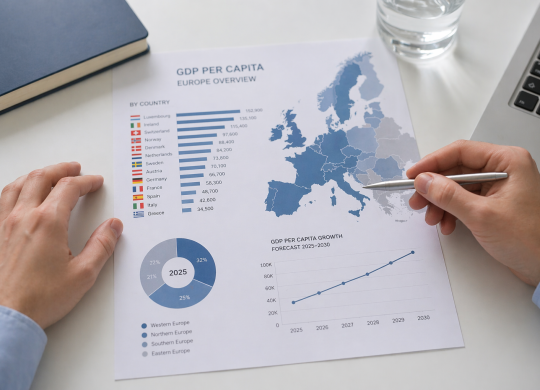
By 2030, most European economies will be growing, but the balance of power will remain largely unchanged. The leaders will remain the same, while the gap between wealthy countries and EU candidate nations will only widen. Learn more about which European countries will become the wealthiest and what this means for living and working abroad

Per capita GDP adjusted for purchasing power parity (PPP) remains the key indicator for assessing the well-being of countries in Europe. It is this indicator that allows us to compare not only the size of economies but also the actual standard of living in different countries.
According to forecasts by the International Monetary Fund, this indicator will rise across the region by 2030. However, an analysis by Euronews shows that the income gap between countries will remain significant, especially between the leaders and EU candidate countries.
Earlier, we talked about the European countries where it is easiest to get a work visa and start a career abroad.
Are you planning to work abroad in 2026? Visit World's Work Guide will help you quickly understand the requirements for a work permit, the list of necessary documents, and the application procedure. The guide contains current employment rules, the main types of permits, common mistakes made by applicants, and practical advice after moving. You will receive structured information in PDF format within a few minutes after ordering. Check out the guide and prepare for working abroad without any stress.

How will Europe’s economic map change by 2030?
By 2030, Europe’s economic landscape will remain relatively stable, despite growth in key indicators in most countries. The main reason is the synchronized development of economies: when all countries increase their GDP per capita, this does not lead to a significant reshuffling of positions in the rankings.
Purchasing Power Parity (PPP) plays a key role in this analysis. Unlike nominal GDP, it accounts for price differences between countries, thus more accurately reflecting the real standard of living. This is why countries with strong but expensive economies may appear less “wealthy” compared to nations where costs are lower.
Another key finding is that the gap between countries is not narrowing. High-income leaders continue to hold a significant advantage, while countries with lower indicators—particularly EU accession candidates—remain far behind, even in the long term.


Ranking of European countries by GDP per capita (PPP) in 2025 and forecast for 2030. Source: IMF World Economic Outlook / Euronews
Which countries will top the ranking of the richest in 2030?
The leaders of the European ranking by GDP per capita will remain largely unchanged by 2030, though there will be one significant change at the top. According to International Monetary Fund forecasts, Ireland will take first place, overtaking the current leader—Luxembourg.
Per capita GDP in Ireland is expected to reach approximately $182,000, while in Luxembourg it will be around $167,000. Both countries are significantly ahead of the rest of Europe, forming a separate group of economic leaders with the highest income levels.
The top five also consistently includes Norway, Switzerland, and Denmark. Their figures exceed $100,000 per person, and, unlike Ireland, these economies demonstrate a more balanced structure without significant influence from multinational corporations.
At the same time, it is important to consider a unique feature of Ireland: its high GDP figure is largely attributable to the presence of large multinational companies. As economists note, in this case, gross national income (GNI) may more accurately reflect the actual level of the population’s well-being than GDP.
We tell you where it is best to build a life in the long term — here.
Europe’s largest economies are far from leading in terms of income
Despite their economic scale, Europe’s largest countries are not among the leaders in terms of per capita income. According to International Monetary Fund projections, Germany will rank only 12th in 2030, France — 15th, and the United Kingdom — 16th.
Even lower on the list will be Italy (18th place) and Spain (22nd place), which will be the weakest among the region’s five largest economies in this regard. This situation clearly demonstrates that the size of an economy does not necessarily mean high per capita income.
The difference is particularly noticeable in purchasing power indicators. For example, in Germany, GDP per capita will be about $86,000, while in Spain it will be approximately $66,000. This creates a gap of about 31%, even among Europe’s leading economies.
The reason for this lag lies in the structure of the economy, population size, and spending levels. Large countries have a strong total GDP, but due to their larger populations, this figure is “diluted” when calculated per person.
To learn more about the ranking of minimum wages in Europe in 2026, please follow the link.
The bottom of the ranking – EU candidate countries
The lowest positions in the GDP per capita ranking by 2030 are predominantly held by EU candidate countries. Among them are Ukraine, Kosovo, and Moldova, which remain at the bottom of the list even in the long term.
In most of these countries, GDP per capita will not exceed $50,000, and in some cases will remain below $30,000. By comparison, this is roughly half the level of even the weakest economies among EU countries.
The gap with developed countries remains significant and systemic. It is explained not only by differences in growth rates but also by structural factors: less developed economies, lower levels of investment, and limited access to the EU market.
At the same time, there are exceptions. Turkey, despite its candidate status, is performing better—by 2030, it could rise to approximately 29th place, surpassing even some EU countries, including Bulgaria, Latvia, and Greece.


Comparison of GDP per capita (PPP) in European countries in 2025 and forecast for 2030. Source: IMF World Economic Outlook / Euronews
Why does the ranking of the richest countries remain almost unchanged?
The main reason for the stability of the ranking is the synchronized growth of economies. Most European countries are simultaneously increasing their GDP per capita, so even a significant improvement in indicators does not guarantee a rise in the ranking.
Another factor is the structure of the economy. Leading countries, such as Ireland or Luxembourg, have strong financial and corporate sectors that ensure consistently high incomes.
Other countries, even those with a large overall GDP, cannot quickly close the gap due to a different economic model.
In addition, price levels and costs also influence rankings. This is why the PPP indicator remains key: it demonstrates the real well-being of the population, rather than just “dry” economic figures.
If you are planning to work abroad in 2026 and want to better understand the rules of employment, work permits, taxes, and basic employee rights, it is worth preparing for the move in advance. Visit World's practical working guide will help you navigate the current requirements, types of work permits, and steps to take upon arrival to avoid common mistakes and feel confident in your new life abroad.
We remind you! New economic indicators show which countries have been able to increase their GDP and which have lost ground due to inflation and slowing growth. Ranking of the richest countries in the world in 2026 — follow the link.
Products from Visit World for a comfortable trip:
Travel guide for 200 countries;
Legal advice from a local specialist on visa and migration issues;
Travel insurance around the world (please select the country of interest and citizenship to receive services);
Medical insurance all over the world.
We monitor the accuracy and relevance of our information, so if you notice any errors or inconsistencies, please contact our hotline
Recommended articles
3 min
Expats
The best cities in Europe to live in 2026: 5 great places to move to
European cities have traditionally dominated global quality-of-life rankings thanks to their safety, well-developed infrastructure, access to healthcare, and high standard of daily living. In 2026, the top-ranked cities are those that combine a strong economy, convenient transportation, a clean environment, and stable conditions for work and life. Learn more about the 5 most livable cities in Europe in 2026, their advantages, cost of living, and key features
21 kwi. 2026
More details3 min
Travels
Majowe wakacje to jeden z najlepszych czasów na podróżowanie: pogoda jest już letnia, a ceny jeszcze nie osiągnęły szczytu. Eksperci radzą, aby nie zwlekać z rezerwacją, ponieważ ceny lotów i hoteli gwałtownie rosną, gdy zaczyna się lato. Dowiedz się więcej o krajach, w których możesz cieszyć się przystępnymi wakacjami tej wiosny
23 kwi. 2026
More details3 min
Expats
Best Countries to Move in 2026: Work, Study and Residency Options
Are you planning to move abroad in 2026? Global competition for skilled professionals is intensifying, and many countries are simplifying the requirements for immigration, education, and remote work. Learn more about the best countries to move to, current residency programs, and the actual requirements to get started
23 kwi. 2026
More details3 min
Expats
Top 25 Najlepszych Krajów do Emerytury w 2026 roku: Gdzie Znaleźć Najlepszą Jakość Życia
Gdzie na świecie są najlepsze warunki do życia po emeryturze? Nowy globalny ranking uwzględnia nie tylko poziomy dochodów, ale także opiekę zdrowotną, bezpieczeństwo, środowisko i stabilność gospodarczą. Dowiedz się więcej o 25 najlepszych krajach, w których emerytura może być naprawdę komfortowym etapem życia
24 kwi. 2026
More detailsAll materials and articles are owned by VisitWorld.Today and are protected by international intellectual property regulations. When using materials, approval from VisitWorld.Today is required.