

Food Prices in Europe: Where Are Groceries Most Expensive and Why?
Table of contents
- How much do EU households spend on food?
- How are countries compared, and what does the index mean?
- Food prices in Europe: who leads in cost?
- A basket of 18 items: what does it cost?
- Is eating in Europe’s cheapest countries really a bargain?
- Why is bread in Denmark three times pricier than in Bulgaria?
- Diesel, wages and inflation: what is pushing prices up in 2026?
- What does this mean for travellers and people relocating?
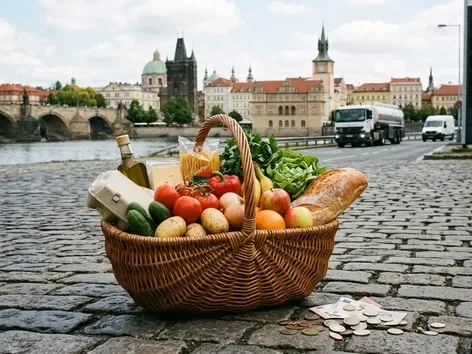
Food prices vary widely across Europe, with costs differing by more than threefold between countries. Find out where groceries are most and least expensive and what drives these price differences

The same loaf of bread can cost more than three times as much in Copenhagen as in Sofia. At the end of October, Euronews Business looked into why that happens and showed how widely food prices in Europe differ from one country to the next. We went through its figures and added official Eurostat data to give a fuller picture.
Travel health insurance takes the worry out of medical bills if something goes wrong, and in many countries foreigners pay a lot for treatment. The policy covers emergency medical care, evacuation and other unforeseen situations, and runs from a few days to a year or longer. Get your insurance on Visit World: enter your citizenship and destination country, and the system will show the options available to you.

How much do EU households spend on food?
Food and non-alcoholic drinks take up 13.6% of household spending in the EU on average. That makes it the second-largest item after housing and utilities, which account for 23.6%. The share looks very different from country to country, though: in Romania, for example, 23.1% of the family budget goes on food.
How are countries compared, and what does the index mean?
The data comes from Numbeo, a crowdsourced cost-of-living database. Its index is set against New York by default, where the value is 100. Euronews Business recalculated it so that the EU average became the baseline. On that scale, Switzerland scores 189.2 and Moldova just 57.2. Groceries in Swiss shops are 89.2% more expensive than the European average, while in Moldova they are 42.8% cheaper. A basket that costs €100 at the EU average would cost €189.20 in Switzerland and €57.20 in Moldova.
Numbeo is not official statistics, since its database is filled in by users. Eurostat calculates things differently. According to its data, in 2025 food and non-alcoholic beverages were the most expensive in Luxembourg (122% of the EU average) and the cheapest in Romania (80%). The gap here is much smaller than in the Numbeo index, where Romania scores 66.7. The direction is the same, though: the north and west are pricier, the south-east is cheaper. That’s worth keeping in mind when you assess the cost of living in Europe.
Visit World services for tourists, migrants, and expats: Insurance | Guides | Legal advice
Food prices in Europe: who leads in cost?

Photo – Euronews
At the top of the ranking is Switzerland (189.2). Iceland (183.6), Norway (154.4), Luxembourg (134.9) and Denmark (128.4) follow. Three of the five most expensive countries are Nordic. The other northern countries are also above average: Finland scores 119.7, Sweden 116.6. Austria (124.5), Ireland (122), Belgium (117.6) and the Netherlands (116.4) come close behind.
Among Europe’s five largest economies, prices are highest in France, where food is 27.5% more expensive than the EU average. Spain remains the only one of the big five where food costs less than average.
- France: 127.5
- United Kingdom: 111.9
- Germany: 111.6
- Italy: 110.2
- Spain: 89.7
Britain, Germany and Italy sit almost side by side, within two points of each other.
A basket of 18 items: what does it cost?

Photo – Euronews
Numbeo lists 19 items in its “Markets” category. Euronews Business collected their prices in October 2026 but left out cigarettes, as they vary widely between countries, as does the share of smokers. The journalists added up the remaining 18 items, counting each once, without weights. The average basket in the EU came to €69.84. The most expensive baskets are:
- Switzerland: €137.90
- Norway: €116.10
- Luxembourg: €99
- Austria: €88.10
- Denmark: €87.70
The cheapest basket is in Moldova (€41.10). Eight more countries let you put it together for under €50: North Macedonia (€43.90), Kosovo (€45.50), Romania (€45.90), Georgia (€46.90), Poland (€49.60), Serbia (€49.70), Montenegro and Bosnia and Herzegovina (€49.80 each). The spread is visible among the big economies too: the basket costs €87.40 in France, €80 in Italy, €75.20 in Germany, €69.10 in Britain and €63 in Spain. All these rankings are based on nominal prices. Once purchasing power is taken into account, the gap narrows, and after the basket is weighted, positions may shift slightly.
Is eating in Europe’s cheapest countries really a bargain?
Among EU countries, food is cheapest in Romania: an index of 66.7, a third below average. In general, prices are lower in the east of the continent and in the Balkans, including EU candidate countries. North Macedonia scores 59.8, Bosnia and Herzegovina 67.9, Serbia 68.8. Turkey (82.1) is below the average but pricier than several EU members. On top of that, food inflation there hit 32.8% in 2025, the highest in Europe.
A low price tag doesn’t mean food is affordable. Ilaria Benedetti of the University of Tuscia points out that food is cheap in Romania, yet families spend almost a quarter of their budget on it. In Bulgaria the share also exceeds 20%. Professor Jeremias Máté Balogh of Corvinus University adds that food can be cheaper in absolute terms yet less affordable once you compare it with what people earn after tax.
Why is bread in Denmark three times pricier than in Bulgaria?
According to Numbeo, 500 g of fresh white bread costs €3.18 in Denmark and €1.02 in Bulgaria. Incidentally, Bulgaria has been part of the eurozone since 1 January 2026, so both prices are now in the same currency. Eggs show a smaller gap: a dozen costs €4.52 in Denmark and €2.69 in Estonia, a difference of less than double. Eggs are a more standardised product, which is why they vary less.
Benedetti explains that the shelf price only partly reflects the cost of the food itself. It also covers wages, energy, rent, transport and taxes, all of which are much higher in wealthy countries. Balogh adds land costs, the structure of the retail market, exchange rates, logistics, farm productivity and even consumer habits. So supermarket prices say more about a country’s economy as a whole than about the cost of the products themselves.
The best countries to live in, according to Nomad Capitalist, are in the article at the link.
Diesel, wages and inflation: what is pushing prices up in 2026?
In Balogh’s view, labour costs remain the most persistent driver of high prices, but energy, fuel and transport keep pushing prices up at every stage, from field to shelf. Benedetti gives a telling example with fuel. After the strikes on Iran in late February, the average price of diesel in the EU rose from €1.59 per litre on 23 February to €2.24 on 28 September, the highest level since records began in 2005. “Diesel drives the entire food chain, from tractors to the trucks delivering to supermarkets,” she said.
Fresh macro data confirms the trend. In September 2026, annual inflation in the eurozone rose to 3.8% from 3.2% in August, with food, alcohol and tobacco adding 0.25 percentage points to the overall figure. By comparison, food in the EU rose by 2.8% on average in 2025. When food inflation slows, it doesn’t mean prices are falling: they simply keep rising more slowly, from an already higher level.
The 10 best countries for remote workers are here.
What does this mean for travellers and people relocating?
When comparing countries, look not only at the price tag but at the share of income that food takes up. That gives a more honest picture of life on the ground than a bare index. For a short trip the difference in the basket is noticeable but rarely decisive. Relocating is more complicated: on top of food come housing, transport and healthcare, which for foreigners in many countries is far from cheap. That is why it’s best to calculate the budget as a whole.
Prices in Europe differ by more than the cost of bread and eggs: healthcare for foreigners in expensive countries can also add up to a considerable sum. So before setting off, it’s worth arranging a policy in advance. It covers the cost of emergency care and medical evacuation, and also protects you if your trip is cancelled or cut short. The insurance suits both a short trip and a long stay, as its term can run from a few days to a year or more. Enter your citizenship and destination country on Visit World and choose the policy that suits you best.
Remember! Where to spend winter 2026–2027 in the warmth, and how much does living abroad cost? We compare 7 countries, rental prices, climate and monthly expenses. We have already covered the best winter destinations and the specifics of long-term stays abroad.
Photo - generated by Gemini
Products from Visit World for a comfortable trip:
Travel guide for 200 countries;
Legal advice from a local specialist on visa and migration issues;
Travel insurance around the world (please select the country of interest and citizenship to receive services);
Medical insurance all over the world.
We monitor the accuracy and relevance of our information, so if you notice any errors or inconsistencies, please contact our hotline.
Recommended articles
2 min
Popular
Najbogatsze miasta świata według PKB na mieszkańca: Ranking 2026
Ranking Visual Capitalist ujawnia, gdzie produkcja gospodarcza na mieszkańca jest najwyższa. Odkryj 40 wiodących miast i dlaczego Nowy Jork zajmuje dopiero dziesiąte miejsce
08 paź. 2026
More details3 min
Expats
The Best Cities in Switzerland for Expats to Live in 2026
The choice of city in Switzerland determines not only the cost of rent, but also taxes, the working language, and the job market. Learn more about life, salaries, housing, and conditions for families in the country’s five largest cities
19 paź. 2026
More details3 min
Popular
Where in Europe will it be easiest to save up for a home in 2026?
Where in Europe will it be easiest to save up for an apartment in 2026? We compare housing prices, salaries, and the time it takes to save. Learn more about the most affordable countries for buying real estate
14 paź. 2026
More details3 min
Expats
Jak cudzoziemiec może uzyskać kredyt hipoteczny w Niemczech w 2026 roku?
Cudzoziemcy mogą kupić dom w Niemczech za pomocą kredytu hipotecznego, ale banki dokładnie sprawdzają dochody kredytobiorców, historię kredytową i stabilność finansową. Dowiedz się więcej o aktualnych stopach procentowych, wymaganiach dla cudzoziemców, wpłatach własnych i dodatkowych kosztach związanych z zakupem nieruchomości w 2026 roku
17 paź. 2026
More detailsAll materials and articles are owned by VisitWorld.Today and are protected by international intellectual property regulations. When using materials, approval from VisitWorld.Today is required.