

What Drivers Need to Know in Switzerland in 2026: Vignette, Traffic Rules, and Fines
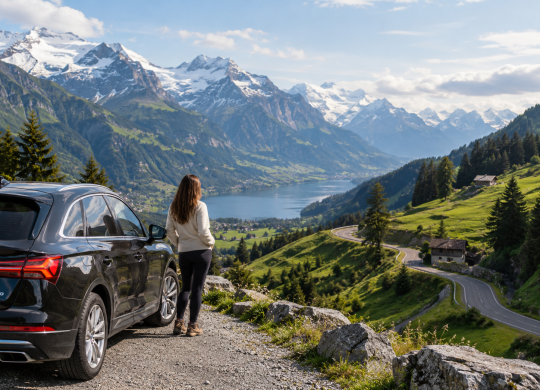
Switzerland has an annual vignette with no short-term options, strict speeding fines, and specific rules for mountain routes. Add to that toll tunnels, car transport trains, and seasonal closures of mountain passes. Learn more about Switzerland’s traffic laws in 2026, road tolls, parking, and winter requirements

Switzerland is great for road trips, but there are a few rules that are easy to overlook. You’ll need a vignette to drive on the highways; speed limits and parking are strictly enforced in cities; and in mountainous areas, your route may depend on the weather and the condition of the mountain passes.
Before your trip, it’s a good idea to check tolls, local traffic laws, and seasonal restrictions in advance. This will help you avoid unnecessary expenses and problems along the way.
Are you planning a trip to Europe by car?
In many countries, highways are tolled and require an electronic road vignette. This is a digital permit that confirms payment for the use of toll roads and is checked automatically by the license plate number - without stickers and paper receipts. Making a vignette online before you travel will help you avoid fines, travel delays, and unpleasant situations during inspections.

Basic Traffic Rules in Switzerland
In Switzerland, speed limits are lower than in many neighboring countries. Enforcement is strict, so you should rely primarily on traffic signs rather than the speed limits you’re used to in other countries.
The following basic limits apply to passenger cars:
- 50 km/h – in built-up areas
- 80 km/h – outside built-up areas
- 100 km/h – on expressways
- 120 km/h – on highways
In residential areas, 30 km/h zones are common. There are also “Begegnungszonen” (shared zones), where the speed limit is 20 km/h and pedestrians have special priority.
To learn more about which European countries have introduced new speed limits on highways, follow the link.
Drinking and Driving
For most drivers, the legal blood alcohol limit is 0.5‰. For new drivers, professional drivers, and certain other categories, a stricter limit of 0.1‰ applies.
Even a slight excess can have serious consequences. High blood alcohol levels can result not only in fines but also in the suspension of your driver’s license.
In our previous article, we discussed where in Europe it’s cheapest and fastest to charge an electric vehicle.
Cell Phones and Seat Belts
Using a cell phone while holding it in your hand while driving is prohibited. Hands-free use is permitted as long as the driver remains focused on the road.
Seat belts are mandatory for all passengers. Children under 12 years of age and shorter than 150 cm must be secured in an appropriate child restraint system.
In Switzerland, it is also mandatory to drive with daytime running lights or low beams on during the day. This rule applies year-round.
Learn more about toll roads and traffic rules in Hungary by following the link.
Fines in Switzerland
In Switzerland, fines depend on the severity of the violation. Minor offenses are subject to fixed fines, while serious violations may result in administrative or criminal proceedings. In such situations, the driver risks not only a fine but also losing their driver’s license.
Among the most common penalties are:
- Failure to wear a seat belt – CHF 60
- Holding a cell phone while driving – CHF 100
- Running a red light – CHF 250
- Parking without paying or in violation of parking regulations – ranging from several dozen francs depending on the situation
- Driving on a highway without a valid vignette – CHF 200 plus the requirement to purchase a vignette immediately
- Driving under the influence of alcohol – the penalty depends on blood alcohol concentration and circumstances
- Significant speeding – a large fine, license suspension, and possible criminal charges
We previously discussed the most common reasons tourists are fined on European roads in 2026.
Speeding
Fixed fines apply for minor speeding violations. These vary depending on the type of road.
In built-up areas:
- +1–5 km/h – CHF 40
- +6–10 km/h – CHF 120
- +11–15 km/h – CHF 250
Outside built-up areas:
- +1–5 km/h – CHF 40
- +6–10 km/h – CHF 100
- +11–15 km/h – CHF 160
- +16–20 km/h – CHF 240
On highways:
- +1–5 km/h – CHF 20
- +6–10 km/h – CHF 60
- +11–15 km/h – CHF 120
- +16–20 km/h – CHF 180
- +21–25 km/h – CHF 260
Once a certain threshold is exceeded, fixed fines no longer apply. The case is referred to the competent authorities, and the penalty may include license suspension.
We previously reported that Europe is introducing new measures to combat drunk driving: cars won’t start after alcohol consumption.
Drunk Driving
For most drivers, the legal limit is 0.5‰. For novice drivers, professional drivers, and certain other categories, the limit is 0.1‰.
If the limit is exceeded, the penalty depends on the blood alcohol concentration and the driver’s behavior. Possible penalties include a fine, a warning, license suspension, and criminal liability.
If the blood alcohol concentration is 0.8‰ or higher, the consequences become significantly more severe. In such cases, the driver risks losing their license for at least several months.
In our previous article, we discussed the specifics of driving in the Czech Republic: roads, vignettes, parking, and fines in 2026.
Cell Phones and Dangerous Driving
The fine for using a cell phone without a hands-free device is CHF 100. If the use of a smartphone has led to a dangerous situation, the penalty may go beyond a fixed fine.
Aggressive driving, dangerous passing, failure to maintain a safe following distance, and endangering other road users are all subject to separate penalties. In serious cases, higher fines and license suspension are imposed.
Vignette and Parking
Drivers face a CHF 200 fine for driving on a toll highway without a valid vignette. Additionally, the vignette itself must be purchased.
Parking fines depend on the violation. The most common offenses include parking in an unpaid space, exceeding the permitted time limit, improper use of a blue zone, or parking where it is prohibited.
The Swiss enforcement system is quite strict. Therefore, it is best not to ignore even minor violations, especially in cities and on highways.
Learn more about the world’s best countries for road trips in 2026 by following the link.
Vignettes and Toll Roads in Switzerland
For passenger cars, motorcycles, and trailers weighing up to 3.5 metric tons, an annual motorway vignette is required on Swiss highways and certain national roads. In 2026, it costs CHF 40.
There are no short-term options for 1, 7, or 10 days. Even if you plan to drive through the country in transit for just a few hours, you still need a full annual vignette to use the toll road network.
You can choose one of two formats:
1. Sticker vignette – a physical sticker on the windshield
2. E-vignette—an electronic version linked to the license plate
Both options have the same price and the same validity period. The 2026 vignette is valid from December 1, 2025, through January 31, 2027.
For the electronic version, it is important to correctly enter the license plate number and country of registration. If the information is incorrect, the vignette may not be considered valid.

Where is the vignette insufficient?
Not all road tolls in Switzerland are covered by the standard vignette. Certain special routes, tunnels, and transporting a vehicle by train require separate payment.
These charges may include:
- The Great St. Bernard Tunnel between Switzerland and Italy
- The Munt la Schera Tunnel in the Engadin region
- Certain car train routes through the Alps
- Private mountain roads and local tourist routes
Rates for these depend on the specific section, season, and type of vehicle.
Fine for Not Having a Vignette
Driving on a toll road without a valid vignette results in a fine of CHF 200. Additionally, the driver must purchase the vignette.
Inspections are conducted by the police, customs authorities, and highway patrols. For e-vignettes, verification is based on the license plate number, so a paper receipt is not required.
For most tourist routes through Zurich, Bern, Lucerne, Lausanne, or toward Italy and Austria, highways save a significant amount of time. If the trip is short, however, you can plan your route using regular roads without using the toll network.
Learn more about current toll rates in Poland for 2026 by following the link.
Parking in Switzerland
In Swiss cities, parking is often regulated not only by signs but also by the color of the road markings. For tourists, the most important thing is to distinguish between blue and white spaces.
Blue zones are designated for short-term, free parking using a special parking disc. You must set the disc to your arrival time, rounded to the nearest half-hour. For example, if you park at 10:10, set the disc to 10:30.
On weekdays, you can usually leave your car in a blue zone for about one hour. There are separate rules for lunchtime and the evening. For example, if a car is parked between 6:00 p.m. and 7:59 a.m., it can be left there until 9:00 a.m. the next morning, provided the parking disc is used correctly.
White parking spaces are often paid parking. The rate and maximum parking time are set by the municipality. Payment is made via a parking meter or a mobile app.
Certain spaces may be reserved for:
- Residents
- People with disabilities
- Electric vehicles while charging
- Delivery vehicles
- Taxis and company vehicles
In Zurich, Geneva, Bern, Basel, and Lucerne, downtown parking spaces are scarce and rates are high. For longer stays, it’s more convenient to use underground parking garages or P+R facilities on the outskirts.
The Swiss parking system is highly regulated. If a spot appears to be vacant but has special markings or an additional sign, you should not park there without first checking the conditions.
Learn more about the specifics of traveling through Slovakia in your own car by following the link.
Documents Required for Traveling in Switzerland
Switzerland is not part of the EU, but the required documents for a road trip are standard. During a traffic stop, the driver must confirm their right to drive, the vehicle’s registration, and proof of insurance.
You should have the following with you while driving:
- A valid driver’s license
- Vehicle registration certificate
- Passport or ID
- Insurance document
- Rental agreement, if the vehicle is rented
- Authorization from the owner, if the vehicle belongs to someone else
If the driver’s license is not issued in the Latin alphabet, an international driver’s license or an official translation may be required. For short tourist trips, documents from EU and EEA countries are usually accepted without additional procedures.
We previously wrote about the ins and outs of traveling through Croatia by car: fines, highways, parking, and important traffic rules.
Green Card for Switzerland
For a vehicle with foreign registration, it is important to verify that its insurance is valid in Switzerland. The Green Card confirms international liability insurance and simplifies the verification of information in the event of a traffic accident.
Before departure, you should check the certificate’s validity period and ensure that Switzerland is included in the coverage area. This is especially important for routes through multiple countries, where the insurance must remain valid until your return.
You can apply for a Green Card online at Visit World before your trip begins. This allows you to prepare the insurance document in advance and avoid having to find a solution while on the road.
Winter Rules in Switzerland
In Switzerland, there is no fixed period during which winter tires are mandatory for all vehicles. However, drivers are responsible for ensuring their vehicle is safe under prevailing weather conditions.
If a car with summer tires cannot drive normally on snow, blocks the road, or causes an accident, this can result in a fine and problems with your insurance company. Therefore, for winter trips—especially in the Alps—winter tires are essentially a necessity.
When are snow chains required?
On mountain roads, there may be a sign requiring the use of snow chains. In this case, they must be installed on the drive wheels.
Having all-wheel drive (AWD) or 4x4 does not always exempt you from this requirement. If the sign applies to all vehicles, AWD or 4x4 vehicles must also be equipped with chains.
For a winter trip to the Alps, it’s best to keep chains in the trunk even if the roads are clear at the time of departure. Conditions at higher elevations can change within a few hours.
Learn more about traffic rules, fines, toll roads, and regulations for driving in Austria in 2026 by following the link.
Mountain Pass Closures
Some high-altitude routes are not cleared for year-round traffic in winter. Due to snow, the Furka, Grimsel, and Susten Passes, among others, are closed seasonally.
The exact dates of closure and reopening vary each year. They depend on snow cover, avalanche risk, and road conditions.
If a pass is closed, you’ll need to reroute through a tunnel or take a car train. Therefore, it’s important to check the status of mountain roads immediately before departure, not just during the initial planning of your trip.
In our previous article, we discussed traffic rules in Italy in 2026, Autostrade tolls, fines, and key considerations for road travel.
Mountain Roads, Tunnels, and Car Transport Trains
In Switzerland, a route through the Alps doesn’t always mean a standard road over a pass. Some high-altitude routes are closed in winter, while on others it’s faster to use a tunnel or a car transport train, where your car is loaded onto a special railcar.
One of the best-known options is the Lötschberg car transport between Kandersteg and Goppenstein. It allows you to cross the mountain range without a long detour. BLS also operates the Simplon route between Brig and Iselle. It’s a good idea to check the schedule and current wait times before departure, as lines can form during peak season.
Another important route is the Vereina car transporter between Klosters Selfranga and Sagliains in the Engadin. The car is transported through the 19-kilometer Vereina Tunnel in about 18 minutes. In the summer of 2026, a standard trip for a passenger car weighing up to 3.5 metric tons costs CHF 36, while the fare is higher in the winter.
Separate rules regarding vehicle weight, height, and dimensions apply to these routes. For example, the standard Lötschberg transport accepts vehicles up to 3.5 metric tons, while larger vehicles are subject to a separate schedule and terms of transport.
Before a mountain trip, it’s worth checking three things: whether the pass is open, whether the required tunnel or road train is operating, and whether there are any lines for loading. In Switzerland, this can significantly change your route, even within a single day.
Are you traveling abroad with your own car or a rented car?
Before traveling, it is important to check whether a road vignette is required for toll roads in the countries of your route. Failure to have a valid vignette can result in fines and automatic camera recordings of violations. Getting an electronic vignette from Visit World is an easy way to travel more relaxed, without unnecessary expenses and surprises on the road!
We remind you! Traveling through Europe in 2026 does not have to be expensive, even despite the general rise in prices. Analysts have compiled a rating of the most affordable destinations where you can combine relaxation, experiences, and moderate expenses. Follow the link to learn about budget locations in Europe that are worth considering for your 2026 vacation.
Products from Visit World for a comfortable trip:
Travel guide for 200 countries;
Legal advice from a local specialist on visa and migration issues;
Travel insurance around the world (please select the country of interest and citizenship to receive services);
Medical insurance all over the world.
We monitor the accuracy and relevance of our information, so if you notice any errors or inconsistencies, please contact our hotline.
Recommended articles
3 min
Transport
Podróżowanie po Chorwacji samochodem: Mandaty, Autostrady, Parkowanie i Ważne Zasady Ruchu Drogowego
Chorwacja nie ma winiety drogowej, ale większość głównych autostrad to drogi płatne, a wysokość opłaty zależy od trasy i kategorii pojazdu. Dodatkowo występują sezonowe korki na drogach prowadzących do Adriatyku, fotoradary oraz specyficzne zasady parkowania w popularnych miastach turystycznych. Dowiedz się, jak działają chorwackie autostrady, jakie zasady ruchu drogowego i mandaty obowiązują w 2026 roku oraz na co powinieneś zwrócić uwagę przed wyruszeniem w podróż samochodową
20 sie. 2026
More details3 min
Transport
Toll Roads and Traffic Rules in Hungary in 2026: What Tourists Need to Know
To drive on most Hungarian highways, you need an e-matrica, and its category depends on the vehicle’s specifications and the number of passenger seats. In 2026, the system introduced new regional products, and an error in the license plate number or an incorrect category may result in an additional charge. Here’s how Hungary’s toll roads work, what traffic rules apply in the country, and what you need to know before your trip
27 sie. 2026
More details3 min
Transport
Podróżowanie po Słowenii samochodem: winieta, drogi płatne i zasady ruchu drogowego
W Słowenii wymagana jest elektroniczna winieta na większości autostrad i dróg ekspresowych. Jest powiązana z numerem rejestracyjnym, a różne klasy taryfowe dotyczą samochodów osobowych i wysokich furgonetek. Tunel Karawanki wymaga oddzielnej opłaty. Dowiedz się, jak działa e-winieta w Słowenii w 2026 roku, gdzie jest wymagana i jakie zasady powinieneś znać przed swoją podróżą
10 wrz. 2026
More details3 min
Transport
Co kierowcy muszą wiedzieć w Niemczech w 2026 roku: zasady ruchu, mandaty i autostrady
Niemieckie autostrady są znane z odcinków bez ogólnego ograniczenia prędkości, ale to nie znaczy, że możesz jeździć jak chcesz. Wiele odcinków ma stałe lub tymczasowe ograniczenia prędkości, a w miastach obowiązują strefy ekologiczne; korzystanie z telefonu komórkowego lub poważne przekroczenie prędkości może skutkować nie tylko mandatem, ale także zakazem prowadzenia pojazdów. Dowiedz się, jakie zasady obowiązują na niemieckich drogach w 2026 roku i co powinieneś sprawdzić przed swoją podróżą
13 wrz. 2026
More detailsAll materials and articles are owned by VisitWorld.Today and are protected by international intellectual property regulations. When using materials, approval from VisitWorld.Today is required.