

All Saints’ Day 2026: History, Traditions and Public Holidays
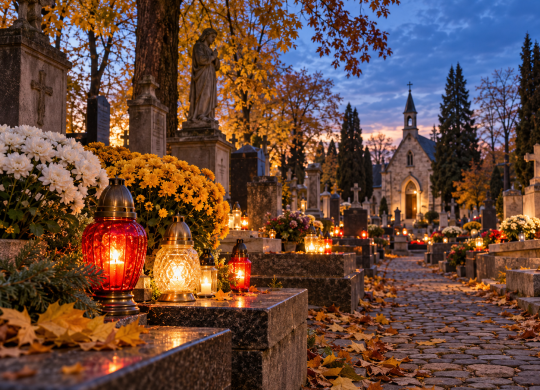
Many countries celebrate All Saints’ Day on November 1. In 2026, the holiday falls on a Sunday, and not everywhere will observe an additional day off on Monday. Learn more about the holiday’s history, traditions around the world, and public holidays on November 1 and 2

In early November, cemeteries in Poland are lit by thousands of candles; in France, people bring chrysanthemums to graves; and in Spain, they prepare traditional sweets. This is how different countries celebrate All Saints’ Day, combining church services with remembrance of loved ones. For travelers, these dates also mean possible changes in the operating hours of stores, public institutions, and public transportation. In 2026, November 1 falls on a Sunday, so before traveling, it’s a good idea to check whether November 2 will be a holiday in a specific country or region.
Planning a trip abroad and want to protect yourself from unforeseen situations?
Travel insurance from Visit World will cover medical expenses, flight delays, and lost luggage in any country. Get a policy online in a few minutes and travel with confidence!

When is All Saints’ Day celebrated, and what does the holiday signify?
All Saints’ Day is celebrated on November 1 in the Roman Catholic Church and many Western Christian communities. In 2026, it falls on a Sunday. The holiday is dedicated to all saints—both those officially recognized by the Church and those whose names remain unknown. In the Orthodox tradition, All Saints’ Sunday falls on the first Sunday after Pentecost, so it has a different, movable date.
In late October and early November, there are three related but distinct dates:
- October 31 – Halloween. Its English name comes from “All Hallows’ Eve”—the eve of All Saints’ Day. Modern costume parties and trick-or-treating are not part of the church celebration on November 1.
- November 1 – All Saints’ Day. In the Catholic tradition, this day honors all those who have attained holiness and are with God.
- November 2 – Commemoration of All the Faithful Departed. On this day, Catholics pray for the deceased. In Poland, it is called Zaduszki; in English-speaking countries, it is known as All Souls’ Day.
All Saints’ Day traditions often include visiting cemeteries, even though the church’s day of remembrance for the deceased comes later. For example, in Poland, families flock to the graves of their loved ones on November 1, bringing flowers and lighting candles. Therefore, in everyday perception, the holiday is closely associated with the memory of the deceased.
Learn more about the best amusement parks and festivals in Europe for Halloween 2026 by following the link.
How did All Saints’ Day originate?
The history of All Saints’ Day begins with the early Christian veneration of martyrs. As early as the 4th century, Christian communities held communal commemorations for those who had died for their faith. Over time, the holiday expanded to include all saints, not just martyrs.
A key event was the consecration of the Roman Pantheon as a Christian church. On May 13, 609, Pope Boniface IV dedicated it to the Virgin Mary and all the martyrs. The anniversary of the consecration was celebrated in May—the November date was established later. Some historical sources date this event to the year 610.
The origin of the November 1 holiday is associated with Pope Gregory III. In the 8th century, he dedicated a chapel in St. Peter’s Basilica to all the saints, and their commemoration in Rome was established on this date.
In the 9th century, under Pope Gregory IV, the celebration on November 1 spread throughout the Western Church.
The custom of visiting the graves of loved ones gradually became intertwined with the church calendar. Today, for many families, it is also a day of remembrance and reunion with loved ones. However, the holiday itself is dedicated to the saints, while a separate Catholic day of prayer for the dead falls on November 2.
In our previous article, we wrote about the most mystical places in Europe to celebrate Halloween 2026.
How is All Saints’ Day celebrated in different countries?
All Saints’ Day is celebrated around the world with church services, lighting candles, and visiting cemeteries. Local customs span both dates—November 1 and 2—ranging from treating children to kite festivals.
- Poland. On Wszystkich Świętych, families decorate graves with chrysanthemums and light small lamps—znicze. After sunset, cemeteries glow with thousands of lights. Visiting the graves of loved ones on November 1 remains one of the main family traditions.
- France. On La Toussaint, people bring chrysanthemums to graves. In 2023, these flowers accounted for 60% of the plants purchased by the French ahead of the holiday. Families often visit cemeteries specifically on November 1, even though the church’s Day of Remembrance for the Dead falls the following day.
- Spain. For Día de Todos los Santos, pastry shops prepare huesos de santo—filled marzipan “saints’ bones”—and buñuelos de viento—fried dough balls. In Catalonia, panellets are popular—small almond-based sweets, often topped with pine nuts.
- Italy. Following Ognissanti on November 1, the deceased are honored on November 2. In Sicily, children are left gifts and sweets supposedly from deceased relatives. Among the traditional treats are frutta martorana: confections made from almond paste that skillfully replicate fruits and vegetables.
- Portugal. The custom of Pão por Deus—“bread for God”—is still observed. On the morning of November 1, children go from house to house with little bags and receive bread, nuts, and sweets. This tradition is still widespread, particularly in the Azores.
- Austria. For the holiday, people bake Allerheiligenstriezel—a sweet braided yeast pastry sprinkled with sugar. Godparents give it to their godchildren. The custom is especially widespread in the eastern part of the country.
- Philippines. The days dedicated to honoring the deceased are called Undas. Families gather at cemeteries, bring flowers, light candles, and pray. Several generations of the family meet at the graves to remember their loved ones together.
- Guatemala. In Sumpango and Santiago Sacatepéquez, giant kites—barriletes gigantes—are displayed on November 1. They are made of paper and bamboo as a symbol of connection to ancestors. Some kites reach 22 meters in diameter. The smaller ones are flown in the sky, while the largest are put on display.
The Day of the Dead in Mexico is a unique tradition that blends the beliefs of indigenous peoples with Catholic holidays. Families set up altars (ofrendas) with candles, flowers, and the deceased’s favorite foods. According to local beliefs, the souls of loved ones temporarily return home. In 2008, the celebrations of Mexico’s indigenous communities were inscribed on UNESCO’s Representative List of the Intangible Cultural Heritage of Humanity.
We previously wrote about The Day of the Dead: Traditions of Celebrating Día de los Muertos in Mexico.
Will November 1 and 2, 2026, be holidays?
All Saints’ Day in 2026 falls on a Sunday, but an additional day off on Monday is not observed everywhere. The rules depend on the country, region, and sometimes the employer.
November 1 is an official holiday in Poland, France, Italy, Austria, Belgium, Portugal, Hungary, Croatia, Slovakia, Lithuania, and Luxembourg. In Slovenia, this day is observed as All Souls’ Day—also a non-working day. The fact that the holiday is on the calendar does not automatically mean that the day off is moved to Monday.
Regional differences apply in several countries:
- Germany. All Saints’ Day is an official holiday in five federal states: Baden-Württemberg, Bavaria, North Rhine-Westphalia, Rhineland-Palatinate, and Saarland.
- Switzerland. The status of the holiday depends on the canton and, in some cases, on the municipality. It is observed as a day off, in particular, in Lucerne, Ticino, Uri, Schwyz, Zug, and Valais. There is no nationwide day off.
November 2, 2026, is a day off in the following countries and regions:
- Spain – nine autonomous communities. Andalusia, Aragon, Asturias, the Canary Islands, Castile-La Mancha, Castile and León, Extremadura, Madrid, and Navarre will have a make-up holiday. In Catalonia and the Valencian Community, there is no region-wide holiday this Monday.
- Monaco. Since All Saints’ Day falls on a Sunday, the holiday is moved to Monday, November 2.
- Lithuania. Both dates are non-working days. November 2 is a separate All Souls’ Day, not a rescheduled Sunday holiday.
- Philippines. November 1 has been declared a special non-working day, and November 2 is an additional special non-working day in observance of All Souls’ Day.
- Belgium. Employees are entitled to a substitute day off for a holiday that falls on a Sunday. However, this is not necessarily November 2: the date is determined by industry regulations or company policy.
In Poland, November 2 remains a regular workday: no additional day off is granted for a holiday that falls on a Sunday. In France, there is also no general transfer to Monday.
Finland and Sweden have a unique calendar arrangement. There, All Saints’ Day is celebrated on the Saturday between October 31 and November 6. In 2026, this falls on October 31.
In our previous article, we discussed where to celebrate Halloween 2026 in Europe: the best cities and locations.
What should you keep in mind when traveling in early November?
When planning a trip for All Saints’ Day, be sure to take local holidays into account. Check the schedules for specific dates: Sunday hours on November 1 and Monday operating hours may vary even in neighboring regions.
- Stores and institutions. Buy what you need in advance. On holidays, supermarkets may be closed or have reduced hours. Tourist shops, pharmacies, and establishments at train stations may have different schedules.
- Public transportation. Check the schedule with your local transit provider. Near cemeteries, there may be additional trips, relocated stops, and route changes.
- Traveling by car. Allow extra time to reach cemeteries. Check city government or police websites for temporary traffic and parking restrictions.
- Museums and landmarks. A holiday does not mean that all sites are closed. Check opening hours and ticket availability. In places of worship, tourist visits may be restricted during services.
- Visiting cemeteries. Please be quiet, do not take close-up photos of people without permission, and do not disrupt family ceremonies. For local residents, these are first and foremost days of remembrance.
No matter how well thought-out your itinerary is, there is always room for force majeure when traveling. Unexpected medical expenses, transportation delays, or luggage problems can ruin your plans and budget. Travel insurance helps you avoid unnecessary worries in such situations. You can apply for a travel insurance policy for a specific trip online at Visit World - quickly and without unnecessary bureaucracy!
Take out a policy online at Visit World and enjoy your trip without any unnecessary worries!
We remind you! Skyscanner has highlighted 10 travel destinations for 2027 that have seen a noticeable surge in interest: from Bishkek to Samos, Greece. Read more about the top picks, their main attractions, and the best time to visit.
Products from Visit World for a comfortable trip:
Travel guide for 200 countries;
Legal advice from a local specialist on visa and migration issues;
Travel insurance around the world (please select the country of interest and citizenship to receive services);
Medical insurance all over the world.
We monitor the accuracy and relevance of our information, so if you notice any errors or inconsistencies, please contact our hotline
Frequantly
asked questions
When is All Saints’ Day in 2026?
How is All Saints’ Day different from Halloween?
Why do people visit cemeteries on All Saints’ Day?
Will November 2, 2026, be a holiday?
Are All Saints’ Day and the Day of the Dead in Mexico the same holiday?
Recommended articles
3 min
Events
Day of the Dead: traditions of celebrating Dia de los Muertos in Mexico
Mexicans are known worldwide for their unique attitude to life and death. It is in this country that the Day of the Dead is celebrated annually, when people honor the memory of their deceased loved ones with loud celebrations. Learn more about the history, symbols, and traditions of Dia de los Muertos in Mexico
17 Aug. 2024
More details3 min
Events
The Most Mystical Places in Europe to Celebrate Halloween 2026
Abandoned fortresses, haunted castles, and places linked to spine-chilling historical events attract tourists from all over the world. Learn more about Europe’s most mysterious locations worth visiting on Halloween 2026
21 Oct. 2026
More details3 min
Events
Where to Celebrate Halloween 2026 in Europe: Best Cities and Places
In 2026, you can turn Halloween into a full-fledged fall getaway featuring festivals, nighttime shows, and unique venues. Learn more about the most interesting places and events for celebrating Halloween in Europe
10 Oct. 2026
More details3 min
Events
The Best Amusement Parks and Festivals in Europe for Halloween 2026
Amusement parks and cities across Europe are preparing for Halloween 2026 with spooky mazes, costume parades, and evening shows. Learn more about the most exciting festivals, event dates, and activities for children and adults
13 Oct. 2026
More detailsAll materials and articles are owned by VisitWorld.Today and are protected by international intellectual property regulations. When using materials, approval from VisitWorld.Today is required.