

Poland remains the EU’s lowest-cost labor market: latest figures

Poland remains one of the most cost-effective EU countries in terms of labor costs, even despite the gradual rise in wages. In 2025, wages here will still be significantly lower than the European average, making the country attractive to businesses. Find out what labor actually costs in Poland and why this is a topic of debate among employers

For many years, Poland has maintained its position as a country with a relatively low-cost labor force within the European Union. It is this factor that makes it attractive to investors and allows businesses to maintain competitive prices for goods and services.
In recent years, labor costs here have been gradually rising, but the difference compared to other EU countries remains significant. In 2025, the average labor cost in Poland reached €19.1 per hour, which is still approximately 45% lower than the EU average. At the same time, even a modest increase in the minimum wage in 2026 drew criticism from the business community.
Earlier, we talked about the European countries where it is easiest to get a work visa and start a career abroad.
Are you planning to work abroad in 2026? Visit World's Work Guide will help you quickly understand the requirements for a work permit, the list of necessary documents, and the application procedure. The guide contains current employment rules, the main types of permits, common mistakes made by applicants, and practical advice after moving. You will receive structured information in PDF format within a few minutes after ordering. Check out the guide and prepare for working abroad without any stress.

How much does labor cost in Poland, and how does this compare to the rest of the EU?
Despite the gradual rise in wages, Poland remains among the countries with relatively low labor costs. This is clearly evident when compared to EU averages.
In 2025, average labor costs in Poland stood at 19.1 euros per hour. By comparison, the EU average reached 34.9 euros, and in the eurozone countries—38.2 euros. Thus, the difference remains significant: Poland is approximately 45% cheaper than the EU average.
Even the increase in this figure—from €17.3 to €19.1 over the year—does not alter the overall picture. The country still belongs to the group of nations with an affordable labor force, which maintains its appeal to investors and manufacturing companies.
When looking at other European countries, the difference becomes even more evident. The lowest labor costs in 2025 are recorded in Bulgaria (around 12 euros), Romania (13.6 euros), and Hungary (15.2 euros). Poland is slightly above this level but still significantly below the European average.
At the same time, the situation in the wealthiest EU countries is radically different. In Luxembourg, labor costs reach 56.8 euros per hour, in Denmark—51.7 euros, and in the Netherlands—47.9 euros. This is two to three times higher than in Poland.
It is precisely this gap that forms the key competitive advantage of the Polish labor market—relatively low costs while maintaining access to the single European market.
By the way, we recently reported that Poland is raising minimum wages for foreign and local workers.
Why is the business community criticizing the minimum wage increase in Poland?
Even a modest increase in the minimum wage in 2026—just 140 zlotys gross—has drawn significant criticism from employers. The reason is that for businesses, it is not the size of the increase itself that matters, but its impact on overall costs.
Polish companies operate in an environment of relatively low prices for goods and services, so opportunities to raise wages are limited. Rising labor costs without a proportional increase in revenue directly impact profitability.
In addition, employers are highlighting several key risks:
1. Rising labor costs reduce business margins, particularly in the manufacturing sector
2. Companies may cut back on hiring or postpone staff expansion
3. Pressure to automate and adopt new technologies is increasing
4. The likelihood of financial difficulties for small and medium-sized businesses is rising
It is also worth noting that an increase in the minimum wage affects more than just the lowest-paid workers. It often leads to a company-wide salary review, which further increases costs.
As a result, even small changes in the minimum wage can have a significant impact on the labor market. This is precisely why businesses in Poland react so sensitively to any decisions in this area.
Detailed information regarding the EU Blue Map in Poland — is available here.
What makes up labor costs in Poland?
Labor costs are not just the take-home pay an employee receives. For businesses, it is a much broader concept that includes all costs associated with maintaining staff.
The cost structure includes both direct payments to employees and mandatory additional payments, particularly social security contributions. It is this component that often significantly impacts the total labor cost for the employer.
On average, in the European Union, the share of additional costs is 24.8%, and in the eurozone countries, it is 25.6%. In Poland, this figure is lower—around 18%. This is another factor that makes the country attractive to businesses.
By comparison, in some EU countries, the burden on employers is significantly higher. For example, in France, the share of additional costs reaches 32.3%, in Sweden—31.7%, and in Slovakia—28.6%.
At the same time, there are countries with minimal additional costs. In Romania, this figure is only 4.8%, in Lithuania—5.5%, and in Malta—5.8%.
Thus, Poland occupies an intermediate position: social security contributions here are not the lowest in the EU, but are significantly lower than the European average. Combined with relatively low wages, this creates a general competitive advantage for the country in the labor market.
If you are planning to work abroad in 2026 and want to better understand the rules of employment, work permits, taxes, and basic employee rights, it is worth preparing for the move in advance. Visit World's practical working guide will help you navigate the current requirements, types of work permits, and steps to take upon arrival to avoid common mistakes and feel confident in your new life abroad.
We remind you! Krakow has been named the best city in Europe for digital nomads thanks to affordable prices, high safety standards, and fast internet. A new study covered dozens of popular destinations and revealed a clear trend favoring Central and Eastern Europe.
Products from Visit World for a comfortable trip:
Checklist for obtaining a visa and necessary documents in Poland;
Legal consultation on immigration to Poland;
Travel insurance for foreigners in Poland;
Medical insurance worldwide.
We monitor the accuracy and relevance of our information, so if you notice any errors or inconsistencies, please contact our hotline.
Recommended articles
1 min
Work
Polska ogłosiła podwyżkę minimalnego wynagrodzenia oraz nowe progi dochodowe dla cudzoziemców, którzy potrzebują zezwolenia na pracę, Karty Niebieskiej UE lub są w trakcie wewnętrznego przeniesienia w ramach firmy. Dowiedz się, jakie kwoty będą obowiązywać od 2026 roku i jak wpłynie to na zatrudnienie
20 lis. 2025
More details2 min
Work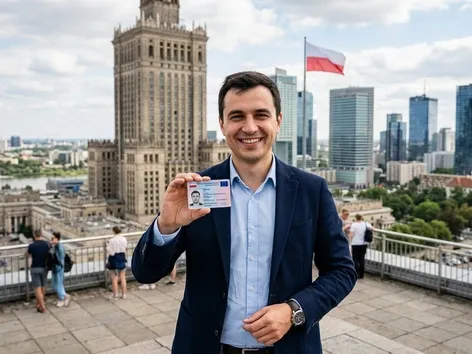
Niebieska Karta UE w Polsce to możliwość legalnej pracy i uzyskania statusu rezydenta. Dowiedz się, kto może ją otrzymać, jakie są wymagania w 2026 roku i jak złożyć wniosek
23 mar. 2026
More details3 min
Expats
Kraków jest najlepszym miastem dla cyfrowych nomadów w Europie: ranking 2026
Kraków został uznany za najlepsze miasto w Europie dla cyfrowych nomadów ze względu na przystępne ceny, wysoki poziom bezpieczeństwa i szybki internet. Nowe badanie objęło dziesiątki popularnych destynacji i pokazało wyraźny trend na rzecz Europy Środkowej i Wschodniej. Dowiedz się więcej o miastach uwzględnionych w rankingu i ile będzie kosztować życie jako cyfrowy nomada w 2026 roku
24 mar. 2026
More details3 min
Expats
Ranking polskich miast według jakości życia w 2026 roku: Gdzie jest najlepsze miejsce do życia?
Business Insider zaktualizował swoje zestawienie jakości życia w stolicach województw w Polsce—Poznań i Rzeszów zajęły czołowe miejsca, podczas gdy Wrocław i Kraków niespodziewanie znalazły się na końcu listy. Dowiedz się więcej o najlepszych i najgorszych miastach w Polsce do życia
26 mar. 2026
More detailsAll materials and articles are owned by VisitWorld.Today and are protected by international intellectual property regulations. When using materials, approval from VisitWorld.Today is required.