

What Drivers Need to Know in Germany in 2026: Traffic Rules, Fines, and the Autobahn
Table of contents
- Basic Traffic Rules in Germany
- Fines and Enforcement in Germany
- Traffic Rules on the Autobahn
- Are roads tolled in Germany?
- What’s important to know about the Autobahn?
- Environmental Zones (Umweltzone)
- Gas Stations and Fuel in Germany
- Parking in German Cities
- Unusual Traffic Rules in Germany
- Documents and Required Equipment
- Winter Tires and Winter Rules
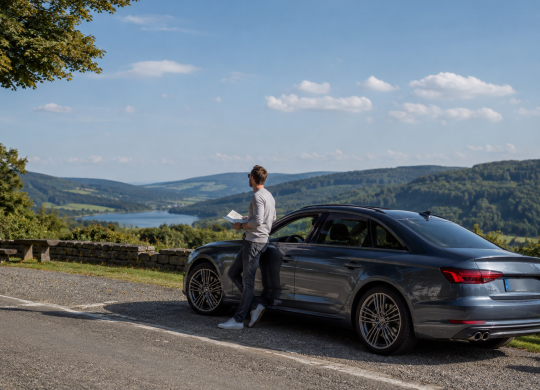
German autobahns are known for sections with no general speed limit, but that doesn’t mean you can drive however you want. Many sections have permanent or temporary speed limits, and cities have Umweltzonen in place; using a cell phone or seriously exceeding the speed limit can result not only in a fine but also in a driving ban. Find out what rules apply on German roads in 2026 and what you should check before your trip

Germany remains one of the most convenient countries in Europe for road travel. There is no general toll sticker for passenger cars, and the Autobahn network allows travelers to quickly cover long distances between Berlin, Munich, Hamburg, Frankfurt, and other cities.
The most well-known feature is that some sections of the Autobahn truly have no mandatory speed limit. However, a recommended speed of 130 km/h applies on these sections, and road signs may impose a lower limit at any time. Outside built-up areas, the standard limit for passenger cars is 100 km/h; in cities, it is 50 km/h.
In this guide, we’ll cover Autobahn rules, fines, environmental zones, parking, winter tires, and the documents you’ll need for a trip through Germany.
Are you planning a trip to Europe by car?
In many countries, highways are tolled and require an electronic road vignette. This is a digital permit that confirms payment for the use of toll roads and is checked automatically by the license plate number - without stickers and paper receipts. Making a vignette online before you travel will help you avoid fines, travel delays, and unpleasant situations during inspections.

Basic Traffic Rules in Germany
In Germany, the basic rules are simple, but the Autobahns have important exceptions. Drivers need to constantly watch for signs, as speed limits often change due to traffic, roadwork, or weather conditions.
The following general limits apply to passenger cars:
- 50 km/h – in built-up areas
- 100 km/h – on regular roads outside cities
- 130 km/h – the recommended speed on the Autobahn and certain expressways without a set limit
On the Autobahn, 130 km/h is the Richtgeschwindigkeit, or recommended speed. Unless a sign specifies a different limit, a passenger car may drive faster. However, in the event of an accident, exceeding the recommended speed may affect the allocation of liability.
If visibility drops below 50 meters due to fog, snow, or heavy rain, the speed must be reduced to a maximum of 50 km/h. The same restriction applies to vehicles traveling with snow chains installed.
To learn more about which European countries have introduced new speed limits on highways, follow the link.
Drinking and Driving
For most drivers in Germany, the limit is 0.5‰. For drivers under the age of 21 and those still in their probationary period after obtaining their license, driving under the influence is completely prohibited.
Even a lower blood alcohol level can have consequences if the driver exhibits signs of dangerous driving or is involved in a traffic accident.
In our previous article, we discussed where in Europe it’s cheapest and fastest to charge an electric vehicle.
Cell Phones, Seat Belts, and Child Safety Seats
Holding a cell phone in your hand while driving is prohibited. You may use a smartphone via a hands-free system or another system that does not require you to hold the device. These rules apply not only to cell phones but also to other electronic devices used for communication, navigation, or information.
Seat belts are mandatory for the driver and passengers. Children under 12 years of age or shorter than 150 cm must be transported in an appropriate child restraint system.
Another characteristic German regulation concerns lighting. For passenger cars, there is no general requirement to use low beams continuously during the day.
They are required in tunnels, at night, and in conditions of poor visibility. Daytime running lights are recommended in all cases.
Learn more about toll roads and traffic rules in Hungary by following the link.
Fines and Enforcement in Germany
In Germany, penalties depend not only on the violation itself. For serious offenses, a driver may receive penalty points in Flensburg and a temporary driving ban.
Typical penalties include:
- Speeding by up to 10 km/h – starting at €20
- Speeding by 21–25 km/h in an urban area – approximately €115 and 1 penalty point
- Speeding by 31–40 km/h in an urban area – starting at €260, 2 penalty points, and a possible driving ban
- Using a cell phone while driving – starting at €100 and 1 point
- Failure to form a Rettungsgasse – starting at €200, 2 points, and a driving ban
- Driving in the emergency lane – even harsher penalties
- Failure to maintain a safe following distance – the fine depends on speed and the actual distance to the vehicle ahead
Enforcement is particularly strict on the Autobahn. There are fewer speed cameras than in cities, but there are many mobile checkpoints and cameras at roadwork sites.
We previously discussed the most common reasons tourists are fined on European roads in 2026.
Traffic Rules on the Autobahn
The German Autobahn has its own set of traffic rules. High speeds here are combined with strict rules regarding lanes, passing, and behavior in traffic jams.
One of the main rules is the Rechtsfahrgebot, or the obligation to stay in the right lane. The left lane is used primarily for passing. After passing, you must return to the right lane. You are not allowed to drive continuously in the middle or left lane without a valid reason.
As a general rule, passing on the right on the Autobahn is prohibited. An exception is possible in heavy traffic when traffic is moving slowly and the right lane is actually moving faster.
When entering the Autobahn, vehicles already traveling on the main road have the right of way. A driver in the acceleration lane must find a safe gap on their own and only then change lanes.
We previously reported that Europe is introducing new measures to combat drunk driving: cars won’t start after alcohol consumption.
What to do in a traffic jam?
As soon as traffic slows to a walking pace or comes to a stop, you must form a Rettungsgasse. You must not wait until an ambulance or fire truck appears behind you.
The rule is simple:
- Vehicles in the far-left lane move as far to the left as possible
- All other lanes move to the right
- The emergency lane must not be used without permission
The corridor is formed between the far-left lane and the adjacent right lane, regardless of whether the Autobahn has two, three, or four lanes.
Using the Rettungsgasse to bypass a traffic jam is prohibited. Such a maneuver carries a fine of €240, two penalty points, and a one-month driving ban. If the driver creates an obstruction or a hazard, the fine may increase to €320.
Another important detail: you must not stop on the Autobahn unless absolutely necessary. The emergency lane is intended for actual breakdowns, traffic accidents, and other emergencies—not for making phone calls, checking your route, or taking a short break.
In our previous article, we discussed the specifics of driving in the Czech Republic: roads, vignettes, parking, and fines in 2026.
Are roads tolled in Germany?
There is no general road vignette or toll for using the Autobahn in Germany for passenger cars. This is one of the main differences from Austria, Slovenia, or Switzerland.
Most Autobahns and federal highways are free for passenger cars. The Lkw-Maut toll system applies primarily to commercial vehicles. Starting July 1, 2024, it will apply to vehicles with a technically permissible maximum weight exceeding 3.5 metric tons if they are intended for or used to transport goods.
However, there are a few local exceptions. Tolls may be charged for travel through certain private tunnels, bridges, or special scenic roads. This is not a nationwide system, but rather individual facilities with their own rates.
For a typical tourist trip between Berlin, Hamburg, Frankfurt, Cologne, Stuttgart, or Munich, you do not need to purchase a vignette.

What’s important to know about the Autobahn?
Free travel does not mean there are no restrictions. Permanent or temporary speed limits are in effect on many sections of the Autobahn. These may be imposed due to roadwork, heavy traffic, noise control, or weather conditions.
Speed limits displayed on electronic signs may change throughout the day. If a sign shows a specific speed, it is mandatory.
There’s a separate rule regarding fuel. Stopping on the Autobahn because your tank is empty may be considered a violation, since running out of fuel is deemed a foreseeable reason for stopping. Therefore, on long trips, it’s best not to wait until the very last minute to refuel.
Learn more about the world’s best countries for road trips in 2026 by following the link.
Environmental Zones (Umweltzone)
In Germany, environmental restrictions do not apply nationwide but rather in specific cities and metropolitan areas. These zones are called Umweltzone. A vehicle may need an Umweltplakette (environmental sticker) to enter.
The green sticker is most commonly used. It confirms that the vehicle meets the requirements of a specific zone. Without it, entry into an Umweltzone may be prohibited even if the vehicle itself meets the emissions standards.
Before your trip, you should check:
- Is there an Umweltzone in the city you’re visiting?
- Do you need a sticker for your specific vehicle?
- Do the restrictions apply to foreign license plates?
- Are there separate rules for diesel vehicles?
- Where are the zone’s boundaries?
This is especially important for trips to major cities. The rules may differ between Berlin, Munich, Stuttgart, and other metropolitan areas.
Foreign vehicles must also comply with these requirements. You can obtain the sticker using the information from your vehicle’s registration document. It must be displayed on the windshield before entering the zone.
The fine for entering an Umweltzone without the required sticker can be as high as €100. Therefore, before traveling to the center of a major city, it’s best to check the environmental regulations just as carefully as you would parking rules or your route.
Learn more about current toll rates in Poland for 2026 by following the link.
Gas Stations and Fuel in Germany
In Germany, it’s easy to refuel even on a long trip, but fuel prices vary significantly by location. At service stations directly along the Autobahn, gasoline and diesel are often more expensive than in cities or near highway exits.
The most common types of fuel at German gas stations are:
- Super E5 – gasoline with up to 5% ethanol
- Super E10 – gasoline with up to 10% ethanol
- Super Plus – gasoline with a higher octane rating
- Diesel – standard diesel fuel
- AdBlue – for diesel vehicles with an SCR system
Before refueling, it’s important to check whether the vehicle manufacturer approves the use of E10. Most modern gasoline-powered cars are compatible with it, but there may be exceptions for older models.
Prices in Germany fluctuate throughout the day. That’s why drivers often use apps and fuel price comparison services. The Federal Cartel Office also collects price data through the Markttransparenzstelle für Kraftstoffe system.
For long trips, it’s most cost-effective to refuel not on the highway itself, but after exiting to the nearest city or industrial area. The price difference can be significant, especially with a full tank.
Another practical detail: stopping on the Autobahn because your tank is empty may be considered a violation. In Germany, running out of fuel is viewed as a situation the driver could have avoided. Therefore, it’s best to monitor your fuel level in advance.
Learn more about the specifics of traveling through Slovakia in your own car by following the link.
Parking in German Cities
In Germany, parking rules vary by municipality, but the basic principles are similar. In the centers of large cities, most spaces are paid, and free parking is often time-limited or available only to residents.
On the streets, pay attention not only to the road markings but also to traffic signs. Next to a “P” sign, there may be additional signs indicating paid hours, maximum parking duration, or a requirement to use a parking disc.
A parking disc (Parkscheibe) is required where parking is free but time-limited. You must set the disc to the nearest half-hour following your arrival. For example, if a car is parked at 10:10, set the disc to 10:30.
In the central districts of Berlin, Munich, Hamburg, Cologne, and Frankfurt, it’s more convenient to use underground parking garages or P+R facilities. This helps you avoid complicated local rules and a long search for an available spot.
You should also pay special attention to signs that read “Bewohner mit Parkausweis.” These indicate that the spaces are reserved for residents with a valid permit. Tourists are not allowed to park there, even for a short time.
Fines for illegal parking depend on the nature of the violation. If a car is blocking a sidewalk, bike path, or driveway, or creating a hazard, the fine increases. In serious cases, the car may be towed.
We previously wrote about the ins and outs of traveling through Croatia by car: fines, highways, parking, and important traffic rules.
Unusual Traffic Rules in Germany
In Germany, there are several rules that are easy to overlook if a driver is accustomed to other European countries. They aren’t complicated, but it’s precisely these details that often lead to fines or conflicts on the road.
One of the basic rules is “rechts vor links,” meaning “right has the right of way.” It applies at uncontrolled intersections unless signs indicate otherwise. Therefore, even on a small residential street, a car on the right may have the right of way.
Another important principle is the “Reißverschlussverfahren,” or “zipper method.”
If one of the lanes ends, drivers should use it almost up to the point where it narrows. Then the cars merge one at a time: one from the main lane, one from the lane that is ending.
The “Umleitung” sign is often seen on the roads. It indicates an official detour due to roadwork, an accident, or a road closure. Such routes may lead far from the main road, so it’s important to pay close attention to additional arrows and numbers.
Special attention should be given to cyclists. When passing a cyclist, a car must maintain a safe lateral distance. In urban areas, this distance is at least 1.5 meters; outside built-up areas, it is 2 meters.
Also, in Germany, you shouldn’t let the engine idle for a long time while stationary. Unnecessary engine idling creates noise and emissions, so you may be fined for it. In winter, it’s better to clear the windshield of ice and start driving without letting the engine idle for too long.
Learn more about traffic rules, fines, toll roads, and regulations for driving in Austria in 2026 by following the link.
Documents and Required Equipment
To drive through Germany in your own car, the driver must have a valid driver’s license, vehicle registration documents, and proof of insurance. If the car is rented or belongs to someone else, it’s also advisable to have a document confirming your right to use the vehicle.
While on the road, you should have the following:
- Driver’s license
- Vehicle registration certificate
- Passport or ID
- Insurance document
- Rental agreement or owner’s permission, if the car is not yours
- Hazard warning triangle
- Reflective vest
- First-aid kit
For cars registered in Germany, the first-aid kit must comply with the current requirements of DIN 13164. For foreign-registered vehicles, the rules of the country of registration apply, but it is best to have basic emergency equipment regardless of any formal exceptions.
In our previous article, we discussed traffic rules in Italy in 2026, Autostrade tolls, fines, and key considerations for road travel.
Green Card for Travel to Germany
For a foreign-registered vehicle, it is important not only to have insurance but also to ensure that it is recognized in Germany. In this case, the Green Card serves as proof of international liability insurance.
This document is especially useful in the event of a traffic accident. It contains the insurer’s details and information about insurance coverage, which may be required by the police or the other party involved in the accident.
Before departing, you should check the Green Card’s validity period and ensure that Germany is included in the coverage area. If the policy expires during your trip, you must renew it before crossing the border.
You can apply for a Green Card online at Visit World. This allows you to obtain the insurance document before your trip and avoid wasting time on paperwork while on the road.
Winter Tires and Winter Rules
In Germany, there is no fixed calendar period during which all vehicles are required to use winter tires. Instead, a situational rule applies: winter tires are required when the road is covered with snow, black ice, slush, or a layer of ice.
Starting in October 2024, tires marked only with “M+S” will no longer be considered sufficient. For winter conditions, tires must bear the Alpine symbol—a mountain with three peaks and a snowflake (3PMSF). This rule will also apply in 2026.
If a vehicle encounters winter conditions while equipped with unsuitable tires, a fine may be imposed. The amount increases if this causes an obstruction, a hazard, or an accident.
In Germany, you are not required to carry snow chains with you at all times. However, on certain mountain roads, a sign may make their use mandatory. When snow chains are installed, the speed limit is 50 km/h.
You should pay particular attention to your vehicle’s equipment before traveling to the Bavarian Alps, the Black Forest, and other mountainous regions. The weather there can change much more quickly than in large cities.
The rule of thumb is simple: if your route takes you through Germany in winter, it’s best not to rely solely on the date. You need to check the actual road conditions and the forecast for your specific route.
Are you traveling abroad with your own car or a rented car?
Before traveling, it is important to check whether a road vignette is required for toll roads in the countries of your route. Failure to have a valid vignette can result in fines and automatic camera recordings of violations. Getting an electronic vignette from Visit World is an easy way to travel more relaxed, without unnecessary expenses and surprises on the road!
We remind you! Traveling through Europe in 2026 does not have to be expensive, even despite the general rise in prices. Analysts have compiled a rating of the most affordable destinations where you can combine relaxation, experiences, and moderate expenses. Follow the link to learn about budget locations in Europe that are worth considering for your 2026 vacation.
Products from Visit World for a comfortable trip:
Travel guide for 200 countries;
Legal advice from a local specialist on visa and migration issues;
Travel insurance around the world (please select the country of interest and citizenship to receive services);
Medical insurance all over the world.
We monitor the accuracy and relevance of our information, so if you notice any errors or inconsistencies, please contact our hotline.
Frequantly
asked questions
Is a vignette required in Germany?
Is it true that there are no speed limits on the Autobahn?
Do foreign cars need an Umweltplakette?
Are winter tires mandatory in Germany?
What is the fine for using a cell phone while driving?
Recommended articles
3 min
Transport
Traveling Through Croatia by Car: Fines, Highways, Parking, and Important Traffic Rules
Croatia does not have a road vignette, but most major highways are toll roads, and the toll amount depends on the route and vehicle category. Added to this are seasonal traffic jams on roads leading to the Adriatic, speed cameras, and specific parking rules in popular tourist cities. Find out how Croatian highways work, what traffic rules and fines are in effect in 2026, and what you should consider before taking a road trip
20 Aug. 2026
More details3 min
Transport
Slovakia by Car in 2026: Traffic Rules, Fines, Vignettes, and Toll Roads
It’s easy to drive through Slovakia in a few hours, but a single mistake with eZnamka can make a short transit much more expensive. Toll highways here are monitored by license plate numbers, separate rules apply to trailers, and in winter, drivers also have to contend with the weather in the Tatra Mountains. Let’s break down how much Slovakia’s roads will cost in 2026, where a vignette is required, and which rules you shouldn’t ignore
30 Aug. 2026
More details3 min
Transport
Toll Roads and Traffic Laws in France in 2026: What Drivers Need to Know
France does not require a general road vignette, but many highways operate under the péage system, and dozens of cities have ZFE environmental zones that require a Crit’Air sticker. Added to this are hundreds of speed cameras, varying speed limits depending on weather conditions, and local regulations in cities. Find out how to pay for roads in France in 2026, where a Crit’Air sticker is required, and what rules you should know before your trip
03 Sep. 2026
More details3 min
Transport
Traveling Through Slovenia by Car: Vignette, Toll Roads, and Traffic Rules
In Slovenia, an electronic vignette is required for most highways and expressways. It is linked to the license plate, and different rate classes apply to passenger cars and tall vans. The Karavanke Tunnel requires a separate fee. Find out how the e-vignette works in Slovenia in 2026, where it’s required, and what rules you should know before your trip
10 Sep. 2026
More detailsAll materials and articles are owned by VisitWorld.Today and are protected by international intellectual property regulations. When using materials, approval from VisitWorld.Today is required.