Icon

The US is expanding the H-2B program in 2026: +64,716 visas for temporary workers

Work
Residence permit
Employment
USA (United States)
The US is expanding the H-2B program in 2026: +64,716 visas for temporary workers

In fiscal year 2026, the US government adopted an interim rule that significantly increases the number of H-2B visas for foreign workers in non-agricultural fields. The decision is aimed at covering labor shortages in key industries and supporting businesses. Learn more about the H-2B visa requirements, new quotas, and important filing deadlines in 2026

Order a consultation with a migration specialist to avoid unpleasant situations during the move
GET


The U.S. Department of Homeland Security (DHS) and the Department of Labor (DOL) have approved an interim rule that provides for an additional 64,716 H-2B visas in fiscal year 2026. This decision was made in response to the chronic labor shortage in certain sectors of the US economy, including tourism, hospitality, construction and infrastructure maintenance.

The expansion of the quota allows employers to hire more foreign workers for temporary and seasonal work, and opens up additional opportunities for candidates from abroad to work legally in the United States. At the same time, the new rule is accompanied by clear deadlines for filing petitions, dividing visas into separate tranches, and enhanced employer verification, which is important to consider when planning your migration steps.


Are you planning to travel, move or work abroad?

A migration lawyer will help you choose the right type of visa or permit, prepare an error-free package of documents and reduce the risk of rejection. Get professional advice now and save time, money and nerves at every stage of the migration process.


What is an H-2B visa and who is it for?


The H-2B visa is a temporary US work visa for foreigners who are engaged in non-agricultural work for a limited period of time. The program was created for situations when American employers cannot find a sufficient number of local workers who are ready and able to perform a specific job within a certain time frame.


Most often, the H-2B program is used in industries with seasonal or peak workloads, where the demand for labor increases sharply during certain periods of the year. These include, in particular, the hotel and restaurant business, tourism, resort services, landscape and maintenance work, construction projects, as well as certain types of manufacturing and logistics services.


To participate in the program, the employer must prove that the need for workers is temporary and that there are not enough citizens or permanent residents in the US labor market who are able and willing to fill these vacancies. A separate condition is to confirm that the hiring of foreign workers will not worsen the level of remuneration and working conditions for American workers in similar positions.


How many additional visas will the H-2B program receive in 2026?


In fiscal year 2026, the US government has authorized an additional 64,716 H-2B visas above the standard annual quota. This means a significant expansion of opportunities for employers who hire foreign workers for temporary non-agricultural work, as well as an increase in the chances for candidates to obtain legal employment in the United States.


The overall picture of quotas for 2026 is as follows:

- 66,000 H-2B visas - the basic annual quota provided for by law;

- 64,716 visas - additional visas introduced by the temporary rule of DHS and DOL;

- In total, employers can expect to receive more than 130,000 temporary employment permits under the H-2B program during the fiscal year.


It is important to note that the number of additional visas in 2026 is consistent with the expansion that was applied in the previous fiscal year. At the same time, the temporary rule is valid only for the fiscal year 2026 and does not automatically guarantee the preservation of the increased quota in the future.


About the H-1B visa to the United States, one of the most popular ways to obtain legal employment, we talked about in our previous article.


How will the additional 64,716 visas be allocated?


The additional H-2B visas in FY2026 will not be allocated in a single batch, but rather according to a clearly defined logic, taking into account the type of applicants and the period of commencement of work. The main goal of this approach is to allocate the majority of the quota to workers who have already participated in the program before and to evenly cover the needs of businesses throughout the year.


There are two main areas of allocation within the additional quota:

- 46,226 visas are reserved for so-called “returning workers” - foreigners who already had H-2B status or a visa in fiscal years 2023, 2024 or 2025;

- 18,490 visas are allocated for applications with start dates between May 1 and September 30, 2026, as well as for the use of unused visas from previous allocations, regardless of whether the candidates have previously worked under the H-2B program.


This separation means that employers and employees who already have experience in the program have the best chance of obtaining visas. At the same time, a separate pool of visas remains available for new candidates, in particular for seasonal work in the second half of the fiscal year.


Earlier, we reported that the United States has already suspended the issuance of immigration visas for 75 countries.


Schedule of the three stages of visa allocation in 2026


The additional H-2B visas in FY2026 will be allocated in stages - through several separate “tranches” tied to the period of commencement of work of foreign workers. This approach allows for an even distribution of the quota throughout the year and avoids a situation where all additional visas are exhausted at the beginning of the fiscal period.


First stage: start of work from January 1 to March 31, 2026


At this stage, 18,490 additional visas are available for “returning workers,” i.e. foreigners who held H-2B status in fiscal years 2023-2025. Employers will be able to file petitions after the USCIS announces that the second half of the H-2B cap has been reached. The deadline for filing is limited - no later than 14 days after the announcement.

If the number of approved petitions does not allow to use the entire quota of this phase, unused visas will be transferred to the second phase of the allocation.


The second stage: start of work from April 1 to April 30, 2026


For this period, 27,736 additional visas for returning workers are provided, as well as the possible use of unused numbers from the first stage. The petition period opens 15 days after the second half of the statutory H-2B cap is reached - the exact date is announced by the USCIS separately.

If the quota for this phase is not fully utilized, the remaining visas will be carried over to the next phase for applications with start dates after May 1, 2026.


Third stage: start of work from May 1 to September 30, 2026


At the final stage, 18,490 additional visas are available, as well as any unused visas from previous stages. It is important to note that at this stage, the requirement of “returning worker” status does not apply - new candidates can also apply.

Petitions may be filed no earlier than 45 days after the second half of the H-2B cap is reached. If a portion of the visas remains unused, it will not be carried over to fiscal year 2027.


What is the Visa Bond programme in the United States 2026 — read here.


Important petition deadlines and restrictions


In addition to the phased allocation of additional H-2B visas in 2026, the interim rule establishes a clear timeframe within which employers can file petitions. Missing these deadlines effectively eliminates the possibility of taking advantage of the additional quota, even if the visas are still formally available.


The key restrictions and deadlines are as follows:

1. Petitions for additional H-2B visas can only be filed at a valid filing address designated by the USCIS;

2. After September 15, 2026, petitions for additional visas will no longer be allowed;

3. After September 30, 2026, such petitions cannot be approved, even if they were filed earlier.


These deadlines mean that employers need to plan their H-2B hiring in advance and not postpone the preparation of documents until the end of the fiscal year. In practice, the main competition for additional quotas occurs in the first days after the opening of each tranche, so delaying the application process significantly reduces the chances of success.


By the way, in our previous article, we talked in detail about the new US citizenship test in 2026.


What are the requirements for employers to obtain additional visas?


Additional H-2B visas in fiscal year 2026 will be available only if the employer can demonstrate a genuine need to hire foreign workers. The interim rule retains the approach of previous years: additional quotas are not “automatic” and require separate justification by companies.


The key requirement is that the employer must demonstrate the existence or inevitability of irreparable damage to the business if it fails to hire all the employees specified in the petition. This is not just about inconvenience or reduced profitability, but about the real risks of breaching contracts, closing facilities, or stopping services due to lack of staff.


In addition, the general terms and conditions of the H-2B program apply, which employers are obliged to comply with regardless of the additional quota:

1. Prove that the US labor market lacks employees who are able, willing and ready to perform the relevant work;

2. Confirm that hiring foreign workers will not result in lower wages or worse working conditions for U.S. workers in similar positions;

3. Comply with the certification procedures of the Department of Labor and the rules for filing petitions with the USCIS.


Employee protection and additional employer screening


The interim rule on additional H-2B visas in FY2026 is not limited to increasing the quota. A special emphasis is placed on strengthening control over the observance of labor rights and preventing abuse by employers who hire foreign labor.


In particular, employers applying for additional visas will be subject to extended checks as part of the application process. Special attention will be paid to companies that have previously committed violations of labor laws under the H-2B program. In such cases, applications may be subject to additional scrutiny, and the decision to grant access to an additional quota will be made more cautiously.


In addition, DHS and DOL have announced their intention to conduct audits of petitions for additional visas during the fiscal year 2026. In the event of material violations, employers may face serious consequences, including revocation of temporary labor certification, cancellation of petitions, imposition of financial penalties, or even temporary or permanent prohibition of participation in the H-2B program. This approach is intended to simultaneously protect both U.S. workers and foreigners coming to the U.S. for temporary work.


Who should pay attention to the H-2B program in 2026?


The expansion of the H-2B quota in fiscal year 2026 will primarily be useful for industries where staff shortages are seasonal or peak and directly affect the ability of businesses to fulfill their obligations to customers. In such industries, labor shortages often lead to reduced working hours, disruption of contracts, or temporary closure of facilities.


The H-2B program has traditionally been of greatest practical interest to:

1. Hotel and restaurant business and tourism infrastructure;

2. Resort areas, theme parks, and recreation services;

3. Construction and repair companies with seasonal projects;

4. Companies providing landscape, cleaning and other services;

5. Logistics and manufacturing companies that have peak loads during certain periods of the year.


For foreign workers, participation in the H-2B program in 2026 may be especially relevant if they have previous experience in the United States under this visa category. At the same time, the additional quota in the second half of the fiscal year opens up opportunities for new candidates seeking legal temporary employment in the United States in areas with high demand for personnel.


If you are planning to apply for a work visa, temporary employment abroad, or have questions about migration procedures, contacting a professional migration lawyer will help you avoid mistakes and unnecessary delays. Visit World specialists advise on the requirements of different countries, help prepare a package of documents, assess the chances of obtaining a visa, and accompany the application process at every stage: from choosing the grounds for entry to obtaining a permit for legal stay abroad.


We remind you! The United States has introduced new, stricter border crossing rules for non-US citizens. We discuss the new conditions for foreigners entering the US in 2026 here.


Products from Visit World for a comfortable trip:


Checklist for obtaining a visa and necessary documents in the USA;

Legal advice on immigration to the USA;

Travel insurance for foreigners in the USA;

Medical insurance all over the world.


We monitor the accuracy and relevance of our information, so if you notice any errors or inconsistencies, please contact our hotline.

Recommended articles

1 min

Residence permit The US to Suspend Immigrant Visa Issuance for 75 Countries From January 21, 2026, and Revoke Over 100,000 Visas in 2025: Who Is Affected?
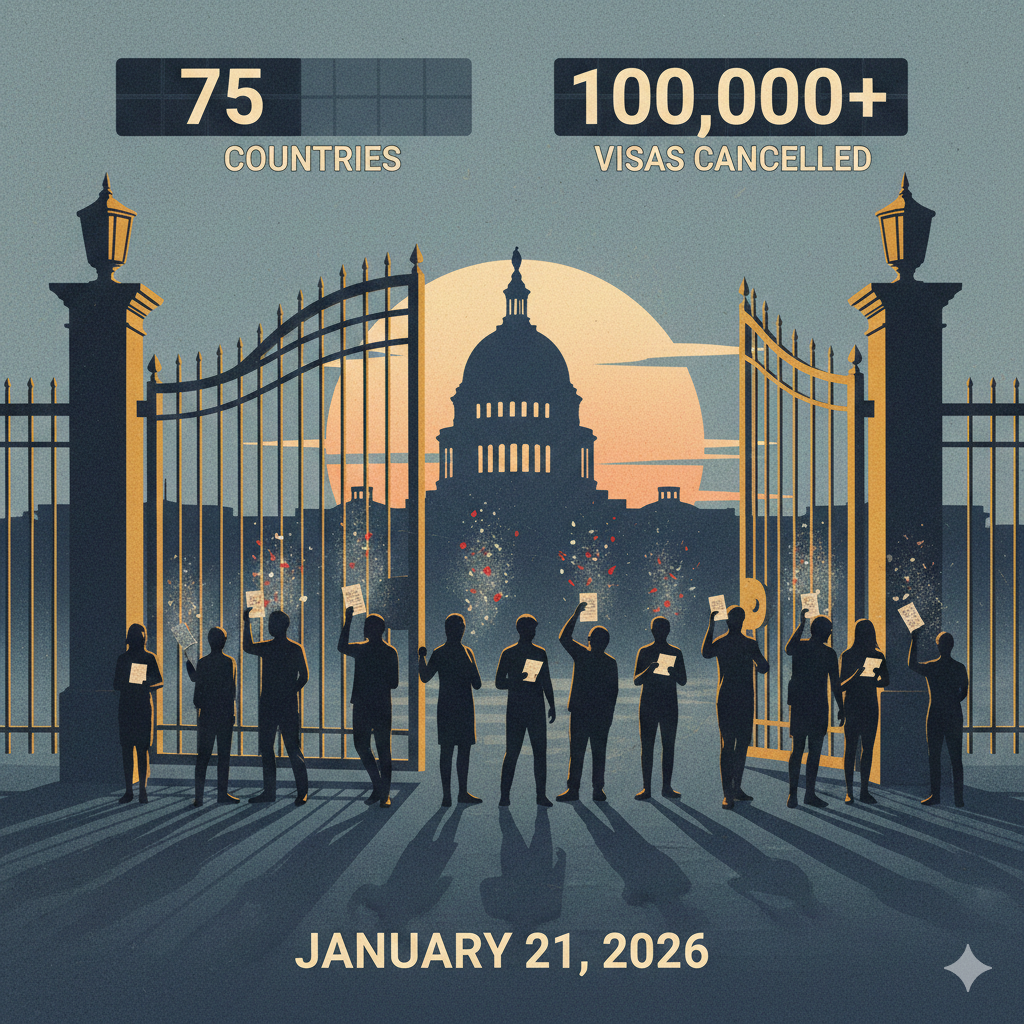
The US to Suspend Immigrant Visa Issuance for 75 Countries From January 21, 2026, and Revoke Over 100,000 Visas in 2025: Who Is Affected?

The US has been suspending visa processing for citizens of 75 countries since January 21 and has already massively canceled over 100,000 visas for 2025. Find out who is at risk, the reasons for the decisions, and what applicants should do

14 sty. 2026

More details

1 min

Blog REAL ID in the USA: from February 1, passengers without a document will have to pay $45

REAL ID in the USA: from February 1, passengers without a document will have to pay $45

Starting February 1, 2026, TSA is tightening REAL ID controls in the US – anyone who does not have a REAL ID will be forced to go through ConfirmID and pay $45. Find out who will be affected by the new rules and what are the alternatives

28 sty. 2026

More details

1 min

Employment H-1B Visa 2027: Registration Dates, New Selection Rules, and Changes in US Fees

H-1B Visa 2027: Registration Dates, New Selection Rules, and Changes in US Fees

The H-1B visa remains one of the most popular paths to legal employment in the U.S. Learn about the H-1B visa filing for FY 2027: key dates, weighted lottery system, possible $100,000 cap, and tips for employers and applicants

03 lut. 2026

More details

3 min

Travels New ESTA rules for travel to the United States: tourists' trips cancelled due to errors in applications

New ESTA rules for travel to the United States: tourists' trips cancelled due to errors in applications

Due to updates to ESTA application rules, travellers are increasingly facing refusals to enter the United States before they even begin their journey. Even previously approved permits can be revoked due to technical errors in the application, resulting in cancelled flights, cruises and business trips. Learn more about the new ESTA requirements, key risks for tourists, and how to prepare for your trip without unpleasant surprises

05 lut. 2026

More details