

New EU entry rules have brought airports to a standstill: passengers are waiting for hours
Table of contents
- What is happening at EU airports following the launch of the new system?
- What is the EES system and how are EU entry rules changing?
- Why the system failed: technical and organizational issues
- The European Commission’s Position: Is Everything Really “Working Well”?
- What does this mean for passengers in 2026?
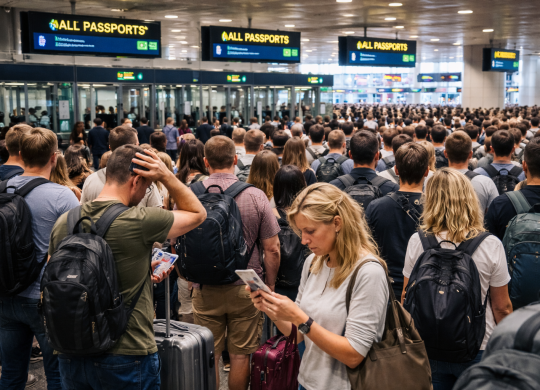
The EU’s new border control system, which involves the collection of biometric data, has already caused widespread delays at airports. Passengers are forced to wait for up to several hours, and the situation could worsen this summer. Learn more about why the new system has caused chaos and how it will affect travel in 2026

The launch of a new electronic border control system in the European Union has caused major disruptions at airports. According to the Financial Times, passengers in several countries are already facing delays of up to three hours while going through security. The heaviest traffic is being reported at both major international hubs and regional airports in France, Germany, Spain, and other countries.
The main cause is the full implementation of the Entry/Exit System (EES), which requires mandatory registration of biometric data for third-country nationals. Although the system is intended to strengthen border security, in practice its launch has already caused long lines, technical glitches, and staff shortages. Industry experts warn that during the peak summer season, the situation could spiral out of control.
In a previous article, we discussed new tourist taxes in Europe in 2026 and which countries will require tourists to pay more.
Planning a trip abroad and want to protect yourself from unforeseen situations?
Travel insurance from Visit World will cover medical expenses, flight delays, and lost luggage in any country. Get a policy online in a few minutes and travel with confidence!

What is happening at EU airports following the launch of the new system?
Following the full launch of the Entry/Exit System (EES), airports across Europe have faced a sharp increase in border control processing times. Issues have been reported in at least 15 countries, including France, Germany, Belgium, Italy, Spain, and Greece.
According to the Airports Council International (ACI), passengers are already forced to wait up to three hours, especially during peak hours. Even major hubs that previously handled the flow are unable to cope with the load. The situation is even more complicated at regional airports due to limited resources.
Main causes of delays:
1. Longer screening times – instead of standard checks, facial and fingerprint scans are now required
2. Technical glitches – self-service kiosks often malfunction or experience delays
3. Staff shortages – border control services cannot keep up with the increased passenger flow
4. Unstable IT system – the central database periodically crashes
On average, the European Commission estimates the check-in time for a single passenger at approximately 70 seconds. However, airport representatives note that in real-world conditions, especially during peak hours, the procedure can take up to 5 minutes per person. This critically impacts throughput: even a slight increase in processing time per passenger creates hours-long lines.
ACI has already warned that the situation could become unmanageable in the coming weeks and especially in the summer, when passenger traffic traditionally increases. Airports are calling for a temporary relaxation of rules or even the suspension of some checks in the event of critical delays.
At the same time, external factors are also putting pressure on the industry. Due to the risk of disruptions in aviation fuel supplies amid the situation in the Middle East, delays may only intensify, creating additional chaos at European airports.
Learn more about the best European cities for a short budget trip by following the link.
What is the EES system and how are EU entry rules changing?
Entry/Exit System (EES) is the European Union’s new electronic border control system, which completely changes the approach to screening foreigners. It replaces traditional passport stamping with digital recording of every border crossing.
The main change is mandatory biometric registration for citizens of non-EU countries, including Ukraine. Upon first entry, the system collects personal data, a facial photo, and fingerprints, which are stored in a single database. This data is then used for faster identification at every subsequent border crossing.
The system has been phased in since October 2025, but has only now become fully operational. During this time, over 52 million border crossings have already been recorded via the EES.
What’s changing for passengers:
- No more stamps in passports – all data is recorded digitally
- Mandatory facial and fingerprint scanning
- Registration upon first entry with subsequent use of data in the system
- Monitoring of stay durations – the system automatically tracks whether the permitted period has been exceeded
In addition to migration control, the system also serves a security function. According to official data, approximately 27,000 people have already been denied entry, of whom about 700 were identified as potential threats.
Despite this, the EES placed a significant strain on the infrastructure right from the start. The biometric data collection procedure takes longer than a standard document check, and technical issues and staff shortages only exacerbate the delays.
In our previous article, we provided a selection of 3 European paradise islands for the perfect honeymoon.
Why the system failed: technical and organizational issues
Despite its claimed efficiency, the launch of the EES immediately revealed a series of systemic issues that caused massive delays at airports. This is not due to a single factor, but rather a combination of technical and organizational failures.
The most critical issue is the unstable operation of the infrastructure. At many airports, self-service check-in kiosks either do not work or operate intermittently. As a result, some passengers are redirected to manual checks, which sharply increases the workload on border guards.
The second key reason is a staff shortage. The system involves a more complex screening procedure, but staffing levels have remained at previous levels. During peak hours, this creates “bottlenecks,” where even a slight delay in processing a single passenger leads to long lines.
There are also issues with the central IT system:
- Periodic database failures
- Delays in processing biometric data
- Unstable synchronization between countries
All of this critically affects the speed of security screening, especially when passenger traffic increases.
Another factor is the lack of flexibility in the rules. Airports do not have sufficient tools to respond quickly to overcrowding. That is why the industry is already calling for temporary relaxation or suspension of checks in the event of critical delays.
It is important to note that these problems arose even before the start of the peak summer season. According to airport representatives, without changes to the system, the situation can only worsen when passenger traffic increases significantly.
Earlier, we wrote about the best beach destinations in Europe to visit as early as late spring.
The European Commission’s Position: Is Everything Really “Working Well”?
Amid criticism from airports, the European Commission offers a much more restrained assessment of the situation. Brussels states that the EES system “is working very well,” and most member states are not facing serious problems.
According to official data, the average check-in time per passenger is about 70 seconds. This, in the European Commission’s view, confirms the effectiveness of digitizing processes and demonstrates that the system is capable of ensuring rapid screening even with a large flow of people.
However, this assessment differs significantly from the actual situation at airports. Industry representatives emphasize that during peak hours, the procedure can take up to 5 minutes per passenger. At this pace, even a slight overload quickly turns into hours-long lines.
The European Commission acknowledges the existence of technical difficulties in some countries but calls this a normal phase in the launch of a large-scale system. They emphasize that the EES has already demonstrated its effectiveness in terms of security and migration control.
Specifically, since its implementation began, over 52 million border crossings have been recorded, and approximately 27,000 people have been denied entry. About 700 of them were identified as potential security threats.
In our previous article, we talked about 5 underrated European cities that can truly surprise you.
What does this mean for passengers in 2026?
The launch of the EES is already changing the experience of traveling to the EU, and these changes are not temporary. Passengers will have to factor in new rules and potential delays as part of their trip.
First and foremost, the time required to clear border control is increasing. Even by optimistic estimates, the procedure takes longer due to biometrics, and in real-world conditions, delays can reach several hours, especially at popular tourist destinations.
The second important change is that the first entry into the EU will take the longest. It is during the first border crossing that full registration in the system takes place, including facial and fingerprint scanning. Subsequent crossings should be faster, but this depends on the system’s stability.
Also worth considering:
- The risk of queues during peak hours increases significantly
- You need to arrive at the airport earlier than usual
- Transit flights become riskier due to possible delays at security
This applies especially to non-EU citizens, who undergo the full verification procedure.
Another factor is uncertainty in the coming months. Since the system has only just begun operating at full capacity, technical issues and organizational glitches may persist. The industry is warning outright that the situation risks worsening in the summer due to increased passenger traffic.
No matter how well thought-out your itinerary is, there is always room for force majeure when traveling. Unexpected medical expenses, transportation delays, or problems with luggage can ruin your plans and budget. Travel insurance helps you avoid unnecessary worries in such situations. You can apply for a travel insurance policy for a specific trip online at Visit World - quickly and without unnecessary bureaucracy!
Take out a policy online at Visit World and enjoy your trip without any unnecessary worries!
We remind you! Some countries are island states with political neutrality, which means that the likelihood of military conflict is quite low. Read more about the countries that are likely to participate in World War III and the top safest countries in the world.
Products from Visit World for a comfortable trip:
Travel guide for 200 countries;
Legal advice from a local specialist on visa and migration issues;
Travel insurance around the world (please select the country of interest and citizenship to receive services);
Medical insurance all over the world.
We monitor the accuracy and relevance of our information, so if you notice any errors or inconsistencies, please contact our hotline
Frequantly
asked questions
What is the EES system and why was it introduced?
Why are there delays at airports?
How long does it take to go through security now?
Who are the new rules for?
How to prepare for travel to the EU in 2026?
Recommended articles
3 min
Travels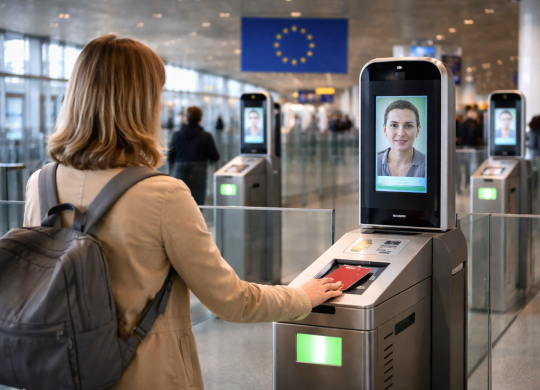
The EU will launch the EES in full operation starting in April 2026: new border crossing rules
The European Union is finalizing the rollout of a new border control system—the Entry/Exit System (EES)—which will be fully operational starting in April 2026. It replaces passport stamps with digital records and biometric data. Learn more about how the border crossing process will change and what you need to consider before your trip
01 Apr. 2026
More details3 min
Investment
Detroit offers up to $15,000 to move: who can get the money and what are the conditions in 2026
A new program in the United States offers up to $15,000 for moving to Detroit. However, not everyone will qualify — there are strict requirements, a limited number of spots, and a competitive selection process. Here’s who can apply, what the conditions are, and how the program works in 2026
14 Apr. 2026
More details3 min
Popular
Housing prices in the EU rose by 65% over 10 years: where it’s most expensive in 2026
Housing prices in the EU have risen by nearly 65% over the past decade, far outpacing the growth in rent. In some countries, property prices have tripled or quadrupled, and the market has returned to growth after a brief downturn. Learn more about where housing prices are rising the fastest and what’s happening in the market in 2026
15 Apr. 2026
More details3 min
Investment
Spain has topped the ranking of Europe’s most attractive countries for real estate investment for the first time. Investment volumes have already exceeded €18.4 billion, and demand continues to grow amid a housing shortage and economic stability. Learn more about why investors are flocking to Spain in 2026
16 Apr. 2026
More detailsAll materials and articles are owned by VisitWorld.Today and are protected by international intellectual property regulations. When using materials, approval from VisitWorld.Today is required.