

Where in the EU Is It Easiest to File Documents Online: A Ranking of Digital Government Services
Table of contents
- How did the European Commission evaluate digital government services?
- Where in the EU are the most public services available online?
- Malta: Almost all key procedures are available online
- Luxembourg: Digital Services for Residents and Businesses
- Finland: Fewer Certificates and Less Data Re-entry
- Estonia: Digital Identification and Linked Government Registers
- Latvia: Over 93% of government procedures are available online
- Lithuania: Well-developed online services for citizens and businesses
- Spain: Many online services, but digital identification is required
- The Netherlands: Convenient Services After Obtaining a DigiD
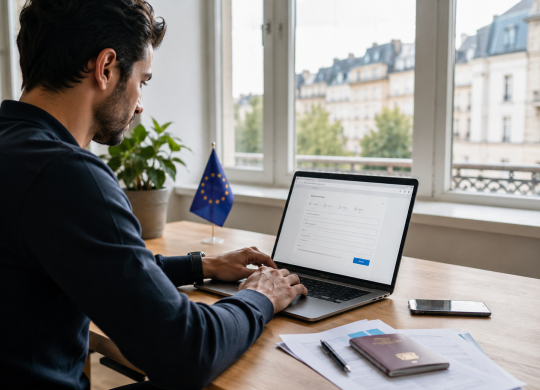
In some EU countries, nearly all key government services are available online, while in others, even a simple procedure still requires an in-person visit. The eGovernment Benchmark 2026 ranking shows where it’s most convenient to file paperwork, use government portals, and conduct business remotely. Learn more about the EU’s digital leaders and the countries where bureaucracy remains largely offline

The level of digitization of public services directly affects how long it takes to register one’s place of residence, apply for social benefits, enroll in university, file a tax return, or start a business. In some EU countries, most of these procedures can be completed remotely, while in others, an online application is only the first step before a personal visit to the relevant agency.
In 2026, the European Commission assessed 96 key public services across nine life situations, including moving, education, healthcare, employment, and doing business. The study revealed a significant gap between countries: the leaders are close to full digitization, while in some parts of the EU, one-third or even more of the procedures are still not fully available online. In this article, we’ll look at where e-government services work best, which countries are lagging behind, and what limitations foreigners may face.
Earlier, we talked about the European countries where it is easiest to get a work visa and start a career abroad.
Planning to move to Europe or apply for a residence permit? Migration legislation is changing rapidly, and even a minor error in the documents can cost months of waiting or refusal.
Consultation with a migration lawyer will help you assess your chances, choose the optimal type of visa and prepare for filing without risks.
Sign up for a consultation and get a clear action plan now.

How did the European Commission evaluate digital government services?
In the eGovernment Benchmark 2026 ranking, the European Commission assessed not only the availability of government portals but also whether users can actually complete the entire procedure online. The study covered 96 key services across nine life situations: moving, transportation, family matters, employment, education, healthcare, legal proceedings, and starting and running a business.
The mystery shopper method was used for the assessment. Trained experts acted as ordinary users: they searched for the needed service, went through the authorization process, filled out forms, and checked whether the process could be completed without an in-person visit.
The main criteria were:
- Availability of the full procedure online
- Clarity of information regarding documents, deadlines, and payment
- Ability to use the service from a smartphone
- Electronic identification and digital signature
- Automatic use of data from government registries
- Application status tracking
- Availability of services to users from other EU countries
That is why a high ranking score means more than just a large number of electronic forms. It indicates that government services function as a fully-fledged online process: from searching for information and submitting an application to receiving the result.
Learn more about the most affordable countries for expats to live in 2026 by following the link.
Where in the EU are the most public services available online?
The level of digitization of public procedures varies significantly across EU countries. According to the eGovernment Benchmark 2026, in the leading countries, nearly the entire process—from searching for information and authorization to submitting an application and receiving a result—can be completed remotely. At the same time, in countries with lower scores, a significant portion of procedures still requires paper documents, correspondence, or an in-person visit.
The countries with the highest scores for the availability of digital services to the public are:
1. Malta – 99.7%
2. Luxembourg – about 98%
3. Finland – about 96%
4. Estonia – about 96%
5. Latvia – 93.5%
6. Spain and the Netherlands – over 88%
7. Lithuania – about 88%
8. Ireland – about 87%
9. Sweden – about 86%
10. Portugal – 84.5%
These figures reflect not the overall popularity of e-government, but the proportion of administrative steps that can be completed online in key life situations. These include moving, employment, education, family matters, healthcare, transportation, and legal proceedings. The European Commission’s official tool rates countries on a scale from 0 to 100 and takes into account both the accessibility of services for local users and the ability to access them from another European country.
A high ranking, however, does not mean that a foreigner will be able to use all services immediately after moving. Accessing government portals often requires a local identification number, an electronic ID card, a registered address, bank authorization, or a digital certificate. Therefore, we will examine not only the performance of the leading countries but also how their digital systems work in practice.
Malta: Almost all key procedures are available online
Malta ranked first in the EU in terms of the accessibility of digital government services to the public. Its score reached 99.7%, meaning that virtually all administrative steps assessed as part of the eGovernment Benchmark 2026 can be completed remotely.
The main online portal is Servizz.gov.mt, where government services are grouped by life situations. Through it, users can find information, submit an application, or access the necessary services in the areas of social security, education, housing, family matters, transportation, and entrepreneurship.
The Maltese eID account is used to access personalized services. It allows residents to verify their identity online and log into government systems without having to register separately on each portal. Maltese citizens and eResidence holders aged 14 and older can obtain such an account.
At the same time, it is important for foreigners to note one detail: the initial eID application process is not always completed entirely remotely. Registration may require a personal visit to a Servizz.gov office or an agency that issues identification documents. According to official data, application verification takes about five days, and the activation link may be sent within ten days.
Thus, Malta’s main advantage lies not only in the large number of electronic forms. Once a resident has obtained a local eID, they can access most government services through a single system and need to visit government offices in person much less frequently.
In our previous article, we discussed the cost of living in the best EU countries in 2026.
Luxembourg: Digital Services for Residents and Businesses
Luxembourg ranks second in the EU: approximately 98% of key government procedures for citizens are available online. The central platform is Guichet.lu, and personalized services are provided through the MyGuichet.lu account. Here, users can file tax returns, report a change of address, apply for specific permits, access social and healthcare services, and interact with government agencies.
To register for MyGuichet.lu, you need one of the following electronic identification methods:
- A LuxTrust product
- A Luxembourg electronic ID card
- An eIDAS-compliant identification method issued in another European country
Luxembourg stands out in particular for the accessibility of its cross-border services. Users can already access its government portals using electronic identification from 22 European countries, including France, Belgium, and Germany. This is important for a country where many people live abroad but work, pay taxes, or conduct business in Luxembourg.
At the same time, a European eID is not always sufficient for a foreigner. To create a full-fledged personal account and access certain procedures, a 13-digit Luxembourgish identification number (Matricule) may be required. For example, it is necessary for filing a tax return electronically, and users without such a number must first submit a separate request to obtain it.
The advantage of Luxembourg is that a single account covers services for both individuals and entrepreneurs. Certain procedures, such as applications for residency or social insurance, are accessible even without authorization; however, a verified digital identity is usually required to sign documents and track the status of a case.
We previously discussed which jobs in Luxembourg are most in demand among foreigners, the characteristics of the labor market, and employment procedures.
Finland: Fewer Certificates and Less Data Re-entry
Finland is among the EU leaders: approximately 96% of key government procedures for the public can be completed online. The central access point is the Suomi.fi portal, which brings together information, instructions, and links to services for citizens, residents, and entrepreneurs. After logging in, users can interact with various government agencies, check data entered into registries, and manage their electronic authorizations.
To log in to government systems, users typically use:
- Finnish online banking codes
- The Mobile ID certificate
- An electronic ID card
- For some services, a compatible electronic identification method from another country
One of the main advantages of the Finnish system is the Suomi.fi e-Authorizations service. Through it, you can grant another person or company an electronic authorization to act on your behalf—for example, to handle tax, medical, or administrative matters. Such an authorization is stored in the national registry, so it is often unnecessary to draw up a separate paper power of attorney for each agency.
Another important feature is Suomi.fi Messages, a single inbox for official communications. Government agencies use it to send decisions, bills, appointment information, and other documents. Starting April 14, 2026, users who log in to government e-services will be prompted to activate Suomi.fi Messages; after that, correspondence from many agencies will be delivered digitally instead of via paper mail.
Access may be more complicated for foreigners if they do not yet have a Finnish personal identification number or a local strong identification method. For certain procedures, you can use the Finnish Authenticator app, but you must first obtain a special Foreigner’s UID and verify your identity.
In our previous article, we discussed life in Finland in 2026 for foreigners: how to move to Finland, the pros and cons of living there, the cost of living, and useful information for expats.
Estonia: Digital Identification and Linked Government Registers
Estonia has approximately 96% availability of digital services according to the eGovernment Benchmark 2026 methodology. At the same time, the country itself reports that all government services are already available online 24/7, although certain procedures may have additional requirements or require identity verification.
The system is based on electronic identification. To log in to government portals, users can use an ID card, Mobile-ID, Smart-ID, or an EU-recognized eID. A digital signature has the same legal validity as a handwritten signature.
Data exchange between agencies is facilitated by the X-tee/X-Road platform. Thanks to this platform, government registries can securely transfer information, so users do not need to resubmit data already in the system each time.
For foreigners, access to the full range of services is typically granted after obtaining a residence permit and a local digital ID. E-residency status simplifies conducting business remotely, but it does not replace a residence permit and does not grant automatic access to all social or medical services.
In our previous article, we discussed Estonian e-residency: how to obtain it, how much it costs, and what opportunities it offers.
Latvia: Over 93% of government procedures are available online
In Latvia, approximately 93.5% of key government services for the public are available online. The main access point is the Latvija.gov.lv portal, which brings together services from state and municipal agencies, as well as instructions for various life situations.
To log in, you can use an eID card, eParaksts mobile, a qualified Smart-ID, or a compatible electronic identification method from another EU country. The portal also hosts e-adrese—a personal email account for official correspondence with government agencies.
The system is used on a fairly large scale: the portal has about 1.6 million unique users, and in 2025, electronic services were accessed through it approximately 8.8 million times.
Foreigners may need a Latvian personal identification number, a residence permit, or a local eID card for certain personalized procedures. Therefore, the online service—while technically available—cannot always be used immediately after moving to the country.
Lithuania: Well-developed online services for citizens and businesses
In Lithuania, approximately 88% of key government services for citizens are available online. The main portal is Elektroniniai valdžios vartai on the Epaslaugos.lt platform, which brings together administrative and public e-services from various institutions.
Through the system, users can search for services by category or life situation, submit an application, and be redirected to the relevant government agency’s service. Personalized procedures typically require a Lithuanian personal identification number and a means of electronic identification, such as bank authorization, Mobile-ID, or an electronic ID card.
For foreigners, some procedures remain more complicated, especially before obtaining a local identification number. At the same time, specialized consultation centers operate in major cities: for example, International House Vilnius provides assistance with residence permits, taxes, social insurance, employment, and starting a business.
Spain: Many online services, but digital identification is required
In Spain, over 88% of key government procedures are available remotely. You can file tax returns, request certificates, check social benefits, pay fees, and interact with various government agencies online.
To access personalized services, you typically need one of the following:
- The Cl@ve system
- An electronic certificate
- A DNIe electronic ID card
- A NIE (foreigner identification number) and a verified phone number
Cl@ve is a common identification system for government agencies. You can register using an electronic certificate, an invitation letter, an in-person visit, or, in certain cases, via video identification. However, automatic video registration is not available to all foreign nationals, so offline identity verification may be required initially.
We previously covered taxes in Spain in 2026: how much employees, entrepreneurs, and property owners pay.
The Netherlands: Convenient Services After Obtaining a DigiD
In the Netherlands, over 88% of key government procedures are available online. Through digital services, you can handle tax matters, submit applications to municipalities, check pension and social security information, and interact with insurance companies and other government agencies.
The primary means of authentication is DigiD—a personal digital ID used to log in to government websites. To obtain a DigiD, a foreigner typically must first register with the population registry and receive a BSN number, which is used when interacting with government services.
Once DigiD is activated, most day-to-day administrative matters can be handled remotely. However, in the early stages of relocation, an in-person visit is often unavoidable: registering an address, obtaining a BSN, and certain immigration procedures must be handled through the municipality or another responsible agency.
If you are planning to legalize, apply for a residence permit or submit migration documents abroad, the assistance of specialized migration lawyers can significantly simplify the process. Specialists will help you assess your chances of obtaining legal status, prepare a package of documents, avoid common mistakes, and accompany you at all stages of the migration procedure: from the initial consultation to obtaining a decision from the migration authorities.
We remind you! New economic indicators show which countries have been able to increase their GDP and which have lost ground due to inflation and slowing growth. Ranking of the richest countries in the world in 2026 — follow the link.
Products from Visit World for a comfortable trip:
Travel guide for 200 countries;
Legal advice from a local specialist on visa and migration issues;
Travel insurance around the world (please select the country of interest and citizenship to receive services);
Medical insurance all over the world.
We monitor the accuracy and relevance of our information, so if you notice any errors or inconsistencies, please contact our hotline
Frequantly
asked questions
Which EU country has the highest level of digitization of public services?
Can a foreigner use online public services right away?
In which EU countries is it easiest to do business online?
Where do government services most often require an in-person visit?
Does a high ranking mean that all documents can be processed online?
Recommended articles
3 min
Expats
Best countries for expats in 2026: where it's easier to adapt and build a new life
Переезд за границу зависит не только от уровня зарплат, но и стоимости жизни, простоты адаптации и отношения местных жителей. Новый международный опрос показал, в каких странах экспаты чувствуют себя наиболее комфортно. Узнайте, кто вошел в десятку лучших направлений для жизни за границей в 2026 году
03 Aug. 2026
More details2 min
Expats
Brand Finance has released an updated global ranking of the world’s most influential nations, covering 193 countries. The top ten includes leaders from various regions—from North America to the Middle East—with their rankings determined by culture, education, tourism, and international reputation. Learn more about the top 10 countries with the greatest cultural influence and the criteria for the Global Soft Power Index ranking
01 Aug. 2026
More details2 min
Popular
Retirement Age in Europe: How Much It Will Rise by 2069 — 2026 Update
Retirement ages continue to rise in most European countries, and this trend is only set to increase in the coming decades. Find out how many years Europeans will work longer by 2069, which countries are changing their pension laws now, and how decisions in Germany and France in 2026 could affect future retirees
02 Aug. 2026
More details2 min
Expats
Which Passport Offers the Best Consular Protection Abroad in 2026
The number of countries with visa-free entry does not mean that you will be helped in a crisis situation abroad. Find out which citizenship provides the broadest consular protection, why the EU passport is an exception among world systems and how dual citizenship affects the possibility of receiving assistance
03 Aug. 2026
More detailsAll materials and articles are owned by VisitWorld.Today and are protected by international intellectual property regulations. When using materials, approval from VisitWorld.Today is required.