

Spain's Traffic Regulations in 2026: Fines, Toll Roads, and ZBE
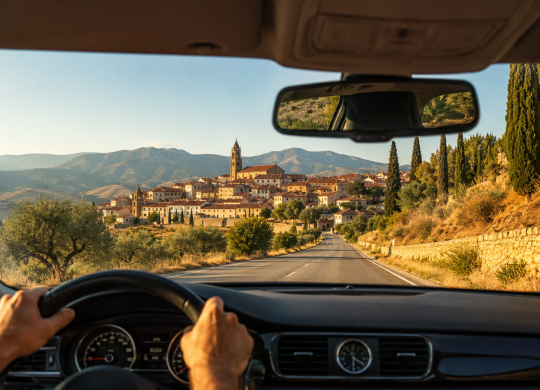
In Spain, most expressways can be used without a toll sticker, but some autopistas still require a toll. In major cities, there are Low-Emission Zones (ZBE), automated cameras, and specific entry rules. Learn more about Spain’s traffic laws in 2026, current fines, toll roads, and restrictions on vehicles in cities

Spain has one of the largest networks of highways in Europe. This is good news for drivers: a significant portion of the autovías are toll-free. At the same time, tolls are still required on certain autopistas de peaje.
In cities, the situation is more complicated. Madrid, Barcelona, and dozens of other municipalities have implemented low-emission zones (ZBE). Additionally, drivers should be aware of speed cameras, strict speeding fines, and new rules for using emergency signals. In 2024, more than 14.2 million foreign tourists arrived in Spain by car, so the DGT has even created a separate, up-to-date guide for drivers from abroad.
Are you planning a trip to Europe by car?
In many countries, highways are tolled and require an electronic road vignette. This is a digital permit that confirms payment for the use of toll roads and is checked automatically by the license plate number - without stickers and paper receipts. Making a vignette online before you travel will help you avoid fines, travel delays, and unpleasant situations during inspections.

Basic Traffic Rules in Spain
In Spain, speed limits depend on the type of road. In cities, they also depend on the number of lanes in each direction.
The following basic limits apply to passenger cars:
- 120 km/h – on autopistas and autovías
- 90 km/h – on regular intercity roads
- 50 km/h – on city roads with two or more lanes in one direction
- 30 km/h – if there is only one lane in each direction
- 20 km/h – on streets where the roadway and sidewalk are at the same level
On certain intercity roads with physical separation of traffic flows, the speed limit for passenger cars may be higher. In any case, traffic signs take precedence.
To learn more about which European countries have introduced new speed limits on highways, follow the link.
Overtaking
In Spain, the rule that previously allowed drivers to briefly exceed the speed limit by 20 km/h while passing is no longer in effect. Drivers must remain within the posted speed limit even while passing.
Seat Belts and Child Restraint Systems
Seat belts are mandatory for the driver and all passengers.
Children under 135 cm in height must use an appropriate child restraint system. As a general rule, it must be installed in the back seat.
Learn more about toll roads and traffic rules in France by following the link.
Cell Phones While Driving
Holding a cell phone in your hand while driving is prohibited. Such a violation can result in the loss of 6 points on your DGT license.
You should also avoid adjusting your GPS while driving. It’s best to set your route before starting your trip.
Alcohol
In Spain, there are separate blood alcohol limits for regular drivers, novice drivers, and professional drivers. Alcohol regulations have been revised in recent years, so it’s a good idea to check the current limits on the DGT website before your trip.
Speed Enforcement
The DGT actively uses fixed and mobile speed cameras. Enforcement also takes place on sections of road with high accident rates.
In 2024, speed was a factor in 22% of fatal traffic accidents in Spain. In 2026, the DGT continued to expand its network of speed cameras.
In our previous article, we discussed where in Europe it’s cheapest and fastest to charge an electric vehicle.
Fines in Spain
In Spain, most serious violations are punishable not only by a monetary fine. Drivers may also lose points on their DGT license. The strictest enforcement applies to speeding, drunk driving, cell phone use, and failure to wear a seatbelt.
Speeding
The fine depends on the speed limit and the actual speed. Speeding can result in a fine ranging from €100 to €600. Serious violations also result in the loss of 2 to 6 points.
For example, on a highway with a speed limit of 120 km/h:
- 121–150 km/h — €100 fine
- 151–170 km/h — €300 and 2 points
- 171–180 km/h — €400 and 4 points
- 181–190 km/h — €500 and 6 points
- Over 190 km/h — €600 and 6 points
Excessively high speeds may be classified as a criminal offense rather than an administrative violation. This applies to cases where the speed exceeds the established limit by more than 60 km/h in an urban area or 80 km/h on an intercity road.
Learn more about toll roads and traffic rules in Hungary by following the link.
Cell Phone Use While Driving
Using a cell phone while driving results in a €200 fine. If the driver is holding a smartphone in their hand, an additional 6 points are deducted.
The ban applies not only to making calls. You may not text, use headphones, or manually adjust the navigation system while driving.
Seat Belts
Failure to wear a seat belt results in a €200 fine and 4 points. The same applies to the improper use of a child restraint system.
We previously discussed the most common reasons tourists are fined on European roads in 2026.
Alcohol
Driving with a blood alcohol concentration above the legal limit carries a fine of €500 or €1,000. Depending on the reading, the driver may also lose 4 to 6 points.
If the blood alcohol concentration exceeds 0.60 mg/L, the offense may be classified as a criminal offense. The DGT has stepped up alcohol enforcement: in 2024, alcohol was a factor in 28% of fatal traffic accidents in Spain.
Speed Cameras
Spain uses fixed, mobile, and sectional speed cameras. The latter measure the average speed between two points.
Enforcement is gradually being expanded. In August 2026, the DGT put five more new checkpoints into operation. The reason is simple: in 2024, excessive speed was a factor in 22% of fatal traffic accidents on roads monitored by the DGT.
We previously reported that Europe is introducing new measures to combat drunk driving: cars won’t start after alcohol consumption.
Toll Roads in Spain
There is no general toll sticker for passenger cars in Spain. Most autovías and a significant portion of the former toll autopistas are accessible for free. Tolls are required only on certain routes and specific sections.
According to the Spanish Ministry of Transportation, following the expiration of several concessions, the government has eliminated tolls on major highways, including sections of the AP-1, AP-2, AP-4, and AP-7. However, certain segments of the AP-7 and other private roads remain toll roads.
In our previous article, we discussed the specifics of driving in the Czech Republic: roads, vignettes, parking, and fines in 2026.
Where else do you need to pay?
As of 2026, certain highways and tunnels remain toll roads. These include:
- AP-6 between the Madrid region and Castile and León;
- AP-51 and AP-61;
- A section of AP-7 in the south of the country;
- AP-9 in Galicia;
- AP-68 between Bilbao and Zaragoza;
- AP-71 in the León region;
- Certain toll tunnels and urban concession roads.
Tolls depend on the road, distance, and vehicle class. Most toll plazas accept credit cards and cash. For regular trips, the Vía-T electronic toll payment system is used.

Autovía and autopista: what’s the difference
For tourists, road classifications are important primarily because of tolls.
An “autovía” is usually marked with the letter A and is most often toll-free. It is a full-fledged expressway with separated traffic lanes.
A “autopista de peaje” is often designated with the code AP. The letter P historically stands for “peaje”—a toll. However, this is no longer an absolute rule, as some AP sections have been made toll-free following the expiration of their concessions.
Therefore, you shouldn’t rely solely on the road number. Before a long trip, it’s best to check the specific section.
Learn more about the world’s best countries for road trips in 2026 by following the link.
How does payment work?
On traditional toll roads, the driver receives a ticket upon entry or passes through a fixed-rate toll booth. The amount is paid upon exiting the toll section.
Lanes marked “Vía-T” are reserved for vehicles with an electronic transponder. If you do not have such a device, you must use a lane that accepts payment by card or cash.
There are significantly fewer toll roads in Spain than in France or Italy. Therefore, in many cases, a long route between major cities can be planned entirely using free expressways.
Learn more about current toll rates in Poland for 2026 by following the link.
Low-Emission Zones (ZBE) in Spain
In Spain, an increasing number of cities are restricting traffic from high-emission vehicles through Zonas de Bajas Emisiones (ZBE). The law requires municipalities with a population of over 50,000 to establish such zones. The same requirements apply to island territories and certain cities with a population of more than 20,000 if air quality standards are exceeded there.
There are no uniform rules for all ZBEs. Each municipality determines the zone’s boundaries, operating hours, permitted vehicle categories, and exemptions. Spain’s Ministry of the Environment maintains an interactive map where you can check zones that are already in effect, planned, or not yet launched.
The most important thing for tourists is not to rely solely on road signs near the city center. Enforcement is often carried out by cameras that read license plates. Before traveling to Madrid, Barcelona, or another major city, it’s best to check local requirements in advance.
Learn more about the specifics of traveling through Slovakia in your own car by following the link.
Foreign Vehicles in ZBEs
Foreign registration does not exempt vehicles from environmental restrictions. For example, Madrid authorities explicitly state that vehicles with foreign license plates are subject to the same access and traffic rules within ZBEs.
Pre-registration of the vehicle may be required to enter certain zones. In Madrid, foreign vehicles are assigned an environmental equivalent to the Spanish emission category. This may require the vehicle’s technical specifications and registration document.
The capital has a general Madrid ZBE, as well as stricter special protection zones—Distrito Centro and Plaza Elíptica. In April 2026, the city changed the transition period for some Category A vehicles. Therefore, older instructions regarding entry into Madrid may no longer correspond to current regulations.
Violating ZBE rules can be costly. In Madrid, unauthorized entry is classified as a serious violation, and the base fine is €200.
We previously wrote about the ins and outs of traveling through Croatia by car: fines, highways, parking, and important traffic rules.
Parking in Spanish Cities
There is no unified parking system for all of Spain. Rules are set by municipalities, so the color of parking markings, rates, and maximum parking times may vary from city to city. The DGT explicitly advises checking local rules before entering tourist areas.
Free parking spaces are usually marked with white lines. Paid zones often operate within municipal ORA systems. Payment is made via a parking meter or a mobile app. Be sure to carefully check the parking zone number: a neighboring meter may serve a different sector.
Blue markings usually indicate paid short-term parking. Green and other colored zones may be reserved for residents or have specific time restrictions. However, the meanings of these colors are not uniform across the country. The final terms and conditions are always indicated on local signs and parking meters.
Madrid operates the SER system—Servicio de Estacionamiento Regulado. It covers blue and green zones, and the rules depend on the type of vehicle and its environmental classification.
Additional restrictions apply to vehicles without an environmental classification. At the same time, vehicles in the Cero Emisiones category can use blue and green SER spaces for free without a standard time limit.
Spaces for people with disabilities, taxis, delivery vehicles, electric vehicle charging, and other special categories are marked separately. You cannot park there without the appropriate permit, even if the space is vacant.
In the city centers of Madrid, Barcelona, Valencia, and other major cities, it is often easier to leave your car in an underground parking garage or at a P+R near public transportation. This helps you avoid complicated parking rules and accidentally entering a ZBE zone.
Learn more about traffic rules, fines, toll roads, and regulations for driving in Austria in 2026 by following the link.
Documents for Traveling in Spain
To travel through Spain in your own car, you must have a standard set of documents. During a traffic stop, the police may ask you to verify your driving privileges, vehicle registration, and proof of insurance.
Typically, a driver needs:
- A valid driver’s license
- Vehicle registration certificate
- Passport or other form of identification
- Insurance document
- Rental agreement, if the car is rented
Licenses issued in EU and EEA countries are recognized in Spain provided they are valid. For documents from third countries, the rules depend on the issuing country and international agreements. In some cases, an international driver’s license may be required.
If the vehicle does not belong to the driver, it is advisable to have a document confirming the right to use it. For a rental car, this is the rental agreement. For a privately owned vehicle, a power of attorney or other document from the owner may be required.
In our previous article, we discussed traffic rules in Italy in 2026, Autostrade tolls, fines, and key considerations for road travel.
Green Card for Travel to Spain
If the vehicle is registered outside the EU, you must verify before departure that its insurance is valid in Spain. For countries participating in the Green Card system, an international certificate confirms third-party liability insurance coverage abroad.
It’s important to check not only Spain but also all transit countries. If your route passes through Poland, Germany, or France, your insurance coverage must be valid for the entire journey.
You can apply for a Green Card online through Visit World before your trip. This allows you to prepare the insurance document in advance and avoid having to deal with this issue while on the road.
Emergency Equipment for Vehicles in Spain
Effective January 1, 2026, the rules for marking a vehicle that has stopped due to an accident or breakdown have changed in Spain. For vehicles registered in Spain, traditional warning triangles have been replaced by the V16 connected warning light. It has become the only permitted device of this type.
The V16 emits a yellow light in a 360° radius and transmits the coordinates of the stopped vehicle to the DGT 3.0 platform. This allows other drivers to be warned via road signs and navigation systems. The light must be stored in an accessible place, such as the glove compartment, so that it can be set up without having to step onto the road for an extended period.
The main reason for this new regulation is safety. According to the DGT, approximately 25 people die each year in Spain after stepping out of their cars onto the road. The V16 allows you to mark your vehicle without having to walk dozens of meters along the roadway carrying a warning triangle.
There is an important exception for tourists. If the vehicle is registered in another country and is in Spain as part of international travel, it is not necessary to purchase a Spanish V16 specifically for the trip. The DGT permits the use of a warning triangle or an equivalent device as provided for by the regulations of the country where the vehicle is registered.
In the event of a breakdown, you must stop the vehicle as safely as possible and mark it with the appropriate warning device. If the situation is dangerous or there are injured people, call the European emergency number 112. The V16 itself does not automatically alert emergency services: it merely transmits the location of the stopped vehicle to the DGT.
In a previous article, we reported that Europe is introducing mandatory surveillance cameras to monitor drivers.
Winter Driving Rules in Spain
In Spain, there is no nationwide requirement to use winter tires during a specific time of year. For most of the country, this isn’t necessary due to the mild climate. However, the situation changes in the Pyrenees, the Cantabrian Mountains, Sierra Nevada, and other high-altitude regions.
On snow-covered roads, authorities may temporarily impose traffic restrictions. In such cases, road signs indicate what equipment is required on a specific stretch of road. This may include winter tires or snow chains.
Before traveling to the mountains, it’s a good idea to check the current conditions along your route using DGT services. During heavy snowfall, certain mountain passes may be closed, and only vehicles with the appropriate winter equipment may be allowed to pass.
Spain also uses a color-coded system for winter driving restrictions. These colors indicate the severity of road conditions:
- Green – Driving is permitted, but caution is advised
- Yellow – Conditions are deteriorating; restrictions may be imposed on certain vehicles
- Red – Driving without winter equipment is prohibited
- Black – the road is closed due to hazardous weather conditions
For trips to the Pyrenees or to ski resorts, it’s best to keep snow chains in the trunk even when there’s no snow in the valley. The weather at higher elevations can change very quickly, and traffic restrictions are imposed based on actual road conditions.
Are you traveling abroad with your own car or a rented car?
Before traveling, it is important to check whether a road vignette is required for toll roads in the countries of your route. Failure to have a valid vignette can result in fines and automatic camera recordings of violations. Getting an electronic vignette from Visit World is an easy way to travel more relaxed, without unnecessary expenses and surprises on the road!
We remind you! Traveling through Europe in 2026 does not have to be expensive, even despite the general rise in prices. Analysts have compiled a rating of the most affordable destinations where you can combine relaxation, experiences, and moderate expenses. Follow the link to learn about budget locations in Europe that are worth considering for your 2026 vacation.
Products from Visit World for a comfortable trip:
Travel guide for 200 countries;
Legal advice from a local specialist on visa and migration issues;
Travel insurance around the world (please select the country of interest and citizenship to receive services);
Medical insurance all over the world.
We monitor the accuracy and relevance of our information, so if you notice any errors or inconsistencies, please contact our hotline.
Frequantly
asked questions
Is a vignette required in Spain?
What is the speed limit on highways?
Can foreign cars enter a ZBE?
Do tourists need a V16 warning light?
Are winter tires mandatory in Spain?
Recommended articles
3 min
Transport
Traveling Through Croatia by Car: Fines, Highways, Parking, and Important Traffic Rules
Croatia does not have a road vignette, but most major highways are toll roads, and the toll amount depends on the route and vehicle category. Added to this are seasonal traffic jams on roads leading to the Adriatic, speed cameras, and specific parking rules in popular tourist cities. Find out how Croatian highways work, what traffic rules and fines are in effect in 2026, and what you should consider before taking a road trip
20 Aug. 2026
More details3 min
Transport
Toll Roads and Traffic Rules in Hungary in 2026: What Tourists Need to Know
To drive on most Hungarian highways, you need an e-matrica, and its category depends on the vehicle’s specifications and the number of passenger seats. In 2026, the system introduced new regional products, and an error in the license plate number or an incorrect category may result in an additional charge. Here’s how Hungary’s toll roads work, what traffic rules apply in the country, and what you need to know before your trip
27 Aug. 2026
More details3 min
Transport
Slovakia by Car in 2026: Traffic Rules, Fines, Vignettes, and Toll Roads
It’s easy to drive through Slovakia in a few hours, but a single mistake with eZnamka can make a short transit much more expensive. Toll highways here are monitored by license plate numbers, separate rules apply to trailers, and in winter, drivers also have to contend with the weather in the Tatra Mountains. Let’s break down how much Slovakia’s roads will cost in 2026, where a vignette is required, and which rules you shouldn’t ignore
30 Aug. 2026
More details3 min
Transport
Toll Roads and Traffic Laws in France in 2026: What Drivers Need to Know
France does not require a general road vignette, but many highways operate under the péage system, and dozens of cities have ZFE environmental zones that require a Crit’Air sticker. Added to this are hundreds of speed cameras, varying speed limits depending on weather conditions, and local regulations in cities. Find out how to pay for roads in France in 2026, where a Crit’Air sticker is required, and what rules you should know before your trip
03 Sep. 2026
More detailsAll materials and articles are owned by VisitWorld.Today and are protected by international intellectual property regulations. When using materials, approval from VisitWorld.Today is required.