

EU tightens border checks: what changed from September 6
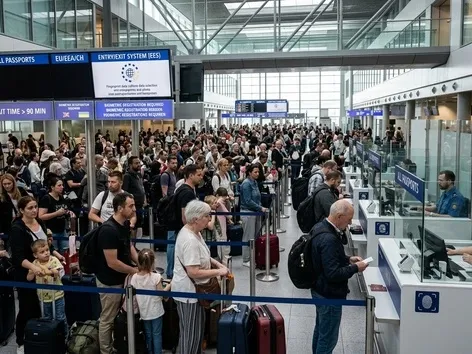
From September 6, stricter EES rules are in effect at EU borders. Find out how long passport control now takes and how to prepare for your trip

As of 6 September, entering the European Union has become harder for travellers from outside the EU: the temporary flexibility measures of the biometric Entry/Exit System (EES), which border officers relied on throughout the summer, have expired. For anyone planning a trip to the Schengen area in the coming weeks, this means longer queues at passport control and less buffer time for airport connections.
Travelling to Europe while border control is running under strain is a good reason to arrange your own protection in advance.
Travel insurance covers a wide range of unforeseen situations: from trip cancellation or delay to emergency medical care, lost luggage or theft of personal belongings. You can buy a policy fully online in a few minutes, choosing coverage that fits your specific route and trip length. That lets you focus on planning your holiday instead of worrying about problems on the road.
Get travel insurance with Visit World now and set off with confidence.

What changed at EU borders on 6 September?
The EES system became fully operational at the EU's external borders on 10 April 2026, with the phased rollout having begun back in October 2025. It replaced traditional passport stamps with digital entry and exit registration: when crossing the border, travellers scan their passport, have their photo taken, provide fingerprints (except children under 12) and give consent for their personal data to be processed.
Even in the early stages of the rollout, the Airports Council International (ACI) recorded a 70% jump in processing times, and passengers widely complained of hours-long queues. To prevent a collapse during the peak summer months, the EU allowed border officers to temporarily suspend biometric data collection at individual crossing points whenever queues grew too long. This regime relied on Articles 7(3) and 7(4) of the EES regulation and applied for 330 days from the system's launch – after which it automatically expired on 6 September.
Visit World services for tourists, migrants, and expats: Insurance | Guides | Legal advice
How long does passport control in the EU take now?
According to the International Air Transport Association (IATA), a standard passport check that used to take 20–25 seconds now takes around 90 seconds – and waiting times at major airport hubs have effectively doubled. A study by the Financial Times and travel analytics group Qsensor already showed how significant the strain had become over the summer: in Frankfurt, average waiting time in July reached 120 minutes, up from 60 the year before; in Munich, queues grew to 60 minutes from 31; and in Amsterdam, maximum waiting time jumped from 80 to 120 minutes.
Within the first few days after the flexibility measures ended, the pattern repeated: in Prague, some travellers reported waits of up to 150 minutes, while at Paris Charles de Gaulle Airport queues reached around 40 minutes. Analysts expect the sharpest increases in waiting times at airports in Spain, France, Italy and Portugal – countries with the heaviest tourist traffic.
Myths about the EU's new EES system – read more here.
Why did airlines ask for the EES flexibility measures to be extended?
Back in summer, nine states – Belgium, France, Germany, Greece, Italy, Malta, the Netherlands, Portugal and Switzerland – formally asked Brussels to extend the flexibility mechanism, citing significant gaps in how the system was operating. Industry bodies backed the request:
- IATA argued that the ability to temporarily suspend biometric checks was critically important at least until the end of the winter season.
- The UK's ABTA travel trade association pointed out that EES was not yet running stably across all member states.
- Airlines warned that without this "safety valve," peak periods could again trigger mass flight delays.
The European Commission did not officially extend the measures, though at a briefing on 1 September its spokesperson acknowledged that some member states still needed adjustments at certain crossing points and pledged support during the transition.
Several countries have restricted entry over Ebola – who's affected and why, in the link.
What's happening at the borders after 6 September?
In practice, the end of the flexibility measures has proven less disruptive than industry experts feared. According to The Guardian, some countries are still not applying biometric checks in full: Greek border officers, for instance, have unofficially exempted UK passengers from EES processing to avoid extra queues. In France, changes at Channel Tunnel crossings remain barely noticeable so far due to technical issues with equipment – fingerprint kiosks installed by Eurotunnel, the Port of Dover ferry operator, and Eurostar at London St Pancras are still not fully functional.
The European Commission says it remains in close contact with states that need adjustments and sees a shared will among member states to make the system stable. Meanwhile, travel industry representatives continue to push for the flexible regime to return, at least until the end of the winter season.
A new low-cost airline has launched in Europe, with tickets from €40 – details here.
How to prepare for your trip: tips for travellers
Jurgen Himmelmann, co-founder and CEO of Global Work & Travel, has previously advised travellers crossing EU borders to build significantly more time into their journeys. Arriving early at the airport helps, he notes, but it doesn't guarantee full control over the situation: bag-drop counters may not yet be open several hours before departure, and once you're in the passport control queue, you can't skip ahead just because your own flight is boarding.
A few practical steps worth considering in the coming weeks:
- avoid bookings with minimum connection times at Schengen area airports;
- check the current EES registration status for your destination country before departure;
- keep printed or offline copies of your booking confirmations and insurance policy in case of delay or a missed flight;
- allow an extra 1–1.5 hours for border control at major transit hubs.
The situation around EES continues to evolve, so it's worth checking the latest requirements on the European Commission's website or consulting a specialist before you travel.
Longer queues at EU borders and increased waiting times at passport control raise the risk of missing a connecting flight or a booked transfer – exactly the kind of situations travel insurance is designed to cover.
A travel insurance policy can reimburse costs for trip cancellation or delay, emergency medical care for illness or injury, and compensate for losses due to lost luggage, theft of belongings, or denied boarding caused by flight disruptions. For travellers heading to peak destinations – Spain, France, Italy or Portugal, where the sharpest rise in queues is currently being recorded – extra cover is especially worthwhile. Choosing the right package is simple: just enter your nationality and destination country, and the system will suggest available coverage options. Before buying a policy, it's worth checking the terms around flight delays caused by border control and the coverage limits for emergency evacuation. This matters even more while waiting times at the border remain unpredictable.
Protect your trip in advance – get travel insurance with Visit World and travel without unnecessary worries.
Also worth noting: bus tours across Europe are gaining popularity again. Operators offer routes through several EU countries. We've already covered the top options.
Photo – generated with Gemini
Products from Visit World for a comfortable trip:
Travel guide for 200 countries;
Legal advice from a local specialist on visa and migration issues;
Travel insurance around the world (please select the country of interest and citizenship to receive services);
Medical insurance all over the world.
We monitor the accuracy and relevance of our information, so if you notice any errors or inconsistencies, please contact our hotline.
Frequantly
asked questions
Who do the new EES rules apply to?
How is EES connected to the ETIAS system?
Can you avoid queues at passport control at EU airports?
Recommended articles
2 min
Travels
Wellness Retreats 2026: Where Travelers Go to Find Peace
Wellness tourism is experiencing a major boom. Discover the destinations leading the 2026 wellness retreat rankings and what makes them so appealing to travelers
29 Aug. 2026
More details3 min
Popular
The Safest and Most Dangerous Major Cities in the World in 2026
Doha topped the ranking of the world’s safest major cities, while Caracas received the lowest score. No European metropolises made it into the top ten; instead, most of the spots were taken by cities in Asia and the Middle East. Learn more about the results of the Numbeo Safety Index 2026 and the details of its methodology
04 Sep. 2026
More details2 min
Travels
Where to Go in Europe in October: Rhodes Island
Travel Off Path has named Rhodes one of the best European destinations for an October vacation. Learn more about the island's attractions
05 Sep. 2026
More details3 min
Events
Oktoberfest 2026 in Munich: Dates, Program, Prices, and Rules for Tourists
Oktoberfest 2026 will kick off in Munich on September 19 and run for 16 days. This year, a liter of festival beer will cost up to 15.90 euros, and the most popular tents may fill up before noon. Learn more about the festival program, table reservations, admission rules, and travel costs
01 Sep. 2026
More detailsAll materials and articles are owned by VisitWorld.Today and are protected by international intellectual property regulations. When using materials, approval from VisitWorld.Today is required.