

The World's Best Cities for Cycling in 2026
Table of contents
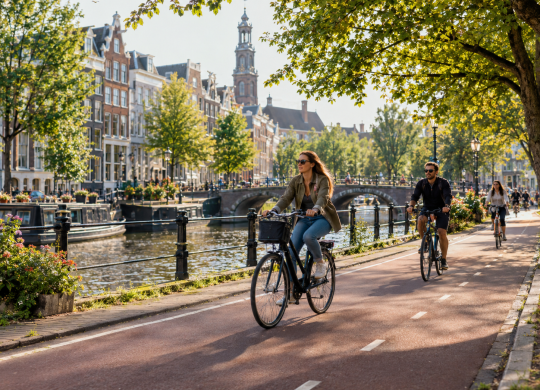
Time Out has named the world’s most bike-friendly cities for 2026, based on a survey of more than 24,000 local residents. The list includes cities in Europe, North America, and Asia. Learn more about the top destinations for cycling trips, their infrastructure, and opportunities for tourists

Time Out has released its ranking of the world’s best cities for cyclists in 2026 based on a survey of local residents. Participants rated how easy it is to get around by bike in their city, and only one city from each country made the final list.
Cambridge took first place with a score of 83.2%, ahead of Montreal and Copenhagen. Below, we highlight the top ten cities and the main advantages each offers for cycling.
Planning a trip abroad?
Insurance from the Visit World portal will help you avoid unnecessary risks. The policy covers the costs of medical treatment, emergency assistance, and unforeseen situations abroad, so that even in the event of delays or route changes, you remain protected and can focus on your trip rather than on problems.

Cambridge, United Kingdom – 83.2%
Cambridge topped the Time Out global ranking with a score of 83.2%. The city’s main advantages for cyclists are its compact size, mostly flat terrain, and well-designed infrastructure. About one-third of all trips in the city are made by bicycle.
Urban planning also actively supports cycling. There is a large multi-level bike parking facility near the train station, and certain streets feature “cycle streets,” where cyclists have the right of way.
For tourists, Cambridge is particularly convenient because most of the main attractions, university colleges, and central areas are located close to one another. A bicycle allows you to move quickly between them without relying on public transportation or navigating complicated routes.
Montreal, Canada – 82.5%
Montreal took second place in Time Out’s global ranking and was named the best city in North America for cyclists. Cycling is well-established here despite cold winters and hilly terrain: 82.5% of local residents surveyed rated the ability to get around the city by bike positively.
By 2026, Montreal’s bicycle network will comprise 1,083 km of routes. Of these, 740 km are accessible year-round, and 251 km are physically separated from motor vehicle traffic by barriers or bollards. In winter, the main year-round routes are cleared of snow, allowing people to ride bikes not only during the tourist season.
The Réseau express vélo (REV)—a high-speed bicycle network that is gradually connecting different parts of the city with protected routes—plays a special role. Time Out notes that once the planned sections are completed, its total length is expected to reach approximately 171 km.
The BIXI system is convenient for short tourist trips. In 2023, about a quarter of Montreal’s residents used it, which clearly demonstrates how well cycling is integrated into the city’s everyday transportation.
Routes along the St. Lawrence River, the Lachine Canal, and through the city’s large parks are particularly convenient for tourists. Thanks to the extensive network of bike paths, bicycles can be used here not only for leisure rides but also as a full-fledged mode of transportation between central districts.
Copenhagen, Denmark – 79.2%
Copenhagen took third place in the Time Out ranking with a score of 79.2%, but in terms of the scale of its cycling culture, the city remains one of the strongest in the world. According to municipal data, Copenhagen residents cycle approximately 1.44 million km every day. Here, cycling has long been not just a leisure activity, but a common form of urban transportation.
The city has an extensive network of dedicated bike lanes, special traffic lights for cyclists, and “green waves” that allow cyclists to travel along central routes with a minimum number of stops. Some bridges, such as Cykelslangen, were built specifically for bicycle traffic and help prevent conflicts with cars and pedestrians.
Copenhagen is convenient for tourists because the main areas are easily connected by a single route: Indre By, Christianshavn, Nørrebro, Vesterbro, and the waterfront can be explored without complicated navigation. Longer routes along the harbor and to Amager Strandpark are also popular.
You can rent a bike at private rental shops, hotels, and through city-run services. At the same time, tourists should keep local rules in mind: signal with your hand before turning or stopping, do not ride against traffic, and do not stop in the middle of a bike lane. In Copenhagen, the flow of cyclists is so dense that these rules have a real impact on safety.
Shanghai, China – 78%
Shanghai took fourth place in the ranking. For a city with a population of over 20 million, the bicycle remains one of the most convenient ways to get around for short distances, and certain routes are well-suited for sightseeing trips.
One of the most interesting options is the Pudong Riverside Greenway along the Huangpu River. This 24-kilometer route is completely separated from motor vehicles and runs from Yangpu Bridge to Xupu Bridge through Lujiazui, Expo Park, Houtan Park, and Qiantan Park. The trip takes about two hours. Separate lanes for cyclists, runners, and pedestrians have been set up along the route, and rest stops are located approximately every kilometer.
For short urban trips in Shanghai, there is a large bike-sharing network. The main operators are Hellobike, Meituan Bike, and Qingju Bike. You can find a bike using a mobile app and unlock it with a QR code; Hellobike, for example, is also accessible via Alipay.
Another perk for tourists is the ability to combine biking with river transport. Transporting a passenger with a bike on a city ferry costs 2.8 yuan, making it easy to cross the Huangpu River and plan a route between Pudong and the city center.
Vienna, Austria – 77.7%
Vienna combines an extensive cycling network with relatively light traffic in many central areas. The city has approximately 1,800 km of cycling routes, including dedicated bike lanes, shared pedestrian-and-bike zones, and routes along the Danube.
For tourists, one of the most convenient options is the Donauinsel—a long island on the Danube with virtually uninterrupted routes free of car traffic. From there, you can continue your ride along the Donaukanal or to the Prater, which also features wide bike paths.
The city operates the WienMobil Rad system with hundreds of rental stations. You can rent a bike through the app, and most stations are located near transit hubs and popular areas, making it easy to combine your ride with the subway or tram.
For a first exploration of the city, biking is particularly convenient in the Ringstrasse and Prater areas and along the waterfronts. At the same time, in the historic center, it’s important to be mindful of pedestrian zones and areas with heavy tourist traffic, where cycling isn’t always comfortable.
Warsaw, Poland – 76.6%
Warsaw ranked sixth in the rating. The city has a mostly flat terrain and an extensive network of bike routes, which is well-suited for both daily commutes and tourist routes between the city center, the waterfront, and green spaces.
One of the most pleasant routes is the one along the Vistula River. On the left bank, you can ride along the central waterfronts, through Powiśle, and near the Copernicus Science Center, while the right bank offers longer stretches with a more natural landscape. Some of the routes are separated from car traffic, making them ideal for leisurely rides.
The city operates the Veturilo bike-sharing system, with numerous stations in central and residential areas. It’s easy to pick up a bike for a short ride and then return it at another station, so tourists don’t necessarily have to rent one for the entire day.
Among the most convenient routes, those through Pole Mokotowskie, Łazienki Królewskie, and along Wisłostrada are particularly worth noting. For exploring central Warsaw, a bicycle is especially practical outside of rush hour, when traffic on major thoroughfares is noticeably heavier.
Marrakech, Morocco – 75%
Marrakech is one of the most unusual entries on this list. In the old medina, biking isn’t always convenient due to narrow streets, heavy pedestrian traffic, and mopeds; however, it’s much easier to get around in the Gueliz and Hivernage neighborhoods and on the wider boulevards.
For tourists, cycling is particularly appealing as a way to venture beyond the historic center. Popular routes lead toward Palmeraie, where the roads are quieter and the scenery shifts to palm groves and open spaces. For longer trips, you can choose routes on the outskirts of the city or in the Atlas foothills, but there you’ll need to factor in the heat, elevation changes, and the need to bring water.
The most comfortable seasons for cycling are fall, winter, and early spring. In the summer, daytime temperatures often exceed 35 °C, so it’s best to plan longer routes for the morning or evening.
The city has private bike rental shops and guided bike tours. For your first ride, it’s best to choose routes outside the medina: there’s less chaotic traffic, wider roads, and it’s much easier to find your way around.
Taipei, Taiwan – 74.5%
Taipei has one of the most convenient city bike-sharing systems in Asia—YouBike 2.0. Stations are located near subway stations, residential neighborhoods, parks, and tourist areas, making it easy to incorporate a bike into a combined city tour.
One of Taipei’s particular strengths is its network of bike paths along the Tamsui, Keelung, and Xindian rivers. These paths are separated from main road traffic and wind through parks and recreational areas. For tourists, this is a more convenient option than riding along the major central thoroughfares.
One of the most popular routes runs along the Tamsui River toward Dadaocheng Wharf. From there, you can continue north or connect to the metro, as the bike routes are well integrated with the city’s transit system.
In the city center, the situation is more complicated: there are many scooters and cars, and traffic at major intersections is heavy. Therefore, for your first bike ride, it’s best to choose river routes or parks, where traffic is much calmer.
Stockholm, Sweden – 73.7%
Stockholm is well-suited for cycling thanks to its many waterfronts, bridges, and routes between the islands. A significant portion of the city’s cycling network runs separate from car traffic, and in central areas, a bicycle often allows you to get between key points faster than by car.
One of the most convenient tourist routes runs through Södermalm, Gamla Stan, Kungsholmen, and Djurgården. It combines the historic center, green spaces, and waterfronts, making it ideal even for a first-time tour of the city.
Stockholm has bike parking, service stations, and free tire pumps. For longer routes, the sections along Lake Mälaren and the city’s canals are particularly convenient.
There’s also a seasonal consideration: it’s most comfortable to ride from late spring to early fall. In the fall and winter, you should take into account shorter daylight hours, rain, snow, and slippery sections, especially on bridges.
Seville, Spain – 72.3%
Seville has become one of the most notable examples of the rapid development of urban cycling in Europe. The city has built approximately 180 km of cycling infrastructure, and its flat terrain and compact city center make cycling convenient for short tourist routes.
The SEVici bike-sharing system operates with automated stations in various parts of the city. It’s easy to cycle between Plaza de España, Parque de María Luisa, the Triana district, the Guadalquivir riverfront, and the central neighborhoods.
Routes along the river and through large parks are particularly convenient, as they have fewer intersections and less car traffic. In the historic center, you’ll need to be more careful due to pedestrian zones, narrow streets, and large crowds of tourists.
The main seasonal factor is the heat. In July and August, daytime temperatures often exceed 35–40 °C, so it’s best to plan longer bike rides for the morning or evening. In spring and fall, Seville is much more comfortable for cycling.
Which other cities made it into the Top 20?
The second ten cities in the ranking also demonstrate very different approaches to cycling: from megacities with large bike-sharing systems to compact European cities with well-developed networks of bike lanes.
- Seoul, South Korea – 72.2%. The city is actively developing bike routes along the Han River, which feature long sections separated from car traffic, parks, and rental stations.
- Medellín, Colombia – 71%. Despite its challenging terrain, the city is expanding its bike network and integrating it with public transportation.
- Rotterdam, Netherlands – 69.3%. Wide streets, modern infrastructure, and a strong cycling culture make the city convenient even for first-time visitors.
- Helsinki, Finland – 69.3%. The waterfront routes and the city’s bike-sharing system are particularly convenient. In the summer, cycling is often one of the best ways to explore the city.
- Abu Dhabi, UAE – 69.2%. The main advantage is the new, specially designed bike paths and long, flat routes. The main limitation is obvious: in the summer, the daytime heat makes cycling significantly more difficult.
- Orlando, USA – 68.7%. The city is gradually expanding its greenways and bike routes, but for tourists, individual recreational areas remain the most convenient, rather than the entire city network.
- Frankfurt, Germany – 65.3%. A compact city center, routes along the Main River, and good integration of bicycles with public transportation.
- Luxembourg, Luxembourg – 64.7%. The city’s small size allows for quick travel between neighborhoods, although elevation changes can be noticeable.
- Ljubljana, Slovenia – 64.4%. A compact city center, low car traffic in the central area, and a convenient city bike-sharing system.
- Brasília, Brazil – 64.4%. The city has wide boulevards and significant distances between neighborhoods, so cycling works best on separate, dedicated routes and in recreational areas.
Are you preparing for a trip abroad in 2026?
Medical insurance from the Visit World portal will provide reliable support during your trip, especially in the context of flight changes and unstable schedules. The policy covers medical expenses, emergency assistance, and other unforeseen situations outside the country, so you can feel confident even when plans have to be adjusted at the last minute.
We remind you! Croatia is stepping up its fight against drunken tourists by introducing new restrictions in popular resort cities. Split became the first city in the country to introduce strict rules on alcohol sales this summer. Read more about the new bans, hefty fines for tourists, and changes in Croatia's tourism strategy.
Products from Visit World for a comfortable trip:
Travel guide for 200 countries;
Legal advice from a local specialist on visa and migration issues;
Travel insurance around the world (please select the country of interest and citizenship to receive services);
Medical insurance all over the world.
We monitor the accuracy and relevance of our information, so if you notice any errors or inconsistencies, please contact our hotline
Frequantly
asked questions
Which city was named the best for cyclists in 2026?
Where is it easiest for tourists to rent a bike?
Which cities are best suited for leisurely bike rides?
When is the best time to plan a city bike tour?
Do you need to wear a helmet when cycling abroad?
Recommended articles
3 min
Travels
Where to Go on Vacation in October: The Best Destinations
October offers plenty of travel opportunities: from beach vacations by the warm sea to island hikes and strolls through historic cities without the summer heat. Learn more about ten destinations worth considering for a mid-fall vacation
12 Sep. 2026
More details3 min
Travels
10 Hidden Gems Around the World Worth Visiting in 2027
Popular tourist destinations are increasingly facing overcrowding, while there are still dozens of fascinating places around the world where, on the contrary, more travelers are welcome. Learn more about little-known travel gems worth adding to your plans for 2027
13 Sep. 2026
More details3 min
Travels
Where to Go in Europe This Winter: Top 10 Destinations
Europe in winter means the sunshine of the Canary Islands, the snow of the Bavarian Alps, and the tranquility of Santorini without the crowds. Learn more about this season’s top destinations
13 Sep. 2026
More details3 min
Travels
The Top 10 Cities in the World for Walking: Skyscanner's Ranking
Skyscanner has compiled a ranking of cities with the best pedestrian infrastructure. Europe took most of the spots. Learn more about the top 10 destinations
14 Sep. 2026
More detailsAll materials and articles are owned by VisitWorld.Today and are protected by international intellectual property regulations. When using materials, approval from VisitWorld.Today is required.